

In-depth guide · CampingSpirit
From Ljubljana via Bled, Bohinj and the Vršič Pass into the emerald-green Soča Valley, then via Idrija to the caves of Postojna and Škocjan and through the Karst to the Adriatic at Piran: around 430 kilometres from Alpine lake to salt water.
The spirit of the route
Slovenia is small, but on this route it changes its face every few hours. In the morning Lake Bled still lies smooth beneath the castle, the church on the island stands in the haze, and at Lake Bohinj the only sounds besides the ducks are the first paddles clattering. Then the hairpins of the Vršič: cobbled bends, larches, limestone walls, a cold wind at the top and the view of Prisojnik with its rock window. On the south side the road drops into the Trenta Valley, and the Soča glows so green that you would think the water had been dyed. In Kobarid and Tolmin museum pieces and soldiers’ cemeteries tell the story of the Isonzo war, in the Karst the air smells of juniper and bora, and underground, rivers roar through halls the size of cathedrals. At the end you stand on the pier in Piran, the sliding door open towards the sea, having driven through high mountains, wine country and the Mediterranean in a single week.
Stage-by-stage plan
1Stage 1: Ljubljana to Bled (approx. 55 km)
- The drive
- From Ljubljana take the A2 motorway (vignette required) towards Kranj and Jesenice as far as the Lesce exit, then a few kilometres on the main road to Bled. Well built and flat, driving time under an hour. If you want to save on the vignette, take the parallel main road via Medvode and Kranj, but expect to drive through villages and allow a good half hour more. In Bled itself the lakeshore road is slow going in summer and parking by the lake is scarce and charged; with a motorhome it is best to drive straight to your site.
- Highlights & must-sees
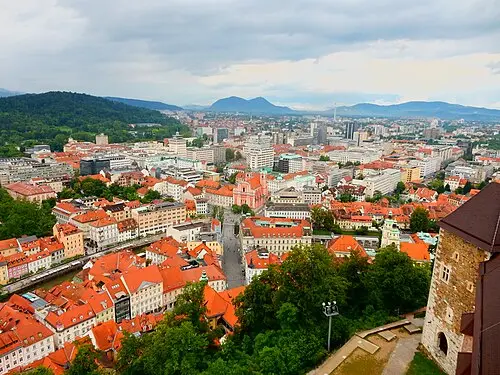
- Ljubljana before you set off: the old town on the Ljubljanica with Plečnik’s Triple Bridge and the Central Market; the city centre is largely car-free, and you can get there from the campsite by bus or bike.
- Bled Castle on the rock above the lake and the Church of the Assumption on the island, which you reach by pletna, the traditional rowing boat.
- Mala Osojnica viewpoint on the south-west shore: a short, steep climb with steps and ladders to the classic view of lake, island and castle, at its finest at sunrise.
- CampingSpirit overnight tip
-
Official campsite or RV park: In Ljubljana, the Ljubljana Resort Hotel & Camp in Ježica on the northern edge of the city (electricity, sanitary facilities, service point, bus connection to the centre) or the motorhome stopover at the P+R Dolgi Most in the south-west with water and waste disposal and a bus connection. In Bled, Camping Bled is in Zaka Bay at the western end of the lake, with electricity, sanitary facilities and waste disposal; book early in high season. There is also a motorhome stopover (PZA) in Bled – check facilities and season in advance.
Free camping or nature tip (where legal): Free camping outside campsites and designated motorhome stopovers is prohibited throughout Slovenia, and the municipalities of the Julian Alps raised fines considerably in 2026 (up to €500 per person). There are regular checks around Lake Bled; the lakeside car parks are not overnight spots.
- Insider tip for campers
- The Vintgar Gorge near Podhom north of Bled charges admission and is very busy in season; entry is by time slot, so buy tickets online in advance and go early in the morning. There is no car parking at the gorge itself: cars park at the official Vintgar LIP car park with a shuttle to the entrance. With a motorhome, it is better to get there from the campsite on foot, by bike or by train to Podhom. Bled cream cake (kremna rezina) is a must.
2Stage 2: Bled to Lake Bohinj (Ribčev Laz) (approx. 28 km)
- The drive
- From Bled take road 209 through the valley of the Sava Bohinjka via Bohinjska Bela and Bohinjska Bistrica to the eastern end of Lake Bohinj at Ribčev Laz. Well built, narrow only in the villages; pure driving time around 40 minutes. For motorhomes Bohinj is practically a dead end: the mountain roads south over the Soriška planina and up to the Pokljuka are narrow and steep and unsuitable for large vehicles. The lakeshore road to Ukanc is narrow; from 1 July to 31 August the road from the Ukanc junction to the car park below the Savica waterfall is closed to motorhomes and caravans, and forest tracks are off limits all year. Parking is only allowed in marked car parks; in summer shuttles run from the car parks in Bohinjska Bistrica and Srednja vas – information and occupancy at promet.bohinj.si.
- Highlights & must-sees
- The church of Sv. Janez Krstnik by the stone bridge in Ribčev Laz, with frescoes and the view across the lake to the Bohinj mountains.
- Savica waterfall above Ukanc: a stepped path to the source of the Sava Bohinjka; the Ukanc–Savica car park is charged, and in July and August you get there without the motorhome by shuttle, bike or on foot.
- Cable car up to the Vogel plateau for the view over the lake to the Triglav massif, or a walk along the north shore between Ribčev Laz and Ukanc.
- CampingSpirit overnight tip
-
Official campsite or RV park: According to Bohinj municipality: Camping Danica in Bohinjska Bistrica (open all year, electricity, sanitary facilities, service point) and Camp Bohinj in Ukanc on the western shore in Triglav National Park (May to October). For motorhomes there is also the fenced stopover at Bohinjska Bistrica railway station with electricity, waste disposal and drinking water, and the stopover at the Senožeta sports centre near Srednja vas with a maximum stay of 24 hours. Reception hours vary by season; booking recommended.
Free camping or nature tip (where legal): In Bohinj, overnight stays in a motorhome, tent or bivouac are only permitted on campsites and the designated motorhome stopovers; the municipality states a fine of €500 per person. Parking is only allowed in designated car parks. In high season the Kobla car park in Bohinjska Bistrica serves as an overflow area with a maximum stay of 12 hours when the stopovers are full.
- Insider tip for campers
- Lake rules: Lake Bohinj lies in Triglav National Park; motorboats are not allowed, and fires, barbecues and camping on the shore are prohibited. Swimming, paddling and SUP only from the bathing areas, dogs on a lead, drone flights in the national park only with a permit. Fill up with water and empty your tanks at the railway station stopover before heading into the mountains.
3Stage 3: Bohinj to Kranjska Gora (approx. 68 km)
- The drive
- Back on the 209 to Bled, then via Lesce onto the A2 or the parallel main road to Jesenice and on along road 201 through the upper Sava Valley via Mojstrana and Gozd Martuljek to Kranjska Gora. The valley road is wide and flat, and the drive takes a good hour. From Kranjska Gora it is only a short way to the Italian border at Rateče and to the Wurzen Pass border crossing into Carinthia (steep, with gradients of up to around 18 %, unsuitable for heavy vehicles and car-caravan combinations).
- Highlights & must-sees
- Peričnik waterfall near Mojstrana: a short walk from the car park in the Vrata Valley, and you can walk behind the upper fall; plus the Slovenian Alpine Museum in Mojstrana.
- Zelenci nature reserve near Podkoren: the spring pool of the Sava Dolinka, reached by a wooden boardwalk, with water that shimmers turquoise.
- Lake Jasna at the start of the Vršič road, with the bronze statue of Zlatorog and a view of the peaks of the Julian Alps.
- CampingSpirit overnight tip
-
Official campsite or RV park: The Kranjska Gora motorhome car park (Parkirišče za avtodome) on the edge of town with water and waste disposal and electricity, but for daytime parking only (roughly 7 am–11 pm); official overnight stays are not provided for. For the night, switch to the small Natura Eco Camp in the village. Check season, pitches and facilities in advance, as well as the current parking rules.
Free camping or nature tip (where legal): The municipalities of the Julian Alps raised fines for wild camping to up to €500 per person in 2026. The car park at Lake Jasna and the trailhead car parks in the Vrata Valley and on the Vršič road are for day visitors; there are checks there.
- Insider tip for campers
- Fill up with fuel and water before the pass: there is no filling station between Kranjska Gora and Bovec. Vehicles and vehicle combinations over 7.5 t are banned from the Vršič. If you are travelling with a caravan or a large, heavy motorhome, it is better to bypass the pass via Tarvisio and the Predil Pass (Italy) to Bovec, around 50 km with far fewer hairpins.
4Stage 4: Kranjska Gora to Bovec (via the Vršič Pass and Trenta) (approx. 48 km)
- The drive
- Road 206 over the Vršič (1,611 m) is Slovenia’s highest pass road: 50 numbered hairpins, 24 on the north side and 26 on the south side down into the Trenta Valley. The carriageway is narrow and steep near the top, and the hairpins on the north side are cobbled; passing is only possible at wider spots, and in summer there are also many cyclists and motorbikes. Under a 2026 regulation, lorries and vehicle combinations over 7.5 t gross vehicle weight and buses over 12.5 m long are banned; there is no general ban on trailers, but the route is very hard work for car-caravan combinations. Motorhomes over about 7 m long need the full width of the road and patience in the tight hairpins. Since 2026, barriers beyond Lake Jasna and before the turn-off to the source of the Soča regulate traffic: driving through is free, parking only in the marked areas at the top of the pass with a ticket from the barrier (around 80 car spaces, free until the end of 2026; entry only while spaces are available). From 1 June to 30 September a free bus runs between Kranjska Gora and Bovec. In winter the pass is closed at times, and in 2026 there were also short full closures for roadworks. Pure driving time around 1.5 hours.
- Highlights & must-sees
- Russian Chapel on the northern ramp: a wooden chapel in memory of the Russian prisoners of war who died building the road during the First World War.
- The top of the Vršič with a view of Prisojnik and its rock window, and a short climb to the Tičarjev dom hut; afterwards the source of the Soča (Izvir Soče) via a short, secured path.
- Juliana Alpine Botanical Garden in Trenta and the Velika korita Soče, the narrow pools of the Soča between Soča village and Bovec, with a footbridge.
- CampingSpirit overnight tip
-
Official campsite or RV park: In the Trenta Valley, Kamp Triglav and Camping Trenta pri Štruklju, both basic, in the national park and better suited to compact vehicles. In Bovec, Kamp Polovnik on the edge of town (electricity, sanitary facilities), Camp Liza and Camp Vodenca on the Soča, plus further sites towards Kamp Klin and Kamp Soča near Soča village. The season mostly runs from spring to autumn; check dates with the site.
Free camping or nature tip (where legal): Trenta and the upper Soča Valley lie in Triglav National Park: overnight stays outside campsites are prohibited, and parking along the Soča is only allowed in marked car parks. The gravel banks by the river are not a place to stay; checks are regular in season.
- Insider tip for campers
- On the way down the southern ramp, use a low gear – the hairpins are tight and steep. Start early: before 9 a.m. the pass is much quieter and there are still parking spaces at the top. The Mangart road near Log pod Mangartom is narrow, charged and, because of its tunnels with two-way traffic, closed to vehicles over 2.2 m high – motorhomes included; overnight stays at the saddle are prohibited. Better to make it a destination by bike or in a smaller vehicle.
5Stage 5: Bovec to Tolmin (via Kobarid) (approx. 40 km)
- The drive
- From Bovec take road 203 along the Soča via Žaga to Kobarid, then on to Tolmin. The valley road is easy to drive, narrow only in Kobarid and Tolmin. A good 45 minutes’ driving time; with detours a relaxed day. At Žaga the narrow road over the Učja saddle branches off into Italy; the turn-off for the Predil Pass is already in Bovec.
- Highlights & must-sees
- Boka waterfall between Bovec and Žaga: from the viewpoint by the road you see the high fall above the Soča, and a steep path leads up.
- Kozjak waterfall near Kobarid: a short walk over the Napoleon Bridge and along wooden walkways into a rock chamber with the fall; admission at the ticket office.
- Kobarid Museum on the Isonzo war and the Italian Ossuary of Sv. Anton above the town, then in Tolmin the Tolmin Gorges (Tolminska korita) at the confluence of the Tolminka and Zadlaščica (admission).
- CampingSpirit overnight tip
-
Official campsite or RV park: In Kobarid, Kamp Koren on the Soča and Kamp Lazar, both with electricity and sanitary facilities. In Tolmin, the PZA Skrin motorhome stopover with water and waste disposal, plus Kamp Siber and Kamp Labrca at the confluence of the Soča and Tolminka. At peak times, for example during festivals in Tolmin, book early.
Free camping or nature tip (where legal): Wild camping is prohibited in the lower Soča Valley too; checks focus on swimming spots and rafting put-ins. Parking by the river only in designated areas.
- Insider tip for campers
- Even in high summer the Soča is rarely warmer than around 10 to 12 °C; swim only in calm spots. If you want to visit the memorial church of Sv. Duh in Javorca above Tolmin, leave the motorhome below and walk – the access road is narrow. There are supermarkets and filling stations in Tolmin and Kobarid.
6Stage 6: Tolmin to Postojna (via Idrija and Predjama) (approx. 100 km)
- The drive
- From Tolmin via Most na Soči and road 102 through the narrow Idrijca Valley to Idrija, then over the high plateau to Logatec and on the main road, or briefly on the A1, to Postojna. The Idrijca Valley is winding and shady, with some narrow village sections; from Idrija the terrain becomes open and wooded. Around 2 hours’ driving time, a little more with the detour to Predjama Castle (around 10 km north-west of Postojna).
- Highlights & must-sees
- Idrija: the former mercury mine (UNESCO World Heritage Site), Gewerkenegg Castle with the town museum, and the bobbin lace tradition.
- Wild Lake (Divje jezero) just before Idrija: a small karst spring pool at the foot of a rock face, bubbling up after rain.
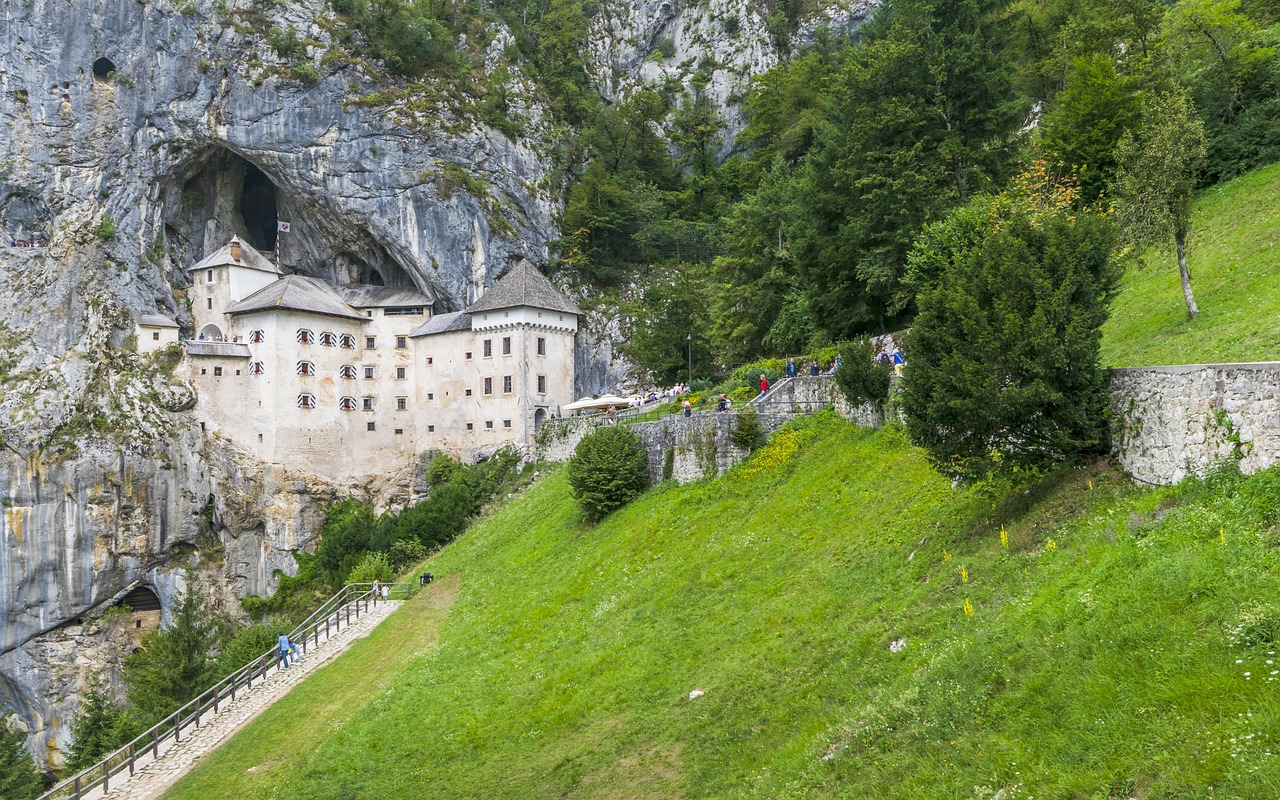
- Predjama Castle, built into a cave in the rock, with the cave system beneath it; visits with combined tickets together with the Postojnska jama.
- CampingSpirit overnight tip
-
Official campsite or RV park: Kamp Pivka jama north of Postojna in the forest, with electricity and sanitary facilities, plus the PZA Postojna motorhome stopover near the cave. Check opening times and season locally; the cave car park is intended for visitors during the day.
Free camping or nature tip (where legal): In the Karst the same nationwide ban applies as in the mountains. The cave and castle car parks at Postojna and Predjama are charged and not approved for overnight stays.
- Insider tip for campers
- You visit Postojna Cave on a guided tour with an electric train; book tickets and time slots online in advance – the cave is cool all year (about 10 °C). In Idrija, try the local žlikrofi, filled dumplings with protected geographical indication.
7Stage 7: Postojna to Piran (via Škocjan and Lipica) (approx. 95 km)
- The drive
- From Postojna take the A1 towards Koper as far as Divača, then a few kilometres to the Škocjan Caves near Matavun, and on to Lipica near the Italian border. Via Kozina and the A1 or the expressway to Koper, then along the coast via Izola to Portorož and Piran. The Karst roads are narrow but quiet; heavy traffic on the coast in summer. Around 2 hours’ driving time without sightseeing. According to ADAC, the H5/H6 sections between the Italian border and Izola have been temporarily vignette-free since January 2026 (check current status).
- Highlights & must-sees
- Škocjan Caves (UNESCO World Heritage Site): a guided tour through the underground canyon of the Reka with the bridge high above the river; far more unspoilt than Postojna.
- Lipica Stud Farm, home of the Lipizzaners since 1580: stable tours and performances according to the programme, surrounded by oak woods and karst pastures.
- Piran: Tartini Square, the church of Sv. Jurij on the hill and the town walls with a view over the bay; plus the Sečovlje salt pans and the cliffs of Strunjan.
- CampingSpirit overnight tip
-
Official campsite or RV park: Camp Lucija near Portorož (electricity, sanitary facilities, service point, bus connection to Piran), Avtokamp Strunjan run by AMD Piran, and Camp Fiesa in a small bay east of Piran (April to October, with its own motorhome area where caravans are not allowed; narrow access, so ask in advance with large vehicles). There is also the motorhome stopover at Marina Portorož with electricity and service point. In July and August book early.
Free camping or nature tip (where legal): Free camping is prohibited on the coast too; Strunjan Landscape Park and the Sečovlje salt pans are protected areas. Piran municipality carries out checks at beach and cliff-top car parks, at night as well.
- Insider tip for campers
- Piran’s old town is largely closed to visitors’ cars; cars park in the Fornače multi-storey car park at the entrance to town, from where a minibus runs to Tartini Square. The car park is not intended for motorhomes – they stay at the Marina Portorož stopover or on the campsites, from which town buses run. In Lipica or on the way, allow time for the fortified church of Hrastovlje with its Dance of Death fresco; buy Teran wine and Karst ham (Kraški pršut) direct from the farms in the Karst.
Camping practice & local rules
Wild camping & overnight parking
- Wild camping and sleeping in your vehicle outside campsites and designated motorhome stopovers (postajališče za avtodome, PZA) is prohibited in Slovenia. Under a new law on the protection of public order from December 2025, municipalities have more leeway; in the Julian Alps (for example in Bohinj) fines of up to €500 per person apply, considerably reduced if paid within the deadline.
- Additional rules apply in Triglav National Park (Bohinj, Trenta, upper Soča Valley, Vršič): no camping, no fires, no drones without a permit, parking only in marked areas. Strunjan Landscape Park and the Sečovlje salt pans on the coast are also protected areas.
- Legal options: campsites and the many municipal PZA stopovers, often with electricity and service point and a maximum stay. Useful resources are avtokampi.si (official directory), park4night and Campercontact; in Bohinj, promet.bohinj.si has information on parking, stopovers and shuttles.
Waste disposal & supplies
- The municipal stopovers and almost all campsites have water and waste disposal; in Bohinj, according to the municipality, the Soriška planina site has no emptying point for chemical toilets. Never drain grey water into drains, rivers or karst fissures: in the Karst, waste water goes straight into the groundwater.
- Tap water in Slovenia is drinkable; fill up at stopovers with drinking water – in the high mountains between Kranjska Gora and Bovec there are no supplies.
- Gas: German exchange cylinders are not exchanged. Autogas (avtoplin, LPG) is available at many larger filling stations; bring an adapter set for refillable cylinders and check the connection type in advance. Arrive with two full cylinders.
Vehicle size & traffic rules
- Tolls: vehicles up to 3.5 t need the electronic vignette (E-Vinjeta, linked to the number plate, bookable up to 30 days in advance; buy only through official channels such as evinjeta.dars.si) on motorways and expressways. According to ADAC: class 2A (cars under 1.3 m high at the front axle and motorhomes up to 3.5 t with permanent living equipment, if the registration document states “motorhome” or “SA”) €16 for 7 days, €32 for a month, €117.50 for a year; class 2B vehicles (e.g. tall vans not registered as motorhomes) pay about double. The coastal expressways H5/H6 between the Italian border and Izola have been temporarily vignette-free since January 2026. Trailers do not need their own vignette. Fines for driving without a vignette are €300 to €800. Check the 2026 rates in advance.
- Vehicles over 3.5 t pay a distance-based toll instead of the vignette via the DarsGo system with a DarsGo box on the windscreen; register and get the box before your first motorway journey (sales points at the border and online). The Karawanken Tunnel (A11) between Austria and Jesenice is a separate special toll section operated by ASFINAG and is included in neither the Slovenian vignette nor DarsGo.
- Speed limits for cars and motorhomes up to 3.5 t: 50 in built-up areas, 90 outside built-up areas, 110 on expressways, 130 km/h on motorways. Car-caravan combinations up to 3.5 t: 90 outside built-up areas, 100 km/h on expressways and motorways. Motorhomes and combinations over 3.5 t: 80 km/h outside built-up areas, on expressways and motorways (source: ÖAMTC).
- Dipped headlights are compulsory in daytime too. Winter equipment is mandatory from 15 November to 15 March (winter tyres, or summer tyres with chains carried); the Vršič may close as early as autumn when it snows. Keep a hi-vis vest within reach for every occupant.
- Alcohol: 0.5 per mille, 0.0 for drivers under 21, new drivers (licence held under 2 years) and professional drivers. Phones only with a hands-free kit. Vršič: closed to vehicles and combinations over 7.5 t and buses over 12.5 m; parking at the top of the pass only via the barrier system and limited; alternative route via the Predil Pass (Italy).
CampingSpirit packing & preparation checklist
- Shorty wetsuit or water shoes for the Soča: the water stays cold even in August, and the pebbles on the bank are slippery.
- Warm jacket and hat for Postojna and Škocjan: in the caves it is around 10 °C with high humidity, on tours lasting several hours.
- Non-slip levelling chocks and a proper brake check: the hairpins of the Vršič and the sloping pitches in the Soča Valley call for level ground and cool brakes.
- Folding bike or e-bike: in Ljubljana, Bled, Bohinj and Piran you get around far more easily without the motorhome, and parking is scarce.
- Waterproof dry bag and binoculars for the pletna trip, paddling on Lake Bohinj and chamois on the Vršič.
- Gas adapter set and cable reel with CEE adapter: not every municipal stopover has short cable runs to the hook-up post.
As of 2026-09. Closures, fees and booking rules change: check official sources before you go.