


In-depth guide · CampingSpirit
From Ljubljana via Stična, the Krka Valley, Novo mesto and Kostanjevica into Bela krajina and down to the warm Kolpa: around 360 kilometres on quiet country roads, where you will spend more time standing in the river than behind the wheel.
The spirit of the route
South-east of Ljubljana, Slovenia grows quieter. The motorway falls behind, and the road follows the Krka, which glides green and lazy over tufa steps, past mills, castles and monasteries where people have prayed, distilled and pressed wine for centuries. On the hills, small vineyard cottages stand among the vines that give Cviček, a light, tart red that people here drink with a cold snack. Beyond the Gorjanci, Bela krajina opens up: airy birch groves above bracken, whitewashed churches, villages where Easter eggs are still decorated with wax. In the evening, from the sliding door, you look out at the Kolpa, Slovenia’s warmest river, with Croatia already on the far bank. In the morning mist lies over the water, a grey heron stands in the gravel, and somewhere in the forests of Kočevje bears move through the undergrowth. This route is not about mountain passes, but about arriving.
Stage-by-stage plan
1Stage 1: Ljubljana to Žužemberk (approx. 70 km)
- The drive
- Ljubljana is only the starting point: if you have the vignette anyway, take the A2 towards Novo mesto as far as the Ivančna Gorica exit; without a vignette, the old main road via Škofljica, Grosuplje and Višnja Gora runs parallel, slower but without problems. From Stična continue to Muljava and down into the Krka Valley to the village of Krka, then downstream via Zagradec to Žužemberk. From Krka the valley road becomes narrower and twistier, with tight passages through villages; a good 1.5 hours of pure driving time in total.
- Highlights & must-sees
- Stična Cistercian Abbey, the oldest monastery in Slovenia (founded in the 12th century) and still home to monks today; within the monastery grounds the Museum of Christianity in Slovenia shows manuscripts and sacred art, and the monastery shop sells herbal teas.
- Muljava: the birthplace of Josip Jurčič, author of the first Slovene novel, “The Tenth Brother”, as a small open-air museum with a thatched farmstead; next to it the Gothic Church of the Virgin Mary with 15th-century frescoes.
- Krška jama at the source of the Krka: the spring is freely accessible at any time, the cave itself only at low water levels and usually only at weekends in season on a guided tour – ask the local tourist association beforehand.
- CampingSpirit overnight tip
-
Official campsite or RV park: Žužemberk has a small municipal motorhome stopover (postajališče za avtodome, PZA for short) near the village centre below the castle; check the number of pitches, service point and fee on avtokampi.si in advance. If you want to stop earlier, “Zlati polž” in Višnja Gora offers a stopover close to the route.
Free camping or nature tip (where legal): Sleeping in your vehicle outside campsites and designated stopovers is prohibited in Slovenia, including on the banks of the Krka and at hiking car parks. The Krka riverside meadows are largely a Natura 2000 site and often privately owned – fine for a swimming break during the day, not at night.
- Insider tip for campers
- The monastery car park in Stična has room for motorhomes; the car parks in Muljava and at the Krka source are small, so with long vehicles it is better to stop on the edge of the village and walk. Fill up with fuel and water in Ljubljana before setting off: there are only a few petrol stations in the Krka Valley.
2Stage 2: Žužemberk to Dolenjske Toplice (approx. 30 km)
- The drive
- Continue downstream on the valley road to Dvor, where the Krka widens, then via Soteska on the edge of Kočevski Rog to Dolenjske Toplice. A quiet, easy regional road with few climbs, just under an hour. A detour leads from Dolenjske Toplice on narrow forest roads into Kočevski Rog to Baza 20 – around 10 km each way, for large vehicles only with caution.
- Highlights & must-sees
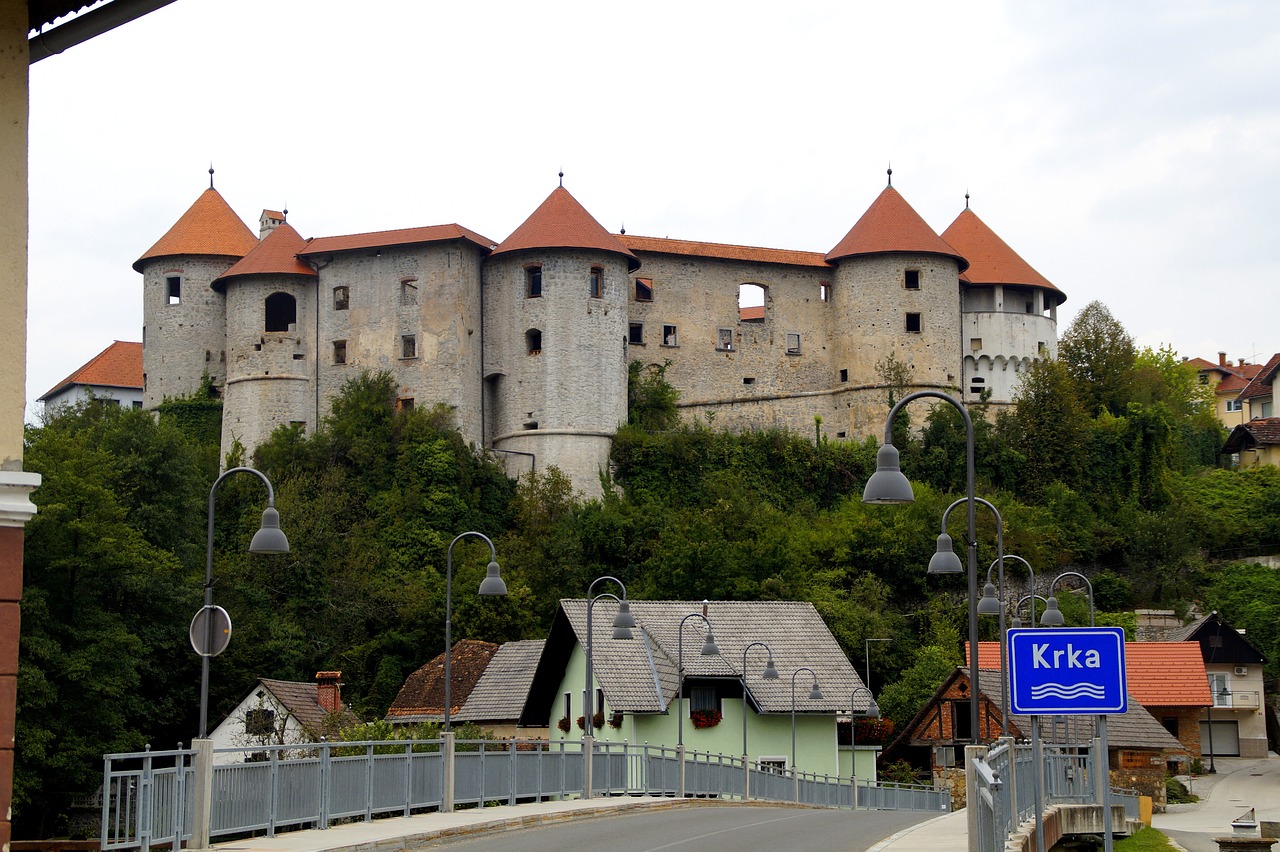
- Žužemberk Castle above the Krka’s tufa steps, partly restored; the best view is from the opposite bank, where the water rushes over the tufa barriers.
- Soteska: the castle ruins above the river and the “Hudičev turn” (Devil’s Tower), a Baroque garden pavilion right on the Krka.
- Baza 20 in Kočevski Rog: the former headquarters of the Slovene Partisan resistance in the Second World War, wooden barracks deep in the beech forest.
- CampingSpirit overnight tip
-
Official campsite or RV park: Kamp Polje in Meniška vas, around 1.5 km before Dolenjske Toplice on the Krka: a small, modern site with pitches for motorhomes, electricity, water, a heated sanitary block and a service point, open roughly from April to September. In the village itself, near the spa, is Kamp Dolenjske Toplice; it is listed as open all year, but in winter it serves only as a stopover without usable sanitary facilities – check season and services in advance.
Free camping or nature tip (where legal): In Kočevski Rog, besides the general ban on overnight stays, take particular care: the forests are bear country, and forest roads are used for timber haulage and are not places to park overnight. No wild camping at Baza 20 or on forest tracks.
- Insider tip for campers
- The Dolenjske Toplice thermal spa has used warm springs for centuries; a spa day after the drive through the valley does you good. From Kamp Polje the village can be reached on foot or by bike, so the camper stays put – parking at the spa centre is scarce.
3Stage 3: Dolenjske Toplice to Novo mesto (approx. 20 km)
- The drive
- A short drive on the regional road through the lower Krka Valley via Straža to Novo mesto, a good 20 minutes. The centre sits on a rocky spur in a tight bend of the Krka; the lanes around Glavni trg are steep, narrow and partly pedestrianised – do not drive in with a motorhome.
- Highlights & must-sees
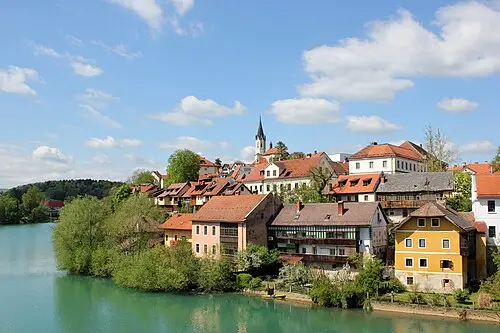
- The Krka bend with the houses on the Breg rising straight out of the water; the classic view is from the Kandija Bridge.
- The Chapter Church of St Nicholas at the highest point of the old town, with a Gothic crypt and an altarpiece attributed to Tintoretto.
- Dolenjski muzej with the Hallstatt-period situlae, decorated bronze buckets that have earned Novo mesto the nickname “City of Situlae”.
- CampingSpirit overnight tip
-
Official campsite or RV park: Novo mesto motorhome stopover (Camper Stop) on Topliška cesta by the Portoval sports centre on the Krka, about 1 km from the centre: few pitches (six, according to the operator), open all year, with electricity, water and disposal for grey water and cassettes. Arrive early in summer.
Free camping or nature tip (where legal): In town, too, only stay overnight at the designated stopover. The car parks on the Krka riverbank and at shopping centres are no alternative; the municipalities carry out checks and impose fines.
- Insider tip for campers
- From the Portoval stopover you can walk along the river into the old town. In the afternoon the detour up Trška gora, the wine hill on the edge of town, is worth it, with vineyard cottages (zidanice) and views over the Krka basin – try Cviček there for the first time and leave the camper where it is.
4Stage 4: Novo mesto to Kostanjevica na Krki (approx. 40 km)
- The drive
- Down the Krka to Otočec, then across the wide Šentjernej plain at the foot of the Gorjanci to Pleterje and on to Kostanjevica na Krki. Flat, well-surfaced regional roads; only the access roads to Pleterje and the vineyards are narrow. About an hour of pure driving time. If you want to shorten the route, you can use the A2 from Novo mesto – the vignette is then required.
- Highlights & must-sees
- Grad Otočec: the moated castle on a small island in the Krka, reached on foot over a bridge; today a hotel, but the courtyard and the riverbank can easily be enjoyed from outside.
- Pleterje Charterhouse, founded at the beginning of the 15th century by the Counts of Celje and still home to Carthusian monks today: the monastery is closed, but the Gothic church and an exhibition on Carthusian life are open; the shop sells fruit brandies from the monastery’s own production. Right next door is the Pleterje open-air museum with thatched farmhouses from the Šentjernej plain.
- Kostanjevica na Krki, Slovenia’s smallest town, on an island in the Krka; in the former Cistercian monastery is the Božidar Jakac Gallery, and in the surrounding park the wooden sculptures of Forma Viva, created at international sculpture symposia since the 1960s.
- CampingSpirit overnight tip
-
Official campsite or RV park: In Kostanjevica na Krki the municipal motorhome stopover is on Krška cesta at the northern entrance to the town, around 300 m from the centre: twelve pitches, open all year, with electricity, water and a service point; payment is by app or SMS, check the current fee on avtokampi.si in advance. For full facilities, the large thermal campsite Kamp Terme Čatež near Brežice lies around 25 km to the east – open all year, with electricity, a service point and thermal pools.
Free camping or nature tip (where legal): Vineyards and the access tracks to the zidanice are private land; staying overnight there is only possible with the winegrower’s explicit invitation on their own land – it is not permitted on public land. The Krka riverbank near Kostanjevica is a Natura 2000 site.
- Insider tip for campers
- Cviček is a protected traditional designation: a light blend of red and white varieties with low alcohol. Many winegrowers in the Cviček area sell direct from the farm – ask about a tasting, but plan to stay the night locally afterwards rather than drive. The Gorjanci, the forested border ridge with Croatia that includes Trdinov vrh, are a hiking tip for an extra day; the mountain roads up are narrow and unsuitable for large motorhomes.
5Stage 5: Kostanjevica na Krki to Metlika / Podzemelj (approx. 70 km)
- The drive
- Back via Šentjernej to Novo mesto and south on the main road over the foothills of the Gorjanci into Bela krajina, down to Metlika and on to the Kolpa at Podzemelj. A few longer climbs and bends over the Gorjanci, otherwise well surfaced. Around 1.5 hours.
- Highlights & must-sees
- Metlika: old town with a castle housing the Belokranjski muzej on the region’s folk culture, and the Slovenian Firefighting Museum on the main square.
- Tri fare in Rosalnice on the edge of Metlika: three Gothic pilgrimage churches side by side in a walled enclosure.
- The region’s wine cellars, with Metliška črnina, the dark red of Bela krajina, and white Belokranjec.
- CampingSpirit overnight tip
-
Official campsite or RV park: Kamp Podzemelj (Kamp Bela krajina) on the Kolpa between Metlika and Črnomelj: a wide, calm stretch of river with a gravel beach for swimming, plenty of space, electricity and sanitary facilities; many seasonal campers in summer. Closer to Metlika is Kamp Lovšin on the Kolpa. The season usually runs from spring to autumn – check in advance.
Free camping or nature tip (where legal): The Kolpa is a border river and largely a Natura 2000 site. Staying overnight on the bank, on bathing meadows or on gravel bars is prohibited; the municipalities step up checks in summer.
- Insider tip for campers
- Do your shopping and fill up in Metlika before moving on – apart from campsite bars there are few supplies along the Kolpa. The main square in Metlika is cramped; park on the edge of the old town and walk.
6Stage 6: Podzemelj to Adlešiči (approx. 40 km)
- The drive
- Via Gradac to Črnomelj, then south into Lahinja Landscape Park and on along small roads through birch groves to Adlešiči on the Kolpa. Narrow, quiet country roads without major climbs, tight in the villages; a good hour without stops.
- Highlights & must-sees
- Črnomelj: old town on a rocky spur between the Lahinja and the Dobličica, plus, a few kilometres to the north-east, the Mithraeum near Rožanec with a Roman rock relief.
- Lahinja Landscape Park with the information centre in Veliki Nerajec and the river meander at Pusti Gradec – a short circular path through wet meadows, past old mills.
- Steljniki: the airy birch groves with bracken, typical of Bela krajina and at their most beautiful in the evening light in late summer and autumn.
- CampingSpirit overnight tip
-
Official campsite or RV park: Kamp Stari pod – Jankovič in Adlešiči right on the Kolpa: a simple site with little shade, lively in summer evenings and popular with younger guests. Check facilities and season in advance; if you prefer it quieter, stay a second night in Podzemelj.
Free camping or nature tip (where legal): In Lahinja Landscape Park, overnight stays, fires and driving on meadow tracks are prohibited. In Bela krajina, too, the rule is: only stay overnight at campsites and stopovers.
- Insider tip for campers
- In the Lahinja park use the car parks at the information centre; the access roads to the mills are farm tracks. Mosquitoes are plentiful along the Lahinja and the Kolpa on warm evenings – keep repellent to hand.
7Stage 7: Adlešiči to Vinica (approx. 25 km)
- The drive
- Upstream on narrow country roads through the villages along the Kolpa to Vinica, where the river narrows between wooded slopes. A deliberately short driving day – the rest belongs to the water. The roads are partly single-track with passing places, a good 45 minutes.
- Highlights & must-sees
- A canoe or raft trip on the Kolpa: calm stretches with small riffles, with hire and return transport through the campsites and operators along the Kolpa.
- Swimming in the Kolpa, considered Slovenia’s warmest river in high summer; gravel bars and bathing spots at the campsites.
- Vinica, birthplace of the poet Oton Župančič, with a view from the castle hill over the Kolpa valley to Croatia.
- CampingSpirit overnight tip
-
Official campsite or RV park: Kamp Katra and Kamp Kolpa lie side by side on the bank near Vinica, just before the border: medium-sized sites right on the water, electricity and sanitary facilities; Kamp Kolpa has a small bar. The village also has a motorhome stopover (PZA). The season usually runs from May to September.
Free camping or nature tip (where legal): The right bank of the Kolpa is Croatia – landing and staying overnight there legally counts as crossing the border outside a border crossing point. On the Slovenian side the general ban applies; the bank near Vinica is checked in summer.
- Insider tip for campers
- Only paddle when the water level is normal: after heavy rain in the Croatian uplands the Kolpa rises quickly and becomes murky and fast-flowing. Take your ID in a waterproof bag – on the river you are on the border. Only empty grey water and cassettes at the campsite.
8Stage 8: Vinica to Kočevje (approx. 65 km)
- The drive
- Continue upstream along the Kolpa via Radenci to Stari trg ob Kolpi, where the valley becomes even narrower and lonelier, then north through the great forests of Kočevsko to Kočevje. Narrow, winding roads with little traffic, unlit forest stretches; a good 1.5 hours. From Kočevje you are back in Ljubljana via Ribnica in a little over an hour.
- Highlights & must-sees
- The upper Kolpa valley near Stari trg with wooden hayracks (kozolci) and river meadows – the quietest corner of the route.
- The forests of Kočevsko with the Rajhenavski Rog virgin forest reserve and one of the densest brown bear populations in Europe; guided bear watching through local operators.
- Kočevje with Rudniško jezero, a mining lake on the edge of town, and traces of the Gottscheers, the German-speaking minority who lived here until their resettlement in 1941/42.
- CampingSpirit overnight tip
-
Official campsite or RV park: On the upper Kolpa are Kamp Muhvič and Kamp Konda near Stari trg and Kamp Kanu near Radenci, all simple and on the water. In Kočevje there is Camp Jezero on the mining lake and Grajski kamp; check facilities and season in advance.
Free camping or nature tip (where legal): In bear country, wild camping is not only prohibited but unwise: leave no food or waste outside, and put rubbish only in the bear-proof containers. Never feed wild animals, and keep your distance.
- Insider tip for campers
- This is where the route ends; for eastern Slovenia, the CampingSpirit guide through eastern Slovenia from Celje to Prekmurje is a good choice, for wine and the bora the guide through the Vipava Valley and Goriška Brda, and for mountains and coast the guide through the Julian Alps, Soča Valley and Karst to Piran. To continue into Croatia, cross via Vinica or Metlika – the CampingSpirit guide to Plitvice, Lika and Zagorje picks up from there.
Camping practice & local rules
Wild camping & overnight parking
- Wild camping and sleeping in your vehicle outside campsites and designated motorhome stopovers (postajališče za avtodome, PZA) are prohibited in Slovenia. Municipalities can set their own rules and fines; along the Kolpa in particular, checks are carried out in summer.
- Protected areas on this route: Lahinja Landscape Park, the Natura 2000 sites along the Krka and the Kolpa, and the forest reserves in Kočevski Rog. Additional bans on fires, driving on meadow and forest tracks, and drones apply there.
- The Kolpa is the border river with Croatia: landing on the Croatian bank counts as crossing the border. Temporary border controls can also take place at this Schengen internal border – always carry your ID.
- Legal options: the small river campsites on the Kolpa, Kamp Polje and Kamp Dolenjske Toplice, municipal PZA such as those in Novo mesto, Žužemberk and Kostanjevica, and tourist farms. Useful resources are avtokampi.si, park4night and Campercontact.
Waste disposal & supplies
- Water and waste disposal are available at the campsites and the Novo mesto stopover; smaller PZA do not always have a service point. Never empty grey water into rivers, ditches or drains – the Kolpa campsites depend on clean bathing water.
- Tap water in Slovenia is drinkable. Between Črnomelj, Vinica and Kočevje there are few petrol stations and shops; stock up and fill the tank in Novo mesto, Metlika or Črnomelj.
- Gas: German exchange cylinders are not exchanged in Slovenia. Autogas (avtoplin) is available at larger petrol stations, for example in Novo mesto and along the A2; bring an adapter set for refillable cylinders and check the connection type beforehand.
- Bear country in Kočevsko, in Kočevski Rog and in parts of Bela krajina: keep food in the vehicle, put rubbish only in lockable containers, and do not leave barbecue leftovers lying around.
Vehicle size & traffic rules
- Tolls: vehicles up to 3.5 t need the electronic vignette (e-Vinjeta) on motorways and expressways – here above all the A2 Ljubljana–Novo mesto; it is linked to the number plate and should only be bought through official channels such as evinjeta.dars.si. Under DARS rules, vehicles up to 3.5 t registered as motorhomes fall into class 2A regardless of height, while tall vans without motorhome registration fall into the more expensive class 2B; trailers do not need their own vignette. Driving without a valid vignette risks heavy fines. If you only use country roads, you do not need a vignette – the old main road via Grosuplje is a good alternative.
- Over 3.5 t, instead of the vignette, distance-based tolling via DarsGo applies, with a DarsGo unit on the windscreen; register and get the unit before your first motorway journey.
- Speed limits for cars and motorhomes up to 3.5 t: 50 in built-up areas, 90 outside built-up areas, 110 on expressways, 130 km/h on motorways. Vehicle-trailer combinations up to 3.5 t: 90 outside built-up areas, 100 km/h on expressways and motorways. Motorhomes and combinations over 3.5 t: 80 km/h outside built-up areas, on expressways and on motorways.
- Dipped headlights are compulsory during the day too. Winter equipment is mandatory from 15 November to 15 March; the Gorjanci and Kočevsko can be snowbound in winter. Keep a high-visibility vest to hand for every occupant.
- Alcohol: 0.5 per mille, 0.0 for young drivers, novice drivers and professional drivers – on the Cviček and Črnina route the most important rule. Phones only with a hands-free kit.
- Flooding: the Krka and the Kolpa can rise sharply within hours after heavy rain; the campsites lie on the floodplain and are evacuated when warnings are issued. Follow the weather warnings from ARSO, the Slovenian Environment Agency, and move early if the water is rising.
CampingSpirit packing & preparation checklist
- Waterproof dry bag for your ID and phone – on the Kolpa you are paddling along the national border.
- Water shoes for the gravel bars and tufa steps of the Kolpa and the Krka; the stones are slippery and sharp-edged.
- Odour-proof rubbish bags and a lockable food box for the bear country around Kočevje and Kočevski Rog.
- Insect repellent and mosquito nets for the sliding door and roof vent – warm evenings on the Lahinja and the Kolpa bring plenty of mosquitoes.
- A fleece or light jacket for Krška jama and Kostanjeviška jama: inside the caves it stays cool even in summer.
- Levelling ramps for the slightly sloping meadow pitches at the river campsites.
As of 2026-10. Closures, fees and booking rules change: check official sources before you go.