



In-depth guide · CampingSpirit
From the hills of the Zagorje via Karlovac, Rastoke and the Plitvice Lakes, through the Lika and over the Velebit to Skradin: around 760 kilometres away from the coast, where you will see woodpiles and flocks of sheep more often than beach car parks.
The spirit of the route
If you only know Croatia from the coast, you will get to know a different country here. In the Zagorje, Baroque churches and wine cellars stand on round green hills, and north of Krapina, Trakošćan Castle is reflected in its lake. Near Karlovac four rivers meet, and in Rastoke the water rushes between old mills. Beyond Plitvice the Lika begins: wide plateaus with haystacks, abandoned farmsteads, beech and fir forests where bears and wolves live. In the morning, mist lies over the karst fields, and through the open sliding door you smell wet grass and woodsmoke. On the Velebit you stand above the clouds and see the Kvarner islands like paper cut-outs in the sea. Finally the route takes you past the Paklenica gorge and the Zrmanja canyon down into warm Dalmatia. Plan economically, bring warm clothes and stay at small sites. On the road it is often very quiet.
Stage-by-stage plan
1Stage 1: Zagreb to Tuhelj (Hrvatsko Zagorje) via Krapina and Trakošćan (approx. 130 km)
- The drive
- From Zagreb take the A2 (toll) north through the Krapina valley to the Krapina exit, around 60 km of motorway. Continue on country roads via Đurmanec through hilly farmland to Trakošćan on the Slovenian border, then back via Krapina and on small, winding roads between vineyards and maize fields to Tuhelj. The village roads in the Zagorje are narrow and often have no hard shoulder; driving time a good 2.5 hours.
- Highlights & must-sees
- Muzej krapinskih neandertalaca in Krapina: a modern museum right at the Hušnjakovo find site, where hundreds of Neanderthal bone fragments were discovered at the end of the 19th century.
- Trakošćan Castle on a wooded hill above the reservoir of the same name, remodelled in Romantic style in the 19th century, with museum rooms; the circular walk around the lake takes a good hour.
- Kumrovec (detour from Tuhelj, around 15 km): the open-air museum “Staro selo” with restored Zagorje houses and the birthplace of Josip Broz Tito.
- CampingSpirit overnight tip
-
Official campsite or RV park: Camp Vita belongs to the Terme Tuhelj spa: pitches with electricity and sanitary facilities on the spa grounds; whether spa admission is included in the pitch price depends on the tariff. A good alternative is Kamp Terme Jezerčica in Donja Stubica at the foot of Medvednica, also at a spa. The Zagorje region has only a few campsites – book ahead in the holidays and at weekends.
Free camping or nature tip (where legal): In the rural Zagorje, too, the Croatian ban on overnight stays outside registered campsites applies. The car park at Trakošćan and hiking car parks are checked less often than on the coast, but a night there is still not allowed. Small legal alternatives are the registered “kamp u domaćinstvu”, mini-camps on farms or at wineries, which are listed in the pitch apps.
- Insider tip for campers
- The A2 is a toll road. If you want to save money and see more, take the old country road via Zaprešić and Zabok. In Zagreb, the city centre around Ban Jelačić Square is unsuitable for motorhomes: narrow one-way streets, tram tracks, multi-storey car parks with height restrictions. Leave the camper on the edge of town and take the tram into the centre. Top up gas and groceries before heading inland – in the Zagorje there are hardly any large supermarkets outside the small towns.
2Stage 2: Tuhelj to Samobor (approx. 55 km)
- The drive
- From Tuhelj via Kumrovec and Klanjec on narrow country roads along the Sutla, which forms the border with Slovenia here, then south through wine villages and via Brdovec to Samobor. A short, relaxed stage with many village through-roads, a good 1.5 hours' driving time.
- Highlights & must-sees
- Antun Augustinčić Gallery in Klanjec with works by the sculptor who, among other things, created the peace monument in front of the UN headquarters in New York.
- Samobor old town with King Tomislav Square, the Gradna stream and the Samobor cream slice (samoborska kremšnita) in the patisseries on the main square.
- The castle ruin Stari grad Samobor, half an hour's walk from the centre, and behind it the woodland of Žumberak – Samoborsko gorje Nature Park with hiking trails to Okić Castle.
- CampingSpirit overnight tip
-
Official campsite or RV park: Vugec plac (Camp Samobor) is on the edge of town: a small site with electricity, water, sanitary facilities and waste disposal, within walking distance of the old town. Around ten kilometres further towards Zagreb is Kamp Zagreb on Lake Rakitje, a larger site with electricity and sanitary facilities. It also works as a base for a visit to Zagreb.
Free camping or nature tip (where legal): In Žumberak – Samoborsko gorje Nature Park, sleeping in your vehicle and camping outside designated sites are prohibited; the forest car parks are for day use. In Samobor itself, overnight parking in public car parks is not intended either.
- Insider tip for campers
- Samobor is best explored on foot; the lanes around the main square are too narrow for motorhomes. If you want to go to Zagreb, take the bus from Samobor, which spares you the big-city traffic. Fill up with water at the site before moving on – public service points are rare inland.
3Stage 3: Samobor to Slunj (Rastoke) via Karlovac (approx. 110 km)
- The drive
- Via Sveta Nedelja and Jastrebarsko south to Karlovac, either on the country road or the A1. From Karlovac take the D1, the old main road south, through forest and river landscapes via Tušilović and Veljun to Slunj. The D1 is well built but single-carriageway with lorry traffic. Driving time around 2.5 hours without stops.
- Highlights & must-sees
- Karlovac: the star-shaped 16th-century fortress town “Zvijezda”, Dubovac Castle on the hill and the Aquatika freshwater aquarium on the Korana.
- Swimming in the Mrežnica near Mrežnički Brig: travertine steps and small waterfalls, a popular swimming spot in summer.
- Rastoke in Slunj: the Slunjčica tumbles over cascades into the Korana, with wooden houses and restored watermills in between.
- CampingSpirit overnight tip
-
Official campsite or RV park: In Slunj you will find Camp Rastoke and Camping Puškarić, both a few minutes above Rastoke, with electricity, sanitary facilities and grass pitches. Rastoke itself is within walking distance. If you want to stop earlier: Camp Slapić on the Mrežnica near Mrežnički Brig, a well-equipped site with electricity, service point and a river swimming spot.
Free camping or nature tip (where legal): Rastoke is a protected cultural site and a densely built village; the car parks at the village entrance are for day use. Overnight stays are banned on the riverbanks and forest tracks of the Mrežnica and Korana, and the banks are often private land. The campsites around Slunj are cheap and close by – that is the better solution.
- Insider tip for campers
- Do not drive your motorhome into Rastoke: the lanes are narrow and steep, and there is parking on the D1 above. In Karlovac it is best to stop by the Korana at Aquatika or on the edge of the old town; the star fortress is best explored on foot. The Karlovac–Slunj route runs through areas that were fought over in the war of the 1990s. Croatia completed the clearance of all known minefields in 2026; occasionally unexploded ordnance may still turn up in the woods – stay on paths, do not touch anything suspicious and report it on 112.
4Stage 4: Slunj to Plitvice Lakes (Plitvička jezera National Park) (approx. 35 km)
- The drive
- Take the D1 south via Rakovica, through forest and pasture, to Entrance 1 of the national park by the big waterfalls. The stage is short so that your park visit can start the same or the next morning; driving time under an hour.
- Highlights & must-sees
- Veliki slap, at around 78 metres the highest waterfall in Croatia, and the view from the cliff edge at Entrance 1 over the Lower Lakes.
- The Upper Lakes from Entrance 2: wooden boardwalks over travertine barriers and cascades between Prošćansko jezero and Kozjak, plus an electric boat across Lake Kozjak.
- Barać Caves near Rakovica, a short detour off the D1, with guided tours in season.
- CampingSpirit overnight tip
-
Official campsite or RV park: The national park runs two campsites of its own: Kamp Korana on the D1 a few kilometres north of Entrance 1, large, with electricity, sanitary facilities and a service point, and Kamp Borje further south towards Korenica, quieter in the forest. There are also private sites such as Camping Plitvice and Bear Camp on the D1 between Rakovica and the park. Allow two nights and book in high season.
Free camping or nature tip (where legal): In the national park, sleeping in your vehicle, camping and fires are prohibited, and the car parks at the entrances are for day visitors only. Motorhomes pay a daily fee there, paid on exit (prices on the park website). There are also checks on the D1 in front of the park and on the forest access roads.
- Insider tip for campers
- Buy tickets in advance online from the national park: when booking you choose the date and entrance; tickets are only validated at that entrance. At peak times the ticket offices are sold out or overwhelmed. Admission prices depend on the season and are cheaper in summer in the late afternoon (prices on the park website). Arrive early in the morning: from late morning onwards, groups back up on the boardwalks. Swimming, drones and dogs off the lead are prohibited. If the car park is full, never park on the D1 – come from the campsite by bike or taxi instead.
5Stage 5: Plitvice Lakes to Otočac via Gospić and Smiljan (approx. 125 km)
- The drive
- Via Korenica into the Lika: country roads lead across the wide karst plateau with hay meadows, juniper and villages where many houses stand empty, to Gospić. After the detour to Smiljan the route heads north via Perušić and the Gacka valley to Otočac. The roads are clear and lightly used; driving time is around 2.5 hours. Expect wildlife on the road, especially at dusk.
- Highlights & must-sees
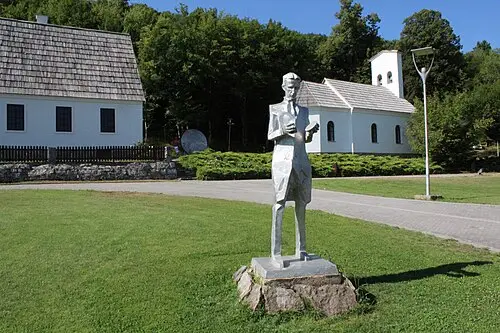
- Memorijalni centar “Nikola Tesla” in Smiljan: the inventor's birthplace, the parish church where his father was priest, and a multimedia centre; opening times are seasonal, check in advance.
- Pećinski park Grabovača near Perušić: a cave park with several karst caves and guided tours in season.
- The springs of the Gacka near Sinac and Otočac, such as Majerovo vrilo with a crystal-clear spring pool and old watermills.
- CampingSpirit overnight tip
-
Official campsite or RV park: Kamp Odmorište Otočac is a small pitch area near Otočac listed by the Gacka tourist board; check facilities and season in advance with the tourist information office. If you want to stay in Gospić, there is Ecocamp Rizvan City in Rizvanuša at the foot of the Velebit, around ten kilometres from town, with electricity, water and waste disposal (season according to the operator mid-April to the end of September).
Free camping or nature tip (where legal): The Lika is sparsely populated, and police and enforcement officers rarely carry out checks here. The ban on overnight stays still applies. On top of that there is nature: brown bears, wolves and lynx live in the Lika's forests. Away from the sites you should not park in the forest, should not leave food scraps outside and should only throw rubbish into closed containers.
- Insider tip for campers
- Fill up in Gospić or Otočac: between the small towns of the Lika there are long stretches without a petrol station. The A1 runs parallel, but the country road across the plateau is the more beautiful route. If you are interested in bears, plan the bear refuge in Kuterevo for the next morning (stage 6). Drive slowly in fog and on icy roads in spring and autumn: the Lika is the coldest region in Croatia.
6Stage 6: Otočac to Sveti Juraj via Krasno and Zavižan (approx. 75 km)
- The drive
- From Otočac on a winding, asphalted mountain road via Kuterevo to Krasno, then past the hamlet of Vukelići to the Babić Siča park entrance at around 1,300 m. The last seven kilometres to Zavižan are a narrow gravel road – only suitable for compact panel vans in dry weather. Larger motorhomes stay at Babić Siča. Back via Krasno to the Oltari Pass (1,018 m) and down in hairpins to the coast at Sveti Juraj. With a hike, a full day.
- Highlights & must-sees
- Utočište za mlade medvjede Kuterevo: a refuge for orphaned bear cubs run by volunteers; ask the refuge about visiting conditions in advance.
- Zavižan: mountain hut and weather station at around 1,594 m, the highest in Croatia, next to the Velebitski botanički vrt with Velebit plants and views of Rab, Krk and Pag.
- Premužićeva staza from Zavižan to the rock towers of the Rožanski kukovi, a well-built stone path, around three to four hours there and back; in Krasno, the Kuća Velebita visitor centre and cheese from the local dairy.
- CampingSpirit overnight tip
-
Official campsite or RV park: Camp Ujča near Sveti Juraj is on the coast below the Oltari Pass, with electricity, water, sanitary facilities and waste disposal. A few kilometres north, in Senj, the tourist board runs the Kamp Škver pitch area by the sea. In Sjeverni Velebit National Park itself there is no site for motorhomes.
Free camping or nature tip (where legal): In Sjeverni Velebit National Park, sleeping in your vehicle, camping and lighting fires outside designated areas are prohibited. The Babić Siča and Alan park entrances are staffed during the day (8 am–4 pm). Wild camping is not allowed on the Oltari Pass or the forestry tracks either; the forestry tracks are closed to motor vehicles.
- Insider tip for campers
- The roads to Zavižan can be closed by snowdrifts in spring and late autumn; check the current situation with the national park before setting off. The park is usually open to visitors from the beginning of May to the end of November. Tickets are available at the Babić Siča park entrance, at Kuća Velebita in Krasno and from the rangers. On the descent from the Oltari Pass to the coast the bora can get very strong: when a storm warning is in force, the Magistrala below the Velebit is often closed to motorhomes and vehicles with trailers. If you cannot get through, drive via Otočac onto the A1.
7Stage 7: Sveti Juraj to Starigrad-Paklenica (approx. 125 km)
- The drive
- Take the D8 south along the Velebit Channel: on the right the bare islands of Rab and Pag, on the left the Velebit wall, and in between a winding, often narrow coast road via Jablanac and Karlobag. Few villages, hardly any overtaking opportunities. From Karlobag the road becomes quieter, followed by the long straight to Starigrad. Driving time around 2.5 hours.
- Highlights & must-sees
- Zavratnica Bay near Jablanac: a narrow inlet between rock walls, 20 minutes' walk from the harbour, with a ship sunk in the Second World War in the clear water.
- Detour from Karlobag up to the Baške Oštarije pass (927 m) with views over the Velebit Channel; Kamp Velebit is also there if you would rather spend the night in the mountains.
- Velika Paklenica: the limestone gorge begins right behind Starigrad. On Anića kuk, climbers scale walls around 400 metres high.
- CampingSpirit overnight tip
-
Official campsite or RV park: There are many campsites around Starigrad-Paklenica. Kamp Nacionalni park is by the sea next to the park administration and is run by the national park itself. Camp Anica Kuk, Autocamp Marko and Autocamp Vesna are smaller family sites in the village, and the larger Camping Paklenica is next to a hotel complex. All have electricity and sanitary facilities, most also a service point. Kamp Velebit in Baške Oštarije has electricity, water and waste disposal, season April to November.
Free camping or nature tip (where legal): On the coast between Senj and Starigrad there are checks, especially at swimming coves and in the harbours. Paklenica National Park prohibits overnight stays and fires outside its own campsite. The fire risk in the karst forests is high in summer, and open fires are then banned everywhere in the countryside.
- Insider tip for campers
- The D8 below the Velebit is one of Croatia's bora routes: in strong winds the police close sections to high-sided vehicles, vehicles with trailers and motorcycles. Check the weather forecast and the HAK notices beforehand. The ferry from Jablanac to Rab belongs to a different route. Food and fuel are available in Karlobag; in between, supplies are thin.
8Stage 8: Starigrad-Paklenica to Skradin (Krka National Park) via Obrovac (approx. 105 km)
- The drive
- Take the D8 to Maslenica, then, without crossing the bridge, the D54 through Jasenice to Obrovac on the Zrmanja, then across the barren Bukovica karst plateau with stone walls, oak scrub and sheep pastures via Kistanje to the Krka and down to Skradin. Little traffic, good country roads, narrow only in the villages. Driving time around 2 hours.
- Highlights & must-sees
- Zrmanja canyon near Obrovac: a turquoise river between high limestone walls, with viewpoints on the road above the town; kayak and rafting tours start upstream at Kaštel Žegarski.
- Krupa Monastery (14th century) in the Krupa valley, and nearby the Kudin most stone bridge over the cascades.
- Burnum near Kistanje: remains of a Roman legionary camp with an amphitheatre above the Krka canyon, now part of Krka National Park.
- CampingSpirit overnight tip
-
Official campsite or RV park: Camping Vrata Krke at the Lozovac park entrance is handy for an early start to Skradinski buk. The small sites around Skradin are described in the CampingSpirit guide to the Dalmatian coast. If you want to stay on the Zrmanja, there is the small site Slapovi Zrmanje near Žegar with electricity and sanitary facilities.
Free camping or nature tip (where legal): Wild camping is not allowed in Krka National Park or on the Zrmanja. Many riverbanks are part of Natura 2000 areas, and the riverside car parks are intended for day visitors. Clearance of the known minefields in the Bukovica has been completed since 2026, but unexploded ordnance may still occasionally turn up: stay on surfaced paths, do not touch anything suspicious and report finds on 112.
- Insider tip for campers
- In Obrovac, motorhomes are best parked on the riverbank below the town. The road up through the old town is narrow. For the Krka there are two options: take the boat from Skradin to Skradinski buk, or start at the Lozovac entrance with its large car park. Roški slap and Burnum in the north of the park are less crowded. Swimming is prohibited in Krka National Park. From Skradin you can reach the coast at Šibenik via the A1 in an hour, or drive back to Zagreb in three hours.
Camping practice & local rules
Wild camping & overnight parking
- In Croatia, camping outside registered campsites is prohibited, as is sleeping in a motorhome in car parks, on forest tracks, on riverbanks and on mountain passes. Unlike in some neighbouring countries, no distinction is made between parking and camping. Inland there are fewer checks than on the coast, but the ban applies here just the same. Fines are in the three-figure euro range or higher.
- National parks (Plitvička jezera, Sjeverni Velebit, Paklenica, Krka) and nature parks (Žumberak – Samoborsko gorje, Velebit) prohibit overnight stays, camping and fires outside their own sites; the entrance car parks are for day use.
- Bears: a large brown bear population lives in the forests of the Lika, Gorski kotar and Velebit. Do not leave food, barbecue or rubbish outside overnight, and only put waste into closed containers. Talk loudly on hikes and keep dogs on the lead. Encounters are rare, but bears at rubbish sites are not unusual.
- Legal alternatives inland are the registered “kamp u domaćinstvu”, small sites on farms and with families offering a few pitches. Croatia completed the clearance of all known minefields from the war of the 1990s in 2026; occasionally unexploded ordnance may still turn up – stay on paths, do not touch anything suspicious and report it on 112. Apps: park4night, Campercontact and the directory of the Croatian camping association (camping.hr).
Waste disposal & supplies
- There are practically no public service points in inland Croatia. Empty your tanks at campsites, many of which offer water and waste disposal to passing travellers for a fee.
- Never discharge waste water into the countryside: the karst of the Lika, Velebit and Bukovica channels everything into the groundwater that feeds the Plitvice Lakes, the Gacka and the Krka.
- Tap water is drinkable. In the Lika, supermarkets and petrol stations are far apart, and supplies are thin especially on Sundays. Do a full shop and fill up in Karlovac, Gospić and Otočac.
- Gas: German exchange cylinders are not swapped. Autogas (autoplin) is available at many larger petrol stations on the motorways and in towns; for refillable cylinders, usually bring the Dish adapter. In the Lika it can get cool at night even in summer, so travel with two full cylinders.
Vehicle size & traffic rules
- Speed limits: motorhomes up to 3.5 t 50 km/h in built-up areas, 90 km/h outside built-up areas, 110 km/h on expressways, 130 km/h on motorways; over 3.5 t and vehicles with trailers 80 km/h outside built-up areas, 90 km/h on motorways.
- Motorway tolls: the A1 (Zagreb–Karlovac–Gospić–Dalmatia) and A2 (Zagreb–Macelj) are tolled by distance; motorhomes more than 1.90 m high above the front axle pay category II. Croatia is switching to a barrier-free system with number plate recognition, which under the new toll law is to apply across the whole network from 1 March 2027. After that, every vehicle must be registered in advance online, via app or at registration points with its number plate and a means of payment; over 3.5 t an ENC box is mandatory. Without registration you face a €120 surcharge plus a fine of €300 to €600. As of October 2026, payment at toll stations is still by cash, card or ENC. Before a trip from March 2027, check the current situation with Hrvatske autoceste.
- Bora and snow: in strong winds the authorities close the A1 between Sveti Rok and Maslenica, the D8 below the Velebit and the Maslenica bridges to motorhomes, vehicles with trailers and high-sided vehicles. From 15 November to 15 April winter equipment is compulsory on many roads in the Lika and Gorski kotar, and snow is possible there even in April and October. The HAK (hak.hr) provides current reports.
- Blood alcohol limit 0.5, 0.0 for drivers under 25 and professional drivers. Mobile phones only with a hands-free kit. During winter time (end of October to end of March), dipped headlights are required during the day too. A high-visibility vest, warning triangle (two for vehicles with trailers) and first-aid kit are compulsory.
- Loads protruding at the rear, such as bikes on a rear rack, must be marked; the red-and-white warning sign is the safe solution. City centres such as Zagreb's Upper Town or the lanes of Rastoke and Obrovac are unsuitable for motorhomes – park on the edge.
CampingSpirit packing & preparation checklist
- Warm sleeping bags, fleece and a hat: on the Lika plateau and at Zavižan, night-time temperatures drop noticeably even in summer, and in spring and autumn down to freezing point.
- Odour-proof, sealable food boxes and sturdy rubbish bags – so that nothing edible stays outside overnight and attracts bears.
- Hiking boots with grippy soles and poles for the karst rock in Paklenica, on the Premužićeva staza and on the wet boardwalks of Plitvice.
- Tick tweezers and insect repellent: there are lots of ticks and mosquitoes in the Lika's forests and along the rivers around Karlovac.
- A smartphone with mobile data, printed Plitvice tickets and a registered credit card – for the national park's online tickets and registration in the new toll system.
- Storm straps for the awning and extra ratchet straps for the rear rack and roof box, because the bora can blow very hard on the Velebit coast and on the A1.
As of 2026-10. Closures, fees and booking rules change: check official sources before you go.