

In-depth guide · CampingSpirit
From Viana do Castelo on the Atlantic up the Minho border river to Melgaço, across the highlands of Castro Laboreiro and Peneda to Soajo and Lindoso, and back through the Lima valley to Braga: 365 kilometres of vineyards, granite granaries and forests full of wild horses.
The spirit of the route
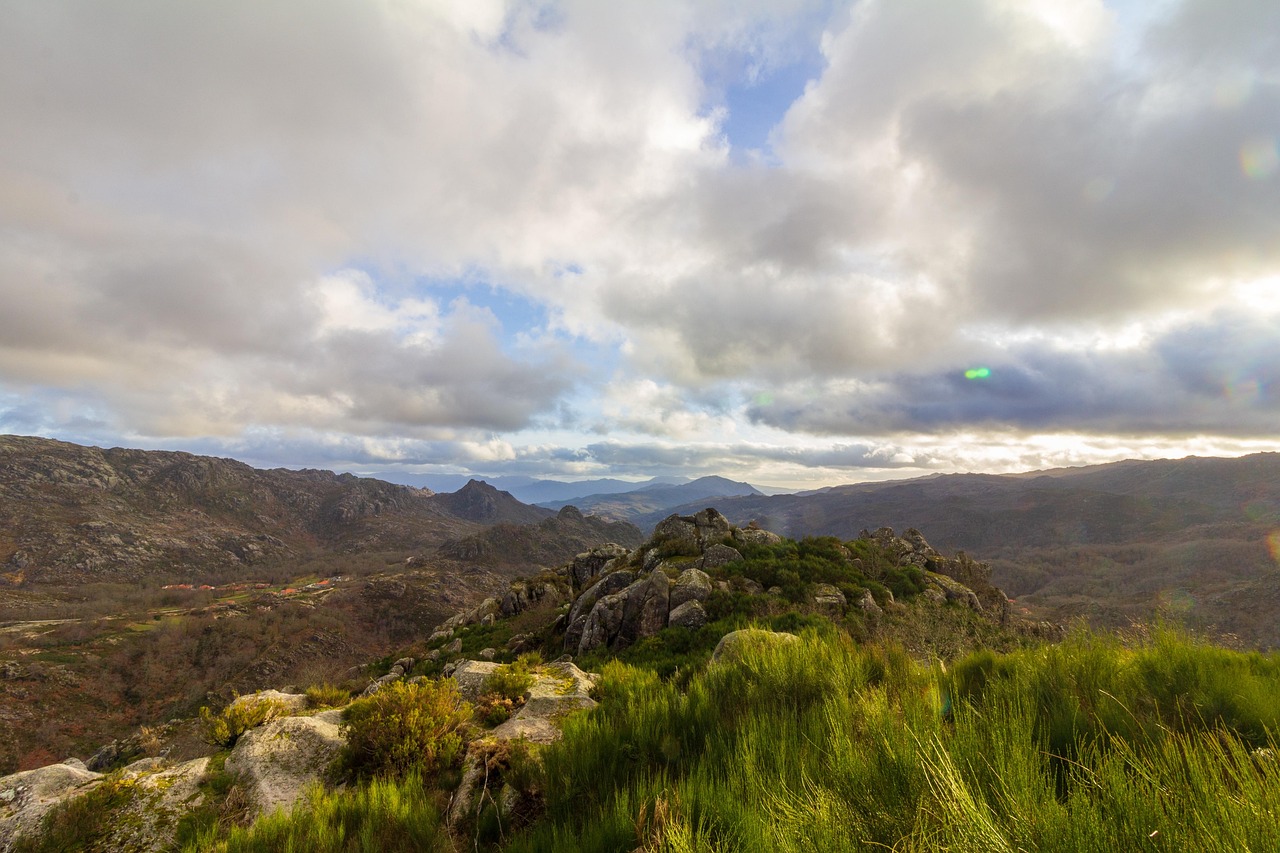
The Alto Minho smells of salt air, wet granite and freshly cut hay. On the Atlantic the north wind whistles over the dunes, but just beyond Caminha the Minho slides up beside the road as a broad, calm border river, with Spain on the opposite bank. The vineyards of Monção and Melgaço, where Alvarinho comes from, hang on pergolas and granite posts so the grapes don’t rot in the damp air. Beyond Lamas de Mouro the national park begins: gravel plateaus, Garrano horses at the roadside, Cachena cattle with widely curving horns. From your sliding door you will see espigueiros, the slim grain stores on granite stilts, and streams tumbling down between boulders. In between lie villages where afternoons are long and a coffee takes ten minutes. Allow for fog, short stages and time for wine tastings where the vehicle stays put.
Stage-by-stage plan
1Stage 1: Viana do Castelo to Caminha (approx. 30 km)
- The drive
- From Viana take the coastal road N13 north, past the wind turbines and dunes of Montedor, through Vila Praia de Âncora to Caminha at the mouth of the Minho. The N13 is wide but narrow and full of zebra crossings in the towns; the A28 runs parallel. About 45 minutes of pure driving time.
- Highlights & must-sees
- Forte de Santiago da Barra in Viana at the mouth of the Lima, a fortress with a view of the harbour and the Atlantic.
- Dunes and lighthouse of Montedor: a coastal strip with walking trails on boardwalks, rough and windy when the north wind blows.
- Old town of Caminha with Praça do Terreiro, clock tower and parish church with a remarkable wooden ceiling; passenger ferries (no vehicles) run from the landing stage across to A Guarda in Galicia.
- CampingSpirit overnight tip
-
Official campsite or RV park: Orbitur Caminha lies behind the dunes near Moledo, a broad sandy beach with a pine forest; toilets and showers, electricity and service point, check the season in advance. Alternatively Camping Sereia da Gelfa near Vila Praia de Âncora, smaller and family-run; ask beforehand about pitch size and access for long vehicles.
Free camping or nature tip (where legal): The whole coast falls under the coastal management plan (POOC): beach car parks, dunes and pine forests are off limits for overnight stays, and the police (GNR) carry out checks even out of season. In the hinterland of the municipalities of Caminha and Viana, local bans also apply; observe the signs.
- Insider tip for campers
- The Atlantic beaches are cold and subject to currents; watch for the bathing flags. It is best to shop and fill up with water in Viana or Caminha; there is neither in the dune area.
2Stage 2: Caminha to Valença (via Vila Nova de Cerveira) (approx. 30 km)
- The drive
- The N13 follows the Minho upstream, with eucalyptus and vine terraces on the left, the river and Galicia on the right. Vila Nova de Cerveira lies directly on the road; beyond the town the road climbs gently until Valença appears with its fortress on the hill. About 45 minutes, little traffic, narrow spots only in the towns.
- Highlights & must-sees
- Vila Nova de Cerveira: a small old town with a defensive wall, known for contemporary art, with sculptures around town and a riverside promenade.
- Fortress of Valença: a double ring of 17th-century bastions above the Minho, inside a granite town with shops selling household linen and souvenirs; the ramparts can be walked.
- Iron road and rail bridge of 1886 over the Minho to Tui; on foot you are in Spain within a few minutes.
- CampingSpirit overnight tip
-
Official campsite or RV park: Camping de Covas near Vila Nova de Cerveira, on the bank of the Minho under pines, with toilets and showers and electricity; ask in advance about service facilities and the length limit. In Valença itself there is no proper campsite in the town centre; motorhome areas on the outskirts change, so check park4night or Campercontact beforehand.
Free camping or nature tip (where legal): In the Minho valley with its Natura 2000 zones (Rio Minho), overnight stays outside approved sites are prohibited. Day visitors and anglers park on the riverbank; overnight only vehicles with a permit or on a designated area stay there.
- Insider tip for campers
- The street inside the fortress walls is narrow, and the car parks are outside the ring; leave the motorhome at the car park at the foot of the fortress and walk in. Spaniards come over to shop, and on Saturday mornings it is crowded.
3Stage 3: Valença to Melgaço (via Monção) (approx. 50 km)
- The drive
- On the country road along the Minho: Monção lies on the river, then the road climbs through vineyards and chestnut forest to Melgaço, the northernmost town in Portugal. Bends and town centres, but easy to drive; about 1 hour 15 minutes without tastings.
- Highlights & must-sees
- Monção: old town with Praça Deu-la-Deu and castle remains, plus the Caldas de Monção hot springs on the edge of town.
- Palácio da Brejoeira near Monção: a neoclassical wine estate where Alvarinho grows; visits and tastings usually by appointment only.
- Melgaço: castle and old town, plus wine estates that sell direct; the local specialities are Alvarinho, smoked meats (Fumeiro) and lamprey in season.
- CampingSpirit overnight tip
-
Official campsite or RV park: Refúgio do Pezo near Melgaço, a rural site (listed in OSM with toilets and showers and electricity); ask in advance about season and pitch size. In Monção and Melgaço, apps also list sites on wine estates and farms that take guests who join a tasting.
Free camping or nature tip (where legal): In the car parks of the old towns of Monção and Melgaço, daytime parking is normal, overnight only where the municipality allows it; local ordinances take precedence. Some wine estates invite guests to stay overnight in the yard – ask on the spot and buy something in return.
- Insider tip for campers
- Drinking and driving do not mix: the blood alcohol limit in Portugal is low. Treat yourself to tastings when the vehicle may stay overnight at the estate. Bring cash for small winemakers; not everywhere takes cards.
4Stage 4: Melgaço to Castro Laboreiro (round trip from Lamas de Mouro) (approx. 45 km)
- The drive
- From Melgaço on the country road up to the national park entrance at Lamas de Mouro, then on to the Castro Laboreiro plateau at around 1,000 m. The road is narrow, with tight hairpins, granite walls at the edge and livestock on the carriageway. For the round trip with a hike, allow half a day to a full day.
- Highlights & must-sees
- Castro Laboreiro: castle ruin above the village and a panoramic view over the plateau; the place gave its name to the shepherd dog Cão de Castro Laboreiro.
- Brandas and inverneiras: the seasonal settlements to which shepherds used to move in summer and winter; some villages are preserved.
- Drive into the highlands past Garrano horses and Cachena cattle; national park trails start at the edges of the villages.
- CampingSpirit overnight tip
-
Official campsite or RV park: Parque de Campismo Lamas de Mouro at the northern entrance of the national park, a small site; facilities, number of pitches and opening times are not documented, please ask in advance. Better suited to smaller motorhomes and tents.
Free camping or nature tip (where legal): The entire Peneda-Gerês National Park is a protected area: overnight stays outside approved sites, fires and camping are prohibited, even in car parks at viewpoints. Expect checks by the park service (ICNF) and the GNR.
- Insider tip for campers
- Fill up with fuel and shop in Melgaço; up there you will find only small shops. Fog can roll in on the plateau within minutes; then switch on dipped headlights and drive slowly. Mobile reception is patchy, so download maps offline.
5Stage 5: Lamas de Mouro to Soajo (via Peneda and Gavieira) (approx. 60 km)
- The drive
- Down narrow mountain roads to Gavieira and up to the Santuário da Peneda in a granite bowl, then through high valleys and villages to Soajo. The roads are narrow and winding, with passing places and livestock; demanding for large vehicles and combinations. A good 2 hours of pure driving time; check the approaches on a current map beforehand.
- Highlights & must-sees
- Santuário da Peneda: Baroque pilgrimage church with a monumental staircase, set in a granite landscape with streams.
- Gavieira and the highlands around Peneda: granite villages, pastures and national park trails; ask the park service or locally about waymarks and lengths.
- Soajo: the Eira Comunitária with 24 espigueiros on granite stilts, the oldest dating from 1782; some are still used today to store maize.
- CampingSpirit overnight tip
-
Official campsite or RV park: Parque de Campismo da Travanca, according to OSM a few kilometres north-west of Soajo; ask in advance about operation, facilities, season and access for longer vehicles. Alternatively pitches on farms in the Lima valley, according to motorhome pitch apps.
Free camping or nature tip (where legal): The roads around Peneda and Soajo lie within the national park; overnighting in car parks is not allowed. At the pilgrimage site of Peneda, parking is intended for visitors only.
- Insider tip for campers
- If in doubt, choose the main road via Arcos de Valdevez rather than the minor routes. In Soajo the drive through the village can be tight; park outside and walk to the espigueiros.
6Stage 6: Soajo to Ponte da Barca (via Lindoso) (approx. 50 km)
- The drive
- From Soajo to the Alto Lindoso reservoir and on to Lindoso on the Spanish border, then down through the Lima valley to Ponte da Barca. The road winds along slopes and granite walls with many bends; wider downstream from Lindoso. Around 1 hour 30 minutes of driving time.
- Highlights & must-sees
- Lindoso: castle on the hillside and beside it more than 50 espigueiros, one of the largest collections in the country; the view crosses the valley to the Spanish border.
- Alto Lindoso reservoir with viewpoints at the dam wall.
- Ponte da Barca: medieval stone bridge over the Lima and a well-kept riverside promenade with plane trees.
- CampingSpirit overnight tip
-
Official campsite or RV park: Camping Lima Escape near Entre Ambos-os-Rios on the Lima, above Ponte da Barca (note: approach via the Lima bridge at Ponte da Barca); toilets and showers, electricity, restaurant; no dedicated motorhome service point is listed, only a disposal point for chemical toilets. Check opening times in advance. Alternatively the Parque de Campismo Rural de Aboim da Nóbrega south of the river, with an adjoining motorhome area according to OSM; clarify its current status beforehand.
Free camping or nature tip (where legal): Around the reservoir and in the park, the ban on overnight stays outside sites applies. In Ponte da Barca the riverside car parks are day car parks; overnighting there only if the municipality expressly signs it.
- Insider tip for campers
- Lindoso has few parking spaces for large vehicles; arrive early in the morning. The village is on the border, and refuelling is easier in Ponte da Barca than up there.
7Stage 7: Ponte da Barca to Barcelos (via Ponte de Lima) (approx. 70 km)
- The drive
- From Ponte da Barca the expressway IC28 or the parallel country road follows the Lima valley to Ponte de Lima, then it heads south on country roads or the A3 to Barcelos. The route is mostly wide, narrow only in the town centres. About 1 hour 30 minutes of driving time.
- Highlights & must-sees
- Ponte de Lima: Roman-medieval bridge and the Alameda along the river; details in the CampingSpirit guide to the Douro valley, Peneda-Gerês and the green Minho.
- Vinho Verde quintas in the Lima valley, many with cellar sales and a farm café. Between Ponte de Lima and Barcelos runs the Caminho Português, the Portuguese Way of St James; with luck you will meet pilgrims on minor roads.
- Barcelos: old town on the Cávado, pottery museum and the colourful rooster (Galo de Barcelos) as its emblem; ceramics in shops and at the weekly market.
- CampingSpirit overnight tip
-
Official campsite or RV park: Parque de Caravanas de Barcelos, a municipal motorhome area with service point on the edge of town; check fee, operation and condition in advance. In the surrounding area, directories also list the Parque de Campismo de Fão near Esposende, run by a camping club; clarify guest access beforehand.
Free camping or nature tip (where legal): In the municipality of Barcelos the 48-hour rule applies only where the municipality has not signed otherwise; sites in town are mostly designated motorhome areas. The river meadows of the Cávado and Lima are a Natura 2000 area.
- Insider tip for campers
- The traditional weekly market in Barcelos is one of the biggest in the north; on market days the approaches and car parks around the centre are closed or full. Check the date with the municipality beforehand.
8Stage 8: Barcelos to Braga (with a detour to Guimarães) (approx. 30 km)
- The drive
- From Barcelos on the N103 and the expressway into the Braga basin. Wide and quick to drive, with sluggish city traffic before Braga. For the detour to Guimarães add about 30 kilometres each way; driving time about 45 minutes each way.
- Highlights & must-sees
- Mosteiro de São Martinho de Tibães west of Braga: former Benedictine monastery with gardens and cloister.
- Sé de Braga: the oldest cathedral in the country, a mix of Romanesque and Baroque with a treasury.
- Pilgrimage hills Bom Jesus and Sameiro as viewpoints; Guimarães with its castle and old town is described in the CampingSpirit guide to the Douro valley, Peneda-Gerês and the green Minho.
- CampingSpirit overnight tip
-
Official campsite or RV park: Parque de Campismo e Caravanismo Municipal de Braga on the southern edge of town; check facilities and season with the municipality. Alternatively GarfePark Camping in the hinterland near Póvoa de Lanhoso, in a quieter spot; ask about operation in advance.
Free camping or nature tip (where legal): In the urban area of Braga, overnighting on streets and car parks is not recommended, and the pilgrimage car parks at Bom Jesus and Sameiro are day car parks. Local signs apply around Braga.
- Insider tip for campers
- Braga’s old town has a pedestrian zone and access restrictions, so take the bus or a taxi from the campsite. For the return journey south or to Spain (Valença), check the A3 toll settlement with the operator in advance.
Camping practice & local rules
Wild camping & overnight parking
- Legal situation: Art. 50-A of the Portuguese Highway Code (Código da Estrada, inserted by Law 66/2021) regulates overnighting in motorhomes, Art. 48 parking. Outside protected areas and where the municipality does not regulate otherwise, overnighting is allowed for up to 48 hours in the same municipality; at sites expressly approved for it, no time limit applies. Check with the municipality or the Automóvel Club (ACP) before your trip whether any changes have come into force since.
- Overnighting and parking outside approved sites is prohibited in Natura 2000 areas, protected areas and coastal zones with a management plan. On this route that affects the Peneda-Gerês National Park, the river meadows of the Minho and Lima, and the coast around Viana and Caminha. Fines are possible, higher in protected areas; please check the amounts in the text of the law.
- Camping behaviour is taboo everywhere: awning, table, chairs, grill and extended parts count as camping; only discharge waste water at service points.
- Wildfire: during the critical fire season in summer and when the risk is high, open fires, barbecuing outside approved facilities and fireworks in rural areas are prohibited; check warning levels with IPMA and closures with ICNF, emergency number 112.
- Legal overnight stays: parques de campismo, Áreas de Serviço de Autocaravanas run by the municipalities, and private pitches. park4night and Campercontact are useful; there are only a few sites in the national park, so book in good time in high summer.
Waste disposal & supplies
- Service points are called “Área de Serviço de Autocaravanas”; in the Minho they are on the edges of towns and at campsites, hardly any in the national park. Good places: Viana, Caminha, Melgaço, Ponte da Barca and Barcelos. Empty the cassette and grey water only there.
- Water: tap water in Portugal is generally drinkable (“água potável”); fountains in villages often carry the notice “água não controlada” – then don’t drink it. Start with a full tank before driving into the highlands.
- Gas: Portuguese exchange cylinders (Galp, Repsol and others) are only available in exchange for Portuguese cylinders with their own connector. Autogas (GPL) is available at many filling stations; with an adapter, refillable tank cylinders can be filled. Arrive with two full cylinders.
- Electricity: Portugal uses 230 V and CEE plugs at campsites; a 25-metre extension cable is useful on grass pitches.
Vehicle size & traffic rules
- Speed limits: cars and motorhomes up to 3.5 t 50 km/h in built-up areas, 90 km/h outside, 120 km/h on motorways (new drivers in their first year at most 90 outside built-up areas). Cars towing caravans: 80 km/h outside built-up areas (90 on IP/IC expressways), 100 km/h on motorways. Motorhomes over 3.5 t have lower limits than cars, according to press sources 80 km/h outside built-up areas; check the motorway limit and vehicle class on the registration document beforehand. Using a phone at the wheel is prohibited, the blood alcohol limit is 0.5 ‰.
- Tolls: Some motorways are purely electronic (blue sign “Somente via electrónica”); there is no way to pay at a booth. Options for foreign vehicles are Via Verde Visitors (transponder, only for class 1 and 2), EASYToll (licence plate linked to a credit card, for stays of up to 30 days) and TOLLCard (prepaid for longer stays); EASYToll and TOLLCard are valid only on the purely electronic stretches. Motorhomes with two axles and a height above the front axle of 1.10 m or more fall into class 2, vehicles with more axles into higher classes. On the ADAC list of purely electronic stretches, the A28 appears only between Apúlia and Angeiras/Perafita near Porto, and the A3 is not listed; whether further sections on your route are electronic and which charges apply, clarify beforehand with the operator.
- On this route the A28 on the coast and the A3 towards Braga are the relevant ones. If you mostly drive country roads (N13), you hardly need motorways, save on tolls and see more.
- Dimensions and weights: in tight village streets such as Soajo and Lindoso, length and width are decisive; vehicles over 7 m should avoid the minor routes in the national park. A warning triangle and a high-visibility vest are compulsory.
- Low-emission zones (ZER) exist in Portugal only in a few large cities such as Lisbon; in Viana, Caminha and Braga the main restrictions are pedestrian zones and access limits in the old towns – do not drive into them.
- Winter equipment is not compulsory, but on the Castro Laboreiro plateau there may be snow and ice in winter.
CampingSpirit packing & preparation checklist
- Via Verde transponder or a registered toll account (EASYToll) – some motorway sections are purely electronic, and paying afterwards is a nuisance.
- Rain jacket and a wool layer: it often rains in the Alto Minho, and it blows cool on the plateaus.
- Levelling ramps and an extension cable – grass pitches and simple campsites are often uneven.
- Offline maps and a torch: reception in the national park is patchy, and fog comes in quickly.
- Hiking boots with good tread – the granite slabs and paths to the waterfalls become slippery when wet.
As of 2026-10. Closures, fees and booking rules change: check official sources before you go.