


In-depth guide · CampingSpirit
From Hobart via Richmond, the Tasman Peninsula and Maria Island into the Huon Valley, to the end of the road at Cockle Creek and back over the Bruny ferry: a good 1,000 kilometres of coast, orchards and history, where the wind has a say.
The spirit of the route
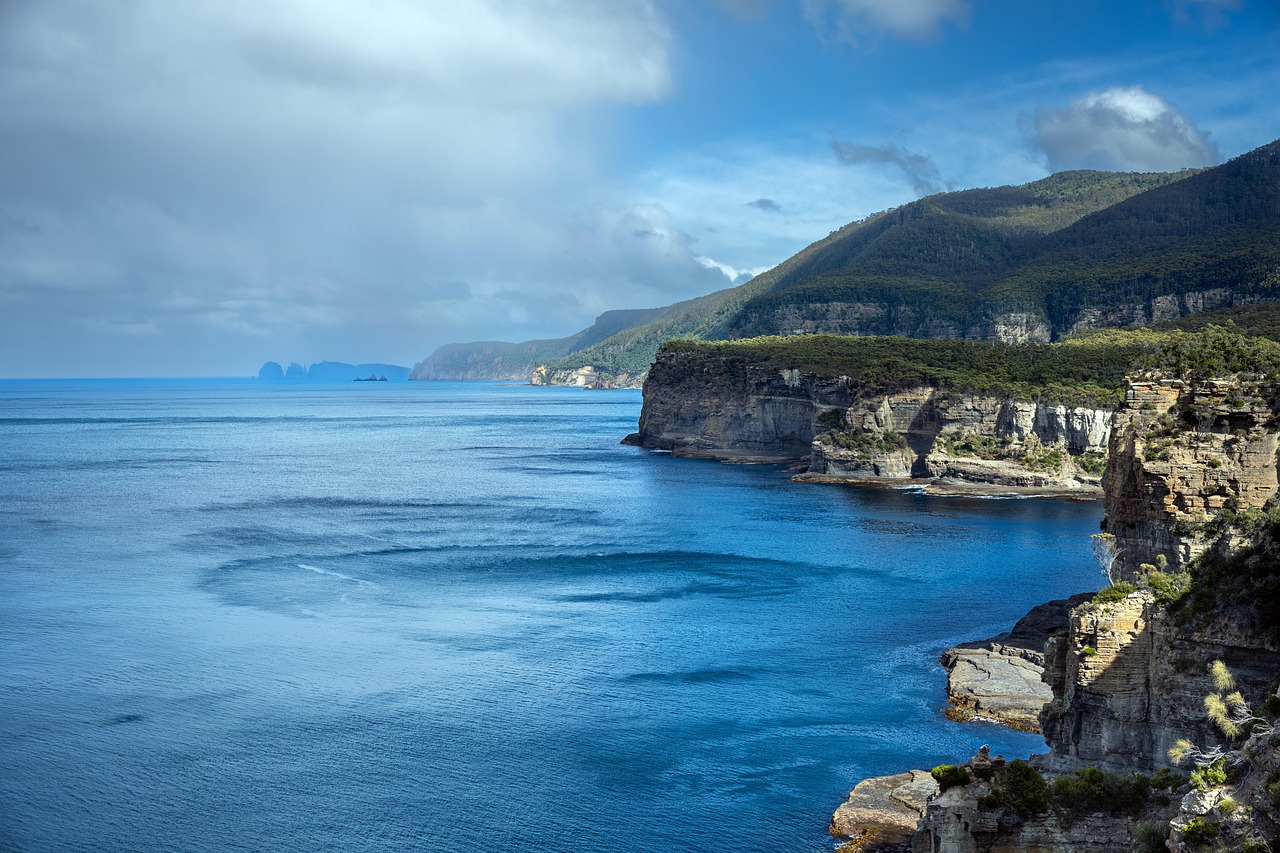
In south-east Tasmania a lot lies close together yet is separated by water. Beyond Hobart the camper rolls over hills of sheep pasture, then across the isthmus of Eaglehawk Neck, where dogs on chains once stopped escapees. From the sliding door you see dolerite columns rising from the Southern Ocean like organ pipes, and later the sandstone walls of a convict settlement in the green of the eucalypts. On Maria Island, where no cars are allowed, wombats graze in front of the brick ruins of Darlington as if there were no people. In the Huon Valley the air smells of apples and wood shavings, at the end of the road in Cockle Creek of salt, tea-tree and rain. And the weather often changes three times a day: you learn to close windows, retract the awning and listen to the wind.
Stage-by-stage plan
1Stage 1: Hobart to Fortescue Bay (via Richmond, Eaglehawk Neck and Port Arthur) (approx. 145 km)
- The drive
- From Hobart over the Tasman Bridge and along the Tasman Highway to Cambridge, then on the Richmond Road to Richmond. Continue to Sorell and on the Arthur Highway (A9) through Dunalley and over the Denison Canal onto the Tasman Peninsula, across the narrow isthmus of Eaglehawk Neck to Taranna and Port Arthur. Two lanes, well built, slow in holiday traffic; the last stretch is about 12 km of gravel to Fortescue Bay. Pure driving time is a good 3 hours, with stops it makes a long day – so start early.
- Highlights & must-sees
- Richmond: the Richmond Bridge of 1823, according to common accounts the oldest bridge in Australia still in use, and Richmond Gaol of 1825, an older prison than Port Arthur.
- Eaglehawk Neck: Tessellated Pavement at Pirates Bay, the Blowhole, Tasman Arch and Devils Kitchen as short walks along the coast.
- Port Arthur Historic Site: the ruins of the penal settlement (1830–1877) by the harbour, with the Isle of the Dead and the memorial to 1996 – allow at least three hours.
- CampingSpirit overnight tip
-
Official campsite or RV park: Fortescue Bay in Tasman National Park: Mill Creek has the larger sites, also suitable for campervans, while Banksia is more for tents under eucalypts close to the beach; tank water (boil it), toilets, showers with tokens, generators at Mill Creek only until 9 pm. From October to April booking ahead is compulsory, from May to September it is first come, first served. If you don’t want to face the gravel road again after the Historic Site, use the NRMA Port Arthur Holiday Park (formerly Port Arthur Holiday Park), which the CampingSpirit guide “Rainforest, granite bays and wombats at dusk – once around Tasmania by motorhome” also describes.
Free camping or nature tip (where legal): There are no free-camping areas on the peninsula: lookout and beach car parks are day-use areas, monitored by the council and Parks and Wildlife. Do not sleep in your vehicle in Richmond and Sorell either. Plan on fixed sites.
- Insider tip for campers
- Fill up, shop and top up water in Sorell: after that the peninsula has only small shops with a limited range. According to the operator, the standard ticket for the Port Arthur Historic Site is valid for two consecutive days; have this confirmed when you buy. In Richmond, large vehicles are best parked on the edge of town, as the main street is narrow.
2Stage 2: Fortescue Bay to Triabunna (via Cape Hauy and Remarkable Cave) (approx. 170 km)
- The drive
- First on foot: the track to Cape Hauy starts at Fortescue Bay and leads (9.4 km return, about 4 hours, grade 3) over many steps and coastal heath to the dolerite columns. Then along the gravel road back to Taranna, to Remarkable Cave (a detour south of Port Arthur, reached by a side road) and again over Eaglehawk Neck to Sorell, finally on the Tasman Highway (A3) via Buckland and Orford to Triabunna. A long stretch of sealed road, with windy coastal sections. Walk and drive together make a very long day.
- Highlights & must-sees
- Cape Hauy: view of The Candlestick and Totem Pole, climbing rocks in the sea, best in the morning.
- Remarkable Cave: a sea cave with a view through the rock wall; a short path with about 115 steps to a platform at the foot of the cliffs, where waves sometimes wash through the tunnel.
- Orford: a stroll along the Prosser River before heading on to Triabunna.
- CampingSpirit overnight tip
-
Official campsite or RV park: Triabunna: Triabunna Cabin & Caravan Park, in town; ask the operator in advance about facilities, powered sites and site length. The ferry to Maria Island leaves from the wharf in Triabunna; tickets and camping fees are available at the Maria Island Gateway. Where and for how long you may leave the motorhome during your stay on the island, clarify in advance with the ferry operator; the caravan park is the safest option.
Free camping or nature tip (where legal): In the Glamorgan Spring Bay council area, free-camping spots are not available everywhere; beach and waterfront car parks in Orford and Triabunna are not overnight sites. Check the council’s current rules and the notes in WikiCamps or CamperMate.
- Insider tip for campers
- Start the Cape Hauy track before 9 am: in summer it gets warm quickly on the way, and the stairs are slippery after rain. Many underestimate the surf at Remarkable Cave – stay behind the barriers and keep hold of children. If you skip Cape Hauy, you save about four hours of walking and reach Triabunna in the early afternoon.
3Stage 3: Triabunna to Maria Island (Darlington) (approx. 15 km)
- The drive
- The vehicle stays in Triabunna: on Maria Island, no vehicles other than those of the park authority are permitted. The ferry leaves from the Maria Island Gateway (check in in good time, the time is given in the booking) and takes a good 30 minutes to Darlington. Ferry places are limited, so book ahead. On the island you go on foot or by bicycle; bikes can be taken along or hired, clarify the conditions when booking.
- Highlights & must-sees
- Darlington: the brick ruins of the convict settlement and the Penitentiary, with wombats, kangaroos and Cape Barren geese in front.
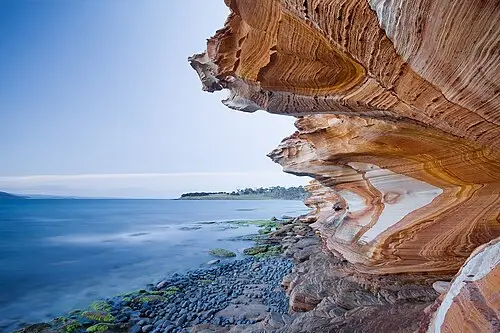
- Painted Cliffs: striped sandstone walls at the end of a beach walk from Darlington; only easy to walk at low tide.
- Fossil Cliffs and the Bishop and Clerk lookout as longer day walks for the fit.
- CampingSpirit overnight tip
-
Official campsite or RV park: Darlington Campground about 500 m south of the jetty behind the dunes: basic tent sites, toilets and a covered barbecue area with gas barbecues; the water is not drinkable and must be treated (boiled or with tablets). The sites cannot be reserved; you pay the fees before departure at the Maria Island Gateway in Triabunna. Other, remote campgrounds such as French’s Farm and Encampment Cove are walking destinations. There are no shops and no power for visitors on the island – everything has to come with you.
Free camping or nature tip (where legal): No free camping: on the island only the campground or the accommodation in the Penitentiary applies (booking via Parks and Wildlife). A valid Parks Pass is required for the national park, including for day visitors.
- Insider tip for campers
- At night wombats and possums walk through the camp – leave food in the shelter or in the box, not in the tent, and do not feed the animals. Take your rubbish back with you. Ferry cancelled in a storm or high waves? Then the buffer day is all you have, so never go to Maria Island on the last day of your trip.
4Stage 4: Maria Island to Franklin (Huon Valley) (approx. 135 km)
- The drive
- Back by ferry to Triabunna and along the Tasman Highway to Sorell, through Hobart and over the Southern Outlet and the Huon Highway (A6) to Huonville and Franklin. Mostly expressway, about 2 hours of driving, much longer in the rush hour around Hobart.
- Highlights & must-sees
- Huonville: the last large town on the Huon with a supermarket and several petrol stations, fruit stalls along the road.
- Franklin: the Wooden Boat Centre, where visitors watch boatbuilders at work or take courses.
- Huon waterfront: the walks along the river in Franklin with a view of the old shipyard buildings.
- CampingSpirit overnight tip
-
Official campsite or RV park: RV site in Franklin, run by the Palais Theatre association, small and intended for self-contained vehicles; clarify conditions and fee in advance with the Palais. Alternative in Huonville: the Huon Valley Caravan Park; ask the operator in advance about facilities and site length.
Free camping or nature tip (where legal): The Huon Valley council allows overnighting in a motorhome only at designated, supervised RV sites such as those in Franklin and Geeveston. Waterfront car parks on the Huon, including Shipwrights Point, can no longer be used for camping.
- Insider tip for campers
- Shop and fill up in Huonville, because south of it the supply thins out. In autumn farm shops offer apples, pears and cider; you may not bring fruit from the mainland, but fruit bought on the island is no problem. If you arrive early in Franklin, you still have time for the Wooden Boat Centre, which is open only during visitor hours.
5Stage 5: Franklin to Geeveston (via Cygnet) (approx. 75 km)
- The drive
- Back to Huonville, then on the Channel Highway to Cygnet, through orchards and over small hills; the return leads again via Huonville and the Huon Highway to Geeveston. Little traffic, bends with views of the Huon estuary. A good two hours with stops.
- Highlights & must-sees
- Cygnet: town centre with small galleries, cafés and farm shops.
- View across the D’Entrecasteaux Channel to Bruny Island from the coastal roads near Cygnet.
- Geeveston: the Forest and Heritage Centre, which shows the forestry and timber crafts of the region.
- CampingSpirit overnight tip
-
Official campsite or RV park: Geeveston: the CMCA RV Park on the Kermandie River, designed for self-contained vehicles; next to it the Geeveston RSL Club offers an RV area. In Cygnet the Cygnet Caravan Park is near the centre; in peak season enquire in good time.
Free camping or nature tip (where legal): As throughout the Huon Valley, no overnight areas for motorhomes are designated outside these sites. Avoid roadsides and harbour car parks.
- Insider tip for campers
- In Geeveston fill up with water and empty the cassette before heading south into the hinterland; the dump-point locations are currently listed in WikiCamps or CamperMate. If you want to go to the Tahune Airwalk, set off from here the next morning.
6Stage 6: Geeveston to Cockle Creek (via Tahune Airwalk and Hastings Caves) (approx. 165 km)
- The drive
- In the morning just under 30 km west to the Tahune Airwalk in the Tahune Forest Reserve and back, then on the Huon Highway to Dover. South of Dover the Hastings Caves Road branches off to caves and thermal pools; then on via Southport to Cockle Creek, where the last roughly 20 km are gravel. So start early and set off with a full tank.
- Highlights & must-sees
- Tahune Airwalk: steel walkway and viewing platform high above the treetops, with a view of the confluence of the Huon and Picton rivers. Check opening times in advance with the operator.
- Hastings Caves State Reserve: the thermal pool and Newdegate Cave, which can only be visited on a guided tour.
- Cockle Creek: the end of the road at the southernmost point in Australia that can be reached by road, with a walk towards South Cape; signs recall the whaling era.
- CampingSpirit overnight tip
-
Official campsite or RV park: Cockle Creek: Boltons Green with about ten sites in Southwest National Park (motorhomes only if self-contained, behind the “No Tents” sign) and the sites of the Recherche Bay Nature Recreation Area (Gillams Beach, Finns Beach, Catamaran, Ramsgate), all free, no booking, first come, first served; individual sites such as Catamaran are closed seasonally, the permitted length of stay is on the notices. More comfort is offered by the Southport Hotel & Caravan Park with pub and shop one stage earlier.
Free camping or nature tip (where legal): On the sites named you may legally stay – nowhere else in the area. The national park is “fuel stove only”, no dogs; north of the bridge in the Recherche Bay Nature Recreation Area only where permitted, in a raised fire pan you bring yourself and never during a fire ban. A Parks Pass is needed for Southwest National Park; Hastings Caves has its own entry fees.
- Insider tip for campers
- Fuel up for the last time in Southport, and check gas and food: Cockle Creek has neither a shop nor waste disposal and hardly any mobile reception. The weather changes quickly at the southern cape; secure your rain jacket and awning.
7Stage 7: Cockle Creek to Adventure Bay (Bruny Island) (approx. 190 km)
- The drive
- Back via Southport and Dover to Geeveston and Huonville, then on the Huon Highway towards Hobart as far as Kingston and on the Channel Highway to Kettering. There you drive onto the ferry to Roberts Point (a crossing of about 20 minutes) and follow the road over the isthmus The Neck to Adventure Bay. A long driving day, winding on Bruny. Driving time about 4 hours plus waiting time at the terminal.
- Highlights & must-sees
- The Neck: dunes and the Truganini Lookout platform, in the breeding season little penguins and shearwaters returning to their nests in the evening.
- Adventure Bay: a long sandy bay, Fluted Cape Walk with cliff views and petrels.
- Cheese, oysters and berries: small farms by the road, mostly with a sales window.
- CampingSpirit overnight tip
-
Official campsite or RV park: Captain Cook Holiday Park in Adventure Bay, opposite the beach, with powered sites, camp kitchen, sanitary facilities and dump point; in the summer holidays clarify length and availability. Simpler: the Parks and Wildlife campground at the Neck (pit toilets, no power; bring water and firewood, check fees and booking status in advance).
Free camping or nature tip (where legal): On Bruny Island overnighting is intended only at campgrounds and holiday parks; lookout and beach car parks are day-use areas. A Parks Pass is needed for South Bruny National Park (Jetty Beach, Cape Bruny); the Neck belongs to the Neck Game Reserve and lies outside it.
- Insider tip for campers
- The ferry cannot be reserved and charges by vehicle type and total length – rear carriers, bicycles and trailers count, and long campers pay considerably more than cars. Be at the terminal at least 20 minutes before departure; peak times are mornings from Kettering and late afternoon from Bruny. Check current length classes and prices with the ferry operator. There are only a few fuel pumps on the island, so cross with a full tank.
8Stage 8: Adventure Bay to Hobart (via Cape Bruny Lighthouse) (approx. 135 km)
- The drive
- From Adventure Bay back to the main road and on south via Lunawanna to Cape Bruny Lighthouse; part of the access to the lighthouse is gravel. Then the return to the ferry at Roberts Point, to Kettering and along the Channel Highway and the Southern Outlet to Hobart. With a lighthouse tour, a whole day.
- Highlights & must-sees
- Cape Bruny Lighthouse: tower built in 1838 on high cliffs above the Southern Ocean; tours are offered by the park authority, check times in advance.
- Cloudy Bay and Lunawanna: long surf beaches and a landscape that grows ever rougher towards the south.
- Hobart: the docks of Sullivans Cove and the Salamanca Market (Saturdays).
- CampingSpirit overnight tip
-
Official campsite or RV park: For the last night the holiday parks in the Greater Hobart area are suitable, which the CampingSpirit guide “Rainforest, granite bays and wombats at dusk – once around Tasmania by motorhome” describes. If you have to catch the ferry to Devonport early, it is better to stay north of Hobart.
Free camping or nature tip (where legal): In Hobart and the neighbouring councils overnighting on streets and car parks is prohibited and enforced. The lookout areas on kunanyi/Mount Wellington are also day-use only.
- Insider tip for campers
- Plan the return to the ferry early: in the late afternoon traffic backs up at the Roberts Point terminal. After the gravel kilometres check tyres, wheel arches and seals and wipe off the dust; report stone chips in the windscreen to the rental company immediately.
Camping practice & local rules
Wild camping & overnight parking
- Tasmania has no statewide freedom-camping law like New Zealand: whether you may sleep in your vehicle is regulated by the councils (here Sorell, Tasman, Glamorgan Spring Bay, Huon Valley, Kingborough) and by Parks and Wildlife for national parks and reserves. Rule of thumb: sleep only at designated sites; beach, waterfront and lookout car parks are off limits.
- In the Huon Valley, motorhomes may overnight only at supervised RV sites such as those in Franklin and Geeveston; on Bruny Island only at campgrounds and holiday parks.
- Parks and Wildlife sites are basic: Fortescue Bay (booking required October to April), Maria Island (fee at the Maria Island Gateway, sites cannot be reserved), Bruny Neck and Jetty Beach (check fees and booking in advance), Recherche Bay and Cockle Creek (free, first come, first served). In the summer holidays and on long weekends, arrive early.
- Parks Pass: compulsory for all the national parks named (Tasman, Maria Island, South Bruny, Southwest), including when staying overnight. A Holiday Pass for the vehicle is worthwhile for several parks; check current prices with Parks and Wildlife.
- Fire: in the summer months fire bans often apply, which also cover fire pans; in Southwest National Park gas stoves only. TasALERT reports warnings.
- Apps: WikiCamps Australia and CamperMate show sites, dump points and user reports; dead zones on the Tasman Peninsula, on Bruny and at Cockle Creek – save maps offline beforehand.
Waste disposal & supplies
- Dump points are found in larger towns and at holiday parks, on Bruny only in Adventure Bay; at Fortescue Bay, on Maria Island, at Recherche Bay and Cockle Creek none at all. Check locations in WikiCamps or CamperMate; never let grey water run onto the ground.
- Drinking water: town supplies are good; tank water at Parks sites is untreated and must be boiled, on Maria Island all water has to be treated. Fill the fresh-water tank before Maria Island, Fortescue Bay and Cockle Creek.
- Gas: Australian cylinders today mostly have the LCC27 valve, older ones still POL. Exchange at petrol stations and hardware stores, refilling only with a valid test date; European cylinders do not fit.
- Fuel: Sorell, Huonville and Kingston have the widest choice; after that Geeveston, Dover and Southport as the last petrol station before Cockle Creek. On Bruny there are only a few pumps with short opening hours, on Maria Island none at all.
- Biosecurity: if you arrive from the mainland by ferry or plane, you may not bring in fruit, vegetables, plants and many fresh foods. Checks are made at the terminal, and offences carry heavy fines; eat fruit beforehand or put it in the quarantine bins.
Vehicle size & traffic rules
- Left-hand traffic: at roundabouts you drive clockwise; whoever is already in the roundabout has priority. After refuelling, parking or a break, take special care to pick the right lane.
- Speed limits: in built-up areas mostly 50 km/h, outside them 100 km/h; on unsealed roads outside built-up areas generally 80 km/h unless signed lower – on the Fortescue Bay Road or the road to Cockle Creek that is often too fast. There are no toll roads in Tasmania.
- Animals: wallabies, pademelons, wombats, possums and Tasmanian devils are on the road between dusk and dawn; “Devil Zone” signs mark accident sections. Avoid driving at night if possible, stay slow and ready to brake, do not swerve. At the Neck little penguins and shearwaters cross the road in the evening.
- Vehicle: observe the rental contract, length and height; close roof vents, retract the awning in wind, secure gas cylinders.
- Unsealed roads and insurance: rental conditions often exclude gravel or allow only short access roads to campsites; the Fortescue Bay Road (about 12 km), the last part to Cockle Creek and the Lighthouse Road on Bruny are gravel. Clarify in writing in advance whether these stretches are insured; wildlife collisions often carry a higher excess.
- Alcohol and mobile phone: blood alcohol limit 0.5 per mille (0.05 BAC), zero for novice drivers; mobile phone at the wheel only with a hands-free kit.
- Arrival with the Spirit of Tasmania between Geelong and Devonport: book length and height correctly and check the terminal in Devonport according to the operator’s information before travelling. Foreign driving licences not in English only with an International Driving Permit or translation.
CampingSpirit packing & preparation checklist
- Levelling ramps and spirit level: the sites at Fortescue Bay, Recherche Bay and Cockle Creek are rarely level.
- Windproof rain jacket, hat and fleece: on the capes and the ferry it can turn cool in summer, below 10 °C, and showers come suddenly.
- Hiking boots with tread for the steps to Cape Hauy, the Fluted Cape and the beach walk to the Painted Cliffs.
- Water container (10–20 l) and water filter or a way to boil water for sites with a rainwater tank.
- Headlamp with red-light mode and a small box in which food cannot be reached by wombats, possums and pademelons at night.
- Offline maps and printed booking confirmations for the ferry to Maria Island and for Fortescue Bay.
As of 2026-10. Closures, fees and booking rules change: check official sources before you go.