

In-depth guide · CampingSpirit
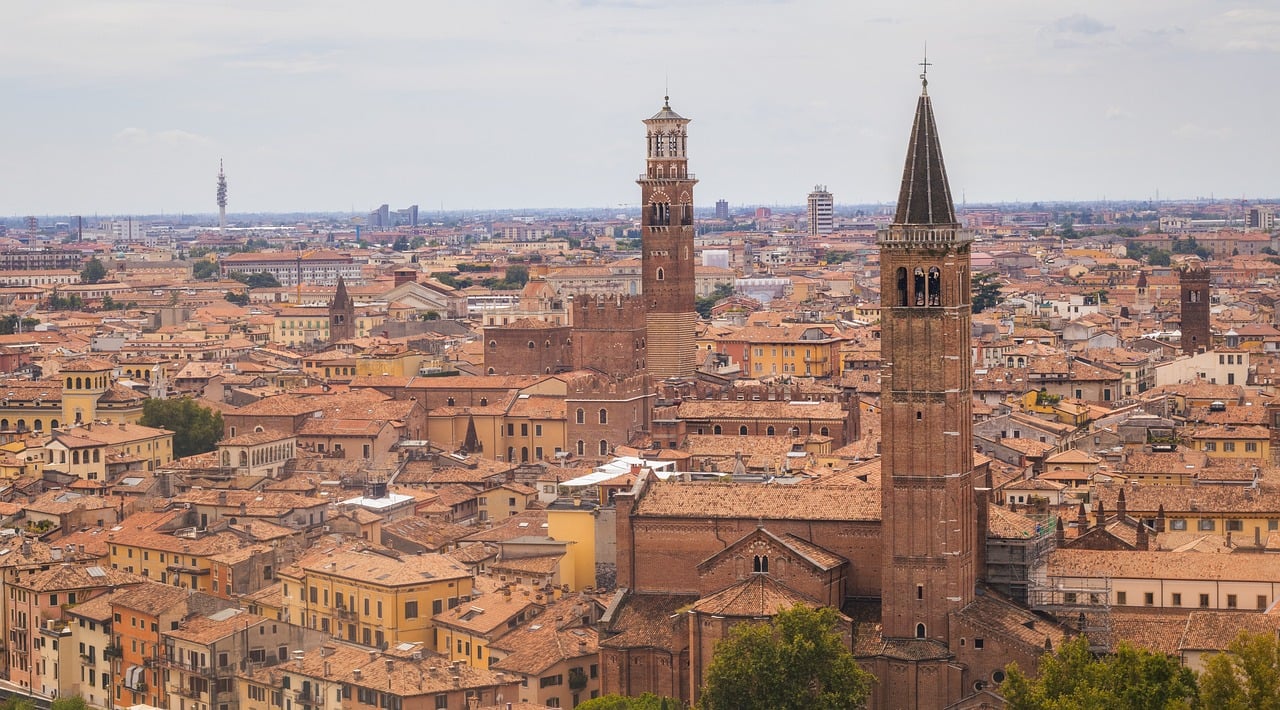
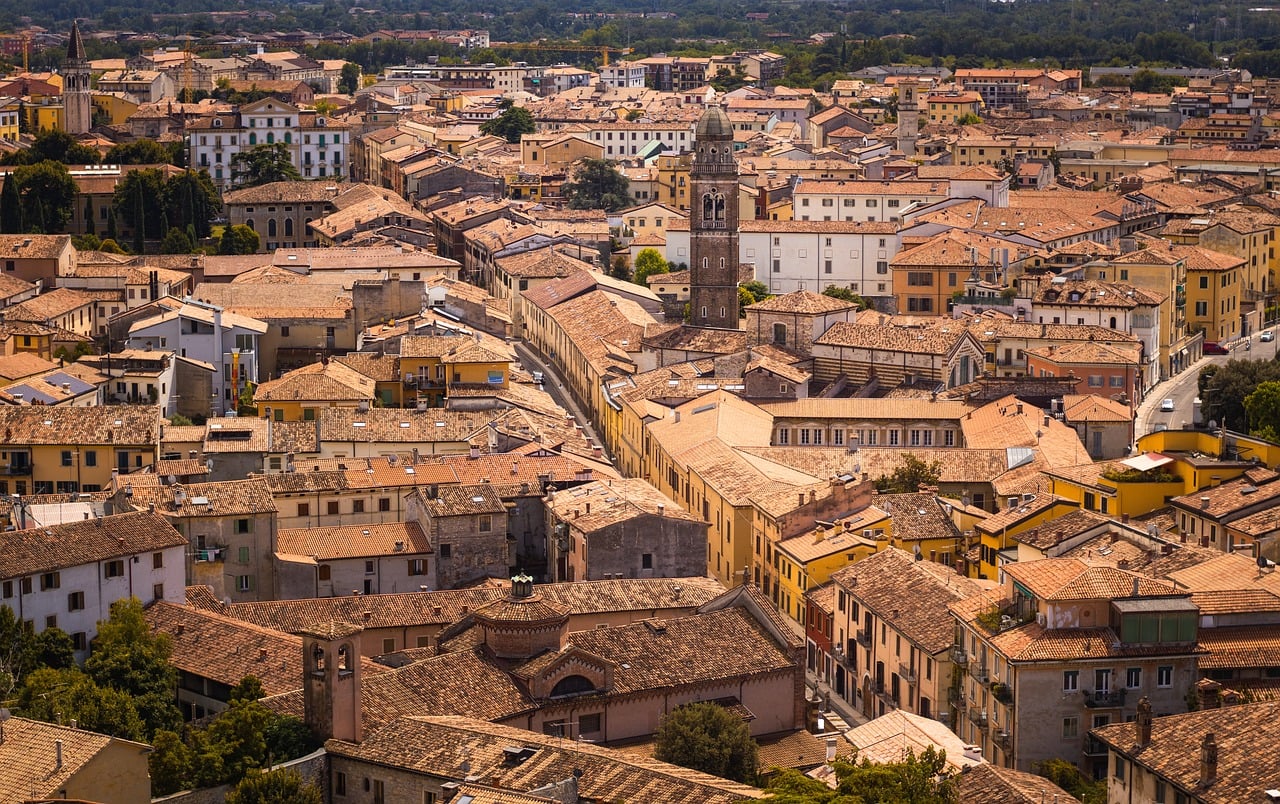
From Verona through the vineyard terraces of Valpolicella up to the rock bridge of Veja, across the upland pastures of Lessinia to the Cimbrian villages and back through Val d’Alpone and Soave: some 245 kilometres of hinterland that most people pass by on their way to Lake Garda.
The spirit of the route
Beyond Verona the plain tips into hills, and the hills carry vines right up to the house walls. In autumn the grapes for Amarone hang drying in the lofts of the wine estates, and the air smells of must and damp limestone. A few hairpins higher up stand cherry trees, then beeches, then nothing but pastures with dry-stone walls and stone-slab fences, malghe with wheels of cheese, and the view back over the haze of the Po Valley to the Apennines. In Giazza people still greet each other in Cimbrian; in Bolca, fish fifty million years old lie in the limestone. From the sliding door you see lakes of mist below you in the morning, and in the evening the castle of Soave above the Garganega pergolas. The roads are narrow, the stages short, and much only reveals itself when you stop: in a Romanesque pieve, at a rock bridge, in conversation in a wine cellar.
Stage-by-stage plan
1Stage 1: Verona to Negrar di Valpolicella (approx. 40 km)
- The drive
- From the Porta Palio aire take the ring road north, cross the Adige at Parona and follow the provincial road through the Valpolicella plain to Sant’Ambrogio. A short, steep village road leads up to San Giorgio and gets narrow in the village itself – park below. Back via San Pietro in Cariano to Fumane and across the hills to Negrar. Between the vineyards there are many narrow municipal roads with walls and oncoming tractors; about 1.5 hours’ driving time.
- Highlights & must-sees
- Pieve di San Giorgio: Romanesque church with a cloister and an early medieval ciborium bearing an inscription from the Lombard period; the village itself is a balcony over the Adige valley and the mountains around Lake Garda.
- Villa della Torre in Fumane: Renaissance villa with a peristyle and the famous fireplaces shaped like masks, now owned by the Allegrini winemaking family; visits by appointment only.
- Pieve di San Floriano near San Pietro in Cariano, one of the most beautiful Romanesque churches in Valpolicella, right by the road.
- CampingSpirit overnight tip
-
Official campsite or RV park: Valpolicella has hardly any public aires, but it does have wine estates with camper pitches for tasting guests. One example is Cantina Fratelli Vogadori in Negrar (Via Vigolo, about 1 km from the village): pitches with electricity and water, WC, but no grey-water or cassette disposal; one night, only in combination with a wine tasting, booking appreciated. If you want to be independent, drive back to Verona (just over 20 km).
Free camping or nature tip (where legal): Under Italian law, parking overnight is allowed wherever parking is allowed – but in the wine villages the car parks are small, often time-limited or closed to motorhomes. Farm tracks and access lanes between the rows of vines are private land belonging to the wine estates. Plan your night at a winery rather than at the roadside.
- Insider tip for campers
- In San Giorgio use the car park at the entrance to the village and walk the last few metres to the pieve. Phone or write ahead for wine tastings – many cellars are family businesses without a dedicated tasting room, and during the autumn harvest they have little time. If you taste Amarone, you don’t drive afterwards: Italy’s limit is 0.5 per mille, and 0.0 for drivers who have held their licence for less than three years.
2Stage 2: Negrar di Valpolicella to Bosco Chiesanuova (approx. 45 km)
- The drive
- From Negrar take the mountain road via Prun with its quarries up into western Lessinia to Sant’Anna d’Alfaedo; the road is paved throughout but narrow and winding, with gradients of around 10 % and a few tight hairpins. From Sant’Anna the landscape opens up: pastures, cherry orchards, dry-stone walls. Via Cerna and Erbezzo to Bosco Chiesanuova at a good 1,100 m. About 1.5 hours’ driving time.
- Highlights & must-sees
- Ponte di Veja: a massive natural rock bridge over a collapsed karst valley, with caves in which prehistoric finds have been made; a short footpath leads down from the car park beneath the arch.
- Museo Paleontologico e Preistorico in Sant’Anna d’Alfaedo, with fossils and finds from the caves of Lessinia.
- Stone-slab fences made of “Pietra di Prun”, the platy local limestone that shapes pastures, roofs and barns here.
- CampingSpirit overnight tip
-
Official campsite or RV park: Area sosta camper in Bosco Chiesanuova on Via Davide Menini, about 400 m from the centre: around 20 pitches on tarmac and grass. Facilities, fees and season vary; some directories list no water or waste disposal – fill up beforehand and check the current situation. Campsite nearby: Campeggio Branchetto north-east of Bosco in the woods, a larger site with a bar, small shop and wooden cabins; check opening times in advance.
Free camping or nature tip (where legal): Most of the plateau belongs to the Parco Naturale Regionale della Lessinia. Protection rules apply there, driving off the roads is prohibited, and camping behaviour outside campsites and aires is not an option; parking in public car parks is possible unless a municipal ordinance prohibits overnight parking. At Ponte di Veja you can park well during the day, but the car park at the inn is not meant for the night.
- Insider tip for campers
- The last bends to the car park at Ponte di Veja are tight – with large vehicles, arrive early at weekends. Fill up in Negrar or Sant’Anna: there are only a few petrol stations on the plateau, and prices are higher than on the plain.
3Stage 3: Bosco Chiesanuova to Velo Veronese (Camposilvano) (approx. 35 km)
- The drive
- A day on the plateau: from Bosco up to the San Giorgio winter sports area at around 1,500 m (dead-end road, narrow, large car park at the top) and back, then via Corbiolo and across the pastures east to the hamlet of Camposilvano near Velo Veronese. The roads are paved but often single-track with passing places; cattle being driven along the road are normal in summer. About 1 hour’s driving time; the rest is hiking and cheese.
- Highlights & must-sees
- Malghe around San Giorgio and Podestaria: in summer many alpine farms sell “Monte Veronese”, the cheese of Lessinia, straight from the farm.
- Covolo di Camposilvano: a deep karst chasm at the edge of the hamlet, plus the small geo-palaeontological museum.
- Valle delle Sfingi near Camposilvano: weathered limestone rocks in animal shapes on a pasture, a short walk.
- CampingSpirit overnight tip
-
Official campsite or RV park: Campeggio Camposilvano in the hamlet of the same name: a small, simple campsite. Season, facilities and space for large vehicles are not reliably documented – check by phone beforehand.
Free camping or nature tip (where legal): Under Veneto regional law, forest and pasture roads (strade silvo-pastorali) are closed to motor vehicles without a permit – even if your satnav offers them as a shortcut. Parking is allowed in the car parks at San Giorgio, camping behaviour is not; in winter separate rules apply there for the ski operations. Follow the signs on site.
- Insider tip for campers
- Don’t empty grey water onto alpine meadows: Lessinia is a karst area, and everything seeps straight into the groundwater from which the villages in the valley drink. In fog – frequent on the plateau – the narrow roads without centre lines are hard to read; better to stay put.
4Stage 4: Velo Veronese to Bolca (approx. 40 km)
- The drive
- From Velo down to Selva di Progno and up the narrow Illasi valley to Giazza, the last village below the Carega massif. Back down the valley to Badia Calavena and on small mountain roads over the hills into the uppermost Val d’Alpone to Bolca. Lots of bends, short steep ramps, narrow village through-roads; about 1.5 hours’ driving time.
- Highlights & must-sees
- Giazza: Cimbrian village with a small ethnographic museum on the language and culture of the Cimbrians, who came from the Bavarian region in the Middle Ages (usually open only on weekend afternoons); the dialect “Taucias Gareida” is still kept alive here.
- Hike from Giazza into the Valle di Revolto, the starting point for tours on the Carega.
- Museo dei Fossili in Bolca with fish, plants and insects from the Eocene, around 50 million years old, when a tropical sea lay here.
- CampingSpirit overnight tip
-
Official campsite or RV park: Small Area Camper on the edge of Bolca (municipality of Vestenanova). Facilities and fees are not reliably documented – plan water and disposal in advance and check the situation on site. Alternatively, the Area sosta camper in Selva di Progno, also simply equipped.
Free camping or nature tip (where legal): Outside the designated pitches the same applies here: parking yes, camping no. The car parks in Giazza are small and full of hikers on summer weekends; staying there overnight is frowned upon.
- Insider tip for campers
- The road to Giazza ends in the village and turning space is scarce – use the car park at the entrance to the village. For the Pesciara, the site where the fossil fish were found, with partly accessible tunnels, and the palaeontological trail past Monte Postale, ask at the museum about opening times and guided tours.
5Stage 5: Bolca to Soave (approx. 35 km)
- The drive
- Down the Val d’Alpone via Vestenanova, Roncà and Montecchia di Crosara: winding at first between chestnut woods and basalt knolls, then wider between vineyards. Via Monteforte d’Alpone to Soave. The village through-roads are narrow but manageable by motorhome throughout; about 1 hour’s driving time.
- Highlights & must-sees
- Lessini Durello vineyards around Montecchia di Crosara: the high-acid Durella grape, grown on volcanic soils, is made mainly into sparkling wine.
- Palazzo Vescovile in Monteforte d’Alpone, a former bishop’s residence from the 15th century in the middle of the village.
- Castello di Soave: the Scaliger castle on the hill above the town, linked to the almost completely preserved town wall – about 20 minutes on foot from the old town.
- CampingSpirit overnight tip
-
Official campsite or RV park: Area sosta camper Soave near the old town, with around 20 pitches; check water and waste disposal, fees and electricity beforehand. Further simple municipal aires are in Roncà and in Colognola ai Colli.
Free camping or nature tip (where legal): On the plain around Soave and San Bonifacio there are plenty of aires, so wild parking is unnecessary. The hill roads in the Soave Classico vineyards are narrow and have hardly any lay-bys – don’t park in field entrances.
- Insider tip for campers
- Don’t drive into Soave’s old town with a motorhome; the gates are narrow. If you want to experience the vineyards, walk from the town up into the hills around Monte Foscarino and Castelcerino. For cheaper fuel, use the large stations on the SR11 towards San Bonifacio.
6Stage 6: Soave to Verona (approx. 50 km)
- The drive
- Through the wine hills to Colognola ai Colli and into the Illasi valley: Illasi, Tregnago and back, then via Lavagno and San Martino Buon Albergo to Verona. Well-built provincial roads, with fairly busy traffic in the valley in places; when entering Verona watch for the ZTL signs and drive straight to the aire. About 1.5 hours’ driving time.
- Highlights & must-sees
- Castello di Illasi: castle ruin with a tall keep above the village, and below it the Villa Carlotti and Villa Perez Pompei Sagramoso with a large park.
- Wine cellars in the Illasi valley, which belongs to the eastern Valpolicella zone – Amarone and Recioto are made here on limestone and marl.
- Verona on foot: from the Porta Palio aire via Castelvecchio and the Scaliger bridge to the Arena and Piazza delle Erbe.
- CampingSpirit overnight tip
-
Official campsite or RV park: Area Camper “Porta Palio” run by the municipal parking company AMT3 on Via Dalla Bona, for motorhomes only (no caravans), open year-round, 24 hours: drinking water and waste disposal, payment at the machine or by QR code; a daily flat rate includes water and disposal, and if you only fill up and empty you pay a lower fee. No reservations. Campsite alternative: Camping Castel San Pietro on the hill above the old town – open only roughly from spring to the end of September, narrow access and pitches, vehicles up to about 7 m according to directories, enquire in advance.
Free camping or nature tip (where legal): Verona enforces parking strictly in the city; spending the night in a motorhome in ordinary car parks is not generally prohibited, but near the old town it is effectively impossible. Outside the city: Area sosta camper in San Martino Buon Albergo, about 8 km east; check bus connections into the city in advance.
- Insider tip for campers
- The old town is a camera-monitored ZTL – if you drive in by mistake, the fine is sent to you abroad via a registered-keeper lookup. Set your satnav to the aire, not to “Arena”. From Porta Palio it is about 15 minutes on foot to Castelvecchio.
Camping practice & local rules
Wild camping & overnight parking
- In the Codice della Strada (Art. 185) Italy distinguishes between parking (“sosta”) and camping (“campeggio”): motorhomes may park and sleep inside wherever parking is allowed – without chairs, awning, legs, levelling chocks or water running out.
- Municipalities can restrict motorhome parking by ordinance; signs showing a crossed-out camper are binding. In Verona and the wine villages of Valpolicella space is tight and checked.
- In the Parco Naturale Regionale della Lessinia driving off the roads is prohibited; in the Veneto, forest and pasture roads (strade silvo-pastorali) are closed to motor vehicles without a permit under regional law. Spend the night at campsites and aires.
- You can stay overnight legally at campsites, in the municipal “aree di sosta camper” and at wine estates or agriturismi with camper pitches (often for customers only). Apps and directories: park4night, CamperOnline, Campercontact, plus networks such as AgriCamper Italia.
Waste disposal & supplies
- Water and waste disposal is called “camper service” or “carico e scarico”. There are reliable stations in Verona (Porta Palio) and on the plain; on the Lessinia plateau they are rare – drive up with full water and an empty cassette.
- Lessinia is a karst area: empty grey water and toilet contents only at service points, never onto meadows or into drains.
- Tap water in the municipalities is drinking water; at fountains and alpine farms look for “acqua potabile” or “non potabile”.
- Gas: German exchange cylinders are not swapped, and Italian cylinders have different connections. Have refillable cylinders and gas tanks filled at GPL stations using the Italian adapter – often only the staff do the filling. GPL stations are mainly on the plain around Verona and San Bonifacio.
Vehicle size & traffic rules
- Speed limits: motorhomes up to 3.5 t 90 km/h outside built-up areas, 110 km/h on expressways, 130 km/h on motorways; over 3.5 t 80 km/h outside built-up areas, 100 km/h on motorways. Vehicle-trailer combinations: 70 km/h outside built-up areas, 80 km/h on motorways. Dipped headlights outside built-up areas, also during the day.
- Tolls on the A4 (exits Verona Est and Soave) and A22 (Verona Nord) are based on axles and height at the front axle: vehicles up to 1.30 m in class A, most two-axle motorhomes in class B; with a trailer a higher class applies. Payment in cash, by card or via Telepass or an EU toll box.
- ZTL: Verona’s old town is a camera-monitored limited traffic zone, and fines arrive by post. In addition, in Verona and other municipalities of the Po Valley, driving bans for older vehicles, especially diesels, apply in the winter half-year under the regional clean-air agreement – check your Euro class in advance.
- Winter equipment: on all provincial roads in the Province of Verona, an annual provincial ordinance requires winter tyres or chains from 15 November to 15 April, and many municipalities follow suit for their roads; snow and ice are regular from Bosco Chiesanuova upwards.
- If a load projects beyond the rear, such as bikes on a rear rack, the red-and-white warning panel (50 × 50 cm) is compulsory. Blood alcohol limit 0.5, 0.0 for new and professional drivers; phones at the wheel only with a hands-free system.
CampingSpirit packing & preparation checklist
- Collapsible water container (10–20 l) for fresh water: reliable water points are lacking on the Lessinia plateau and in Bolca.
- Wine-box holder or non-slip crates: otherwise bottles from the winery won’t survive the hairpins to Bosco.
- Italian GPL adapter, plus two full cylinders when you arrive.
- Warm layer and rain jacket: at 1,500 m it is cool in the evenings even in summer, and fog often rises quickly from the plain.
- Hiking shoes with a good tread for the paths to Ponte di Veja, into the Valle di Revolto and up to the castle of Soave.
- Red-and-white warning panel for the rear rack to Italian specifications.
As of 2026-10. Closures, fees and booking rules change: check official sources before you go.