





In-depth guide · CampingSpirit
From the edge of Postojna below Nanos into the wind-whipped Vipava Valley, via Štanjel and Nova Gorica into the cherry and wine hills of the Brda and up the Soča to Tolmin: around 270 kilometres of wine country, karst villages and border history.
The spirit of the route
Beyond Razdrto the landscape tips over: one moment cool karst forest, the next the view drops from the Nanos escarpment onto a broad, bright valley full of vine rows, cypresses and villages with stone roofs. Down here Slovenia already feels Mediterranean, until the bora arrives – then the wind whistles cold and dry down from Nanos, poplars bend, and stones lie on the roofs against the storm. From the sliding door you see wine cellars in Goče, the walls of the Roman fort in Ajdovščina and, in the evening, the karst village of Štanjel in the last of the light. In Nova Gorica you stand with one foot in Italy; in the Brda the camper rolls along hill ridges where cherries ripen in June and Rebula in autumn. At the end, the Soča rushes beneath the stone arch of Solkan, turquoise and cold – a route for short stages, long evenings at the winery and a watchful eye on the wind warning.
Stage-by-stage plan
1Stage 1: Postojna (edge of town) to Vipava (with a detour up Nanos) (approx. 45 km)
- The drive
- From Postojna on the country road, or briefly on the A1, to Razdrto at the foot of Nanos. Here the Vipava expressway H4 branches off (vignette required, as on the motorway); vignette-free and more scenic is the old road via Podnanos, which drops in hairpins from the karst threshold into the valley. Just before Podnanos a narrow, steep mountain road branches off up to the Nanos plateau: asphalt as far as the edge of the plateau, then gravel to the Vojkova koča, with hardly any passing places – not recommended for motorhomes or car-and-caravan combinations. Better on foot from Razdrto (a good two hours' climb) or by e-bike. Without the detour, a good half-hour's driving.
- Highlights & must-sees
- Nanos plateau: a karst upland with beech forest and mountain meadows; from the edge of the escarpment the view stretches across the whole Vipava Valley to the Gulf of Trieste; stop for a meal at the Vojkova koča mountain hut.
- Sources of the Vipava in the centre of Vipava: the river emerges from numerous karst springs at the foot of Nanos, and small bridges and stone banks invite an evening stroll.
- Vipava itself, with the Lanthieri manor house and the cellars of the Vinarska klet, where you can taste Zelen and Pinela, the valley's indigenous white wines.
- CampingSpirit overnight tip
-
Official campsite or RV park: If you start in Postojna, use the municipal motorhome aire (PZA Postojna) or Kamp Pivka jama in the forest north of town. In the Vipava Valley, about 2 km from Vipava in Gradišče pri Vipavi, Kamp Tura lies below a climbing wall: open all year, around ten pitches for motorhomes and caravans, water and waste disposal; the access road is paved but steep. North of Vipava, the small Kamp Vrhpolje offers pitches in a farm garden. Check facilities and season with the operator in advance.
Free camping or nature tip (where legal): Wild camping is banned throughout Slovenia outside campsites and designated motorhome aires. The hikers' car parks on Nanos and the viewpoint lay-bys on the Podnanos road are for day parking – however tempting the sunset, no overnight stays.
- Insider tip for campers
- Fill up with water and fuel in Postojna before setting off. The stretch between Razdrto and Vipava is the country's best-known bora corridor: when a storm warning is issued, the H4 between the Nanos junction and Selo and the regional road Razdrto–Podnanos–Vipava are regularly closed to car-and-caravan combinations, refrigerated vehicles and vehicles with tarpaulins, and in stronger bora to other vehicle types as well. Motorhomes are not specifically named in these closures, but that is no free pass: the risk from crosswinds is high, and with a caravan in tow the closure applies anyway – check warnings on promet.si and with the weather agency ARSO, and if in doubt wait a day.
2Stage 2: Vipava to Ajdovščina (via Goče and Vrhpolje) (approx. 30 km)
- The drive
- From Vipava on narrow back roads through the vineyard slopes on the southern edge of the valley to Goče; the village lanes themselves are too narrow for large vehicles, so park on the edge of the village. Back into the valley and along its northern edge via Vrhpolje to Ajdovščina. Flat to gently hilly terrain, a relaxed stage of about an hour's pure driving time.
- Highlights & must-sees
- Goče: a listed wine village with stone houses, archways, external staircases and numerous vaulted cellars; when the cellar doors are open, a tasting with the winemaking families is worthwhile.
- Vrhpolje: a village on the Bela stream, long regarded as the site of the Battle of the Frigidus in 394, in which Emperor Theodosius defeated the usurper Eugenius; more recent research places the battlefield a few kilometres away, between Col and Sanabor.
- Ajdovščina: remains of the late Roman fort of Castra with surviving round towers in the middle of the old town, plus the Hubelj karst spring on the edge of town.
- CampingSpirit overnight tip
-
Official campsite or RV park: Avtokamp Ajdovščina on the edge of town, run by the municipal sports centre and open only in summer (roughly June to mid-September), with access to the outdoor pool. Usable all year is the motorhome aire PZA Ajdovščina near the expressway and the centre, with around 13 pitches and water and waste disposal. Alternatively, head back to Kamp Vrhpolje. Along the way, individual wineries in the valley offer pitches for a few motorhomes – check what's available on avtokampi.si or Campercontact and phone ahead.
Free camping or nature tip (where legal): Vineyards and farm tracks are private land; staying overnight there is forbidden and impolite to the winemakers. No night in the vehicle at the Hubelj spring or by the fort either.
- Insider tip for campers
- Ajdovščina is considered one of the windiest places in Slovenia. When the bora blows, retract the awning, secure roof boxes and bike covers, and park the vehicle facing into the wind. You'll find supermarkets and filling stations in Ajdovščina, easy to reach on the edge of town – cheaper than in the villages.
3Stage 3: Ajdovščina to Nova Gorica (via Vipavski Križ and Štanjel) (approx. 60 km)
- The drive
- West to the hill village of Vipavski Križ, then through the lower Vipava Valley via Dornberk to Branik. There the road branches off onto the karst plateau and climbs in bends to Štanjel – well built, but narrow in the villages. Back via Branik into the valley and along the valley road to Nova Gorica. Around 1.5 hours' pure driving time; if you're in a hurry, take the H4 from Ajdovščina (vignette).
- Highlights & must-sees
- Vipavski Križ: a walled little town on a hill with a Capuchin monastery and castle ruins, looking across the valley to Nanos.
- Štanjel: a karst village on a ridge with a castle, a church tower with a lemon-shaped cap and narrow stone lanes; on foot from the car park on the edge of the village.
- Ferrari Garden in Štanjel: a terraced garden by the architect Max Fabiani with a pond, bridge and pavilion, built into the slope below the village walls.
- CampingSpirit overnight tip
-
Official campsite or RV park: Kamp Park Lijak in Ozeljan, around 8 km east of Nova Gorica at the foot of the paragliding mountain Lijak: electricity, sanitary facilities, water and waste disposal, with many paragliders among the guests. Closer to town is the motorhome aire PZA Vrtojba in Šempeter-Vrtojba: eight pitches with electricity, water and waste disposal, open all year. On the way, the Saksida winery in Zalošče near Dornberk has a campsite with terraced pitches among the vines and a pool. Check seasons with all of them in advance.
Free camping or nature tip (where legal): The nationwide ban applies around Štanjel and in the karst too. The car park below Štanjel is a visitor car park, not an aire.
- Insider tip for campers
- Don't drive into the lanes of Štanjel and Vipavski Križ: the archways and walls weren't built for motorhomes. On the edge of the karst, buy Teran and karst ham directly from the farms. Fill and empty tanks preferably at PZA Vrtojba or at a campsite – in the karst, any grey water seeps straight into the groundwater.
4Stage 4: Nova Gorica to Nova Gorica (Kostanjevica and Sveta Gora) (approx. 30 km)
- The drive
- A day around town: short hops to the railway station and to Kostanjevica Monastery on the hill on the southern edge, then via Solkan up the narrow mountain road in hairpins to Sveta Gora (around 680 m). The climb is doable for compact motorhomes but tight with large vehicles – allow for oncoming traffic and buses. Alternatively, walk up the pilgrims' path from Solkan.
- Highlights & must-sees
- Station square (Trg Evrope / Piazza Transalpina): a fenced border once ran through the square in front of the Bohinj Railway station; today a mosaic marks the line, and you can stroll back and forth between Nova Gorica and Gorizia. Since the two towns' joint year as European Capital of Culture, the square has been a place for events and encounters.
- Kostanjevica Monastery: a Franciscan monastery with the crypt of the last French Bourbons, including King Charles X, a historic library and a well-known collection of Bourbon roses that bloom in May.
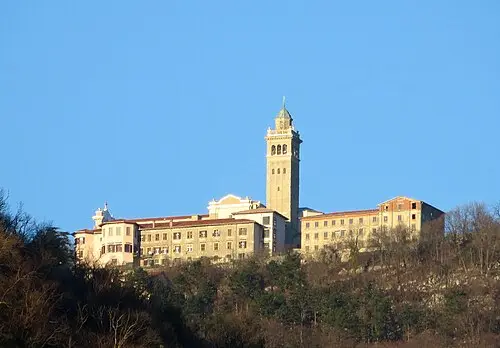
- Sveta Gora: a pilgrimage basilica on the summit, destroyed in the First World War in the middle of the Isonzo Front and rebuilt; on clear days the view takes in the Soča Valley and the Friulian Plain as far as the Adriatic and the Julian Alps.
- CampingSpirit overnight tip
-
Official campsite or RV park: Second night at Kamp Park Lijak or PZA Vrtojba – both are good bases; the town is best explored by bike or city bus.
Free camping or nature tip (where legal): Parking is allowed in the car parks at Sveta Gora and at the station, overnight stays are not. On the Italian side in Gorizia, Italian and local rules apply; as a day trip on foot, crossing the border is easiest anyway.
- Insider tip for campers
- The border with Italy is open (Schengen), but spot checks are still possible – carry ID. Fuel up cheaply in Nova Gorica: Italians come over to fill up, so there are plenty of filling stations on the border roads. Multi-storey car parks in the town centre have height restrictions; with the camper, use car parks on the edge of town.
5Stage 5: Nova Gorica to Goriška Brda (Šmartno, Dobrovo, Medana) (approx. 40 km)
- The drive
- Via Solkan and the bank of the Soča, then up into the Brda at Podsabotin. The roads run along the hill ridges and are well surfaced but often narrow, with blind bends and walls and vine rows right beside the carriageway. Circuit Šmartno – Gonjače – Dobrovo – Medana and back to Podsabotin, about 1.5 hours' driving. The border with Italy runs right through the hills; this route deliberately leaves out the Collio side.
- Highlights & must-sees
- Šmartno: a fortified village on a hill ridge with a ring wall, defensive towers and stone houses; park below the walls.
- Gonjače lookout tower: a tower with a memorial to 315 victims of the Second World War, climbed by stairs; at the top, a panoramic view over the Brda and, on clear days, from the Julian Alps to the Adriatic.
- Dobrovo Castle with the gallery of the painter Zoran Mušič, a wine cellar with Brda wines and a restaurant, plus Medana, birthplace of the poet Alojz Gradnik, with wineries in the village centre.
- CampingSpirit overnight tip
-
Official campsite or RV park: Kamp Brda in Podsabotin, at the entrance to the Brda: explicitly designed for motorhomes, around a dozen pitches on grass and paving, electricity, water and waste disposal, sanitary facilities, pool, plus a restaurant and wine tasting on site. It lies on a busy road, so expect some traffic noise; arrive around midday, when the choice is greater. According to Campercontact, open roughly April to November; check opening times with the site in advance.
Free camping or nature tip (where legal): In the Brda, vineyards, field and farm tracks are private land; staying overnight outside the campsite or at wineries without explicit permission is forbidden. The car parks at Šmartno and at the Gonjače tower are for visitors only.
- Insider tip for campers
- The best months are June (cherries) and September to October (harvest, with St Martin's celebrations in November). But harvest time also means tractors with trailers on the narrow roads – drive slowly and wait at passing places. Buy wine and olive oil directly from the winemaker and ask there about places to stay overnight: some wineries allow guests a night.
6Stage 6: Goriška Brda to Tolmin (via Solkan, Kanal and Most na Soči) (approx. 65 km)
- The drive
- Back to Solkan and north along the valley road beside the Soča: the valley narrows, and the road follows the river in long bends, with a few narrow sections and tunnels of the parallel Bohinj Railway. Via Kanal ob Soči to Most na Soči on the reservoir, then a few kilometres to Tolmin. Around 1.5 hours' driving.
- Highlights & must-sees
- Solkan Bridge: a railway bridge on the Bohinj Railway with one of the largest stone arches in the world (85 m span); best seen from the bank of the Soča and from the cycle path under the bridge, where kayakers set off.
- Kanal ob Soči: a little town on a rock above the Soča with the stone bridge from which young men have jumped into the river in a summer competition for generations – watching, yes; copying, better not.
- Most na Soči: an emerald-green reservoir at the confluence of the Soča and Idrijca, with a lakeside path and boat trips; then in Tolmin a short visit to the Tolminska korita gorges, described in detail in the CampingSpirit travel guide to the Julian Alps, Soča Valley and Karst.
- CampingSpirit overnight tip
-
Official campsite or RV park: In Tolmin, the municipal motorhome aire PZA Skrin with water and waste disposal, plus Kamp Siber and Kamp Labrca at the confluence of the Soča and Tolminka. Around Most na Soči there are small tent and glamping sites; ask in advance whether motorhomes are welcome.
Free camping or nature tip (where legal): Wild camping is banned on the lower Soča too; checks focus on bathing spots and kayak put-ins. Gravel banks and riverside meadows are not pitches.
- Insider tip for campers
- The Soča valley road is popular with cyclists and motorbike groups in summer – be patient at the narrow sections. In Kanal and Most na Soči the car parks are small; with large vehicles, stop on the edge of town. For the upper Soča Valley with Kobarid, Bovec and the Vršič, the Idrija Valley or the Škocjan Caves and the Lipica stud farm, see the CampingSpirit travel guide to the Julian Alps, Soča Valley and Karst.
Camping practice & local rules
Wild camping & overnight parking
- Wild camping and sleeping in your vehicle outside campsites and designated motorhome aires (postajališče za avtodome, PZA) is banned in Slovenia. Since a new law on the protection of public order in December 2025, municipalities have more leeway on fines; in the Julian Alps up to €500 per person is possible – in the municipalities of the Vipava Valley and the Brda, ask locally.
- Vineyards, farm tracks and farmyards are private land. Some wineries in the Vipava Valley and the Brda offer pitches for a few motorhomes – that is legal if the site is listed as an aire or the winemaker gives explicit consent.
- Nanos and the edge of the karst are part of Natura 2000 areas; fires and camping are off-limits there. The banks of the Soča are also checked during the season.
- You'll find legal options on avtokampi.si (the official Slovenian directory of campsites and PZA), park4night and Campercontact. On the Italian side, in Gorizia, Italian rules apply.
Waste disposal & supplies
- Water and waste disposal are available at the PZA in Postojna, Ajdovščina, Vrtojba and Tolmin and at the campsites; simple winery pitches often have only water and electricity. Never empty grey water into drains, streams or karst fissures: in the karst and on Nanos, waste water goes straight into the springs from which the Vipava Valley drinks.
- Tap water in Slovenia is safe to drink; the karst springs of Vipava and Hubelj supply the valley's water.
- Gas: German exchange cylinders are not swapped. Autogas (avtoplin, LPG) is available at many larger filling stations, for example on the main roads near Ajdovščina and Nova Gorica; bring an adapter set for refillable cylinders and check the connection type beforehand. Arrive with two full cylinders.
- Fuel is usually cheaper in Slovenia than in Italy – fill up in Nova Gorica before a trip across the border.
Vehicle size & traffic rules
- Tolls: vehicles up to 3.5 t need the electronic vignette (E-Vinjeta, linked to the number plate; buy only through official channels such as evinjeta.dars.si) on motorways and expressways. This also applies to the Vipava expressway H4 between Razdrto and Vrtojba; the parallel country roads via Podnanos, Ajdovščina and Dornberk are vignette-free. According to ADAC, motorhomes up to 3.5 t with fixed living equipment, registered as motorhomes in the vehicle documents, travel in class 2A; tall vans without motorhome registration fall into the more expensive class 2B. Check the tariff in advance; driving without a vignette risks fines of €300 to €800.
- Vehicles over 3.5 t pay distance-based tolls instead of a vignette via the DarsGo system with a DarsGo box on the windscreen; register and get the box before your first motorway journey.
- Speed limits for cars and motorhomes up to 3.5 t: 50 in built-up areas, 90 outside, 110 on expressways, 130 km/h on motorways. Car-and-caravan combinations up to 3.5 t: 90 outside built-up areas, 100 km/h on expressways and motorways. Motorhomes and combinations over 3.5 t: 80 km/h outside built-up areas, on expressways and motorways (source: ÖAMTC).
- Bora: in strong gusts in the Vipava Valley (often over 100 km/h, considerably more in extreme conditions), the H4 between Nanos and Selo and the country roads between Razdrto, Vipava and Ajdovščina are closed to car-and-caravan combinations, tarpaulin-covered and refrigerated vehicles, and in stronger bora to other vehicle types as well; motorhomes are not specifically named. At times the A1 between Kastelec and Kozina is closed completely. Current closures on promet.si, warning levels from ARSO (meteo.si). Tall, empty motorhomes and panel vans are also highly at risk.
- Dipped headlights are compulsory during the day too. Winter equipment is mandatory from 15 November to 15 March (winter tyres, or summer tyres with chains carried); Nanos and Sveta Gora can be icy in winter. Keep a hi-vis vest within reach for every occupant.
- Alcohol: 0.5 per mille; 0.0 for drivers under 21, newly qualified drivers (less than 2 years) and professional drivers – so plan cellar tastings carefully and only taste once you're at your pitch. Phones only with a hands-free kit.
CampingSpirit packing & preparation checklist
- Extra guy ropes and storm straps for the awning and bike cover: in the Vipava Valley the bora tears off anything unsecured, and awnings should be fully retracted whenever there's a warning.
- A windproof, warm jacket even in spring and autumn: in a bora the wind-chill temperature drops by many degrees despite the sunshine.
- Folding bike or e-bike: between Nova Gorica, Solkan and Gorizia and in the Brda wine villages, getting around without the motorhome is far more relaxed.
- A wine box with dividers and non-slip storage crates: tastings in Goče, Vipava and Dobrovo rarely end empty-handed, and the hill roads are twisty.
- ID card or passport for spontaneous trips across the open border to Gorizia.
- Water shoes for the Soča pebbles at Solkan and Most na Soči: the water stays cool even in summer, and the stones are slippery.
As of 2026-10. Closures, fees and booking rules change: check official sources before you go.