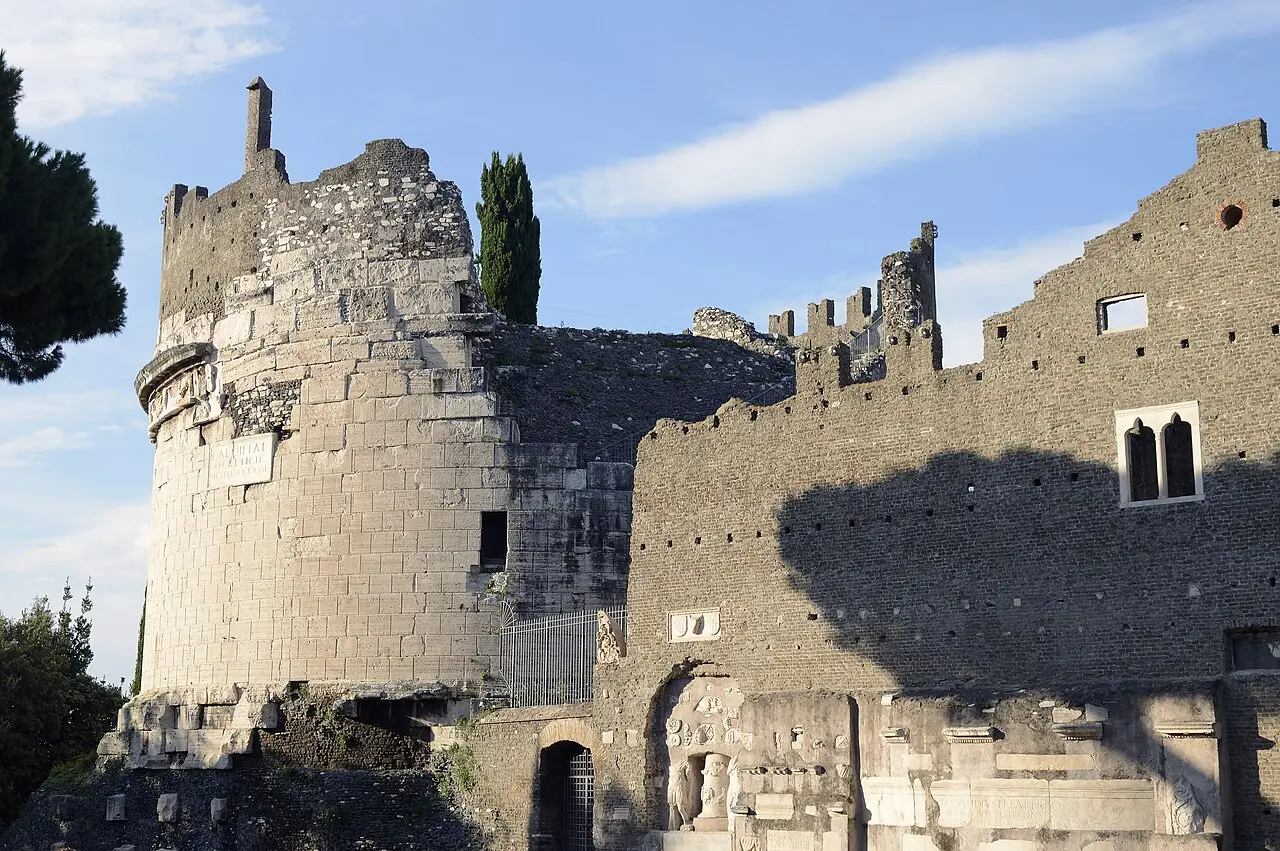
Tomb of Caecilia Metella, Appian Way
Rome, Italy
A round Roman tomb from the first century BC on the Via Appia Antica, later built into a castle. South of it the ancient paving runs between pines and ruins; it is best walked or cycled, as cars share a narrow lane.
The mausoleum of Caecilia Metella on the Via Appia Antica dates from the Augustan period, roughly between 30 and 10 BC. Caecilia Metella was the daughter of the consul Quintus Caecilius Metellus and probably the daughter-in-law of Licinius Crassus. A cylinder about 11 m high, clad in travertine, rises from a square base, topped by a marble frieze of garlands and ox skulls (bucrania). These gave the area its name, "Capo di Bove".
In the early 14th century the Caetani family incorporated the tomb as the main tower of their fortification, the Castrum Caetani; the Ghibelline battlements date from this conversion. The associated church of San Nicola a Capo di Bove is regarded as the only evidence of Cistercian Gothic at this spot. In the Caetani palace the Museum of the Via Appia displays statues, sarcophagi and inscriptions from tombs in the area. The burial chamber is about 6.5 m across and open to the sky through an oculus.
A little further along the Via Appia Antica (no. 222) lies the Capo di Bove site, with mosaics and the remains of a Roman villa with a bath complex, discovered when a swimming pool was being dug. Allow about one to two hours for the mausoleum and museum; if you then follow the Via Appia, you will need considerably longer.
- Nearest town
- Rome, Italy
- Category
- History & culture
- GPS
- 41.8522, 12.5210
Hours, fees and access change. Confirm with the operator or park before you go.
Good to know
Best time to go
The most pleasant months are usually April–May and September–October. Still fine, with some compromises, in March, June and November. (Estimate from long-term temperature averages, terrain and pass seasons)
Getting there
- Italy: Motorway tolls. Tolls on most autostrade; pay at the barrier by card or cash. Motorway limit for cars: 130 km/h.
Sources
Featured in these trip guides


Nearby









Campsites nearby
- Area Sosta Camper RomaeMotorhome stopover2 km from Tomb of Caecilia Metella, Appian Way · 35 pitchesMotorhomesElectricityDrinking waterShowersToiletsWaste disposalDogs allowedWi-Fi
- LGPMotorhome stopover4 km from Tomb of Caecilia Metella, Appian WayMotorhomesElectricityShowersToiletsWaste disposalDogs allowedWi-Fi
- Village FlaminioCampsite12 km from Tomb of Caecilia Metella, Appian WayTentsCaravansMotorhomesElectricityDrinking waterShowersToiletsWaste disposalDogs allowedWi-Fi
- Fabulous VillageCampsite13 km from Tomb of Caecilia Metella, Appian WayTentsCaravansMotorhomesElectricityDrinking waterShowersToiletsDogs allowedWi-Fi
- Area sosta Mira Lago Roma EstMotorhome stopover16 km from Tomb of Caecilia Metella, Appian WayMotorhomesElectricityShowersToiletsWaste disposalDogs allowedWi-Fi
- Seven HillsCampsite18 km from Tomb of Caecilia Metella, Appian WayTentsCaravansMotorhomesElectricityShowersToilets
All campsites in Italy · Campsite data: © OpenStreetMap contributors, ODbL 1.0 · Updated October 3, 2026
FAQs
Where is Tomb of Caecilia Metella, Appian Way?
Tomb of Caecilia Metella, Appian Way is in Rome, Italy, at GPS 41.8522, 12.5210. It is about 16 km from Castel Gandolfo.
Can you camp near Tomb of Caecilia Metella, Appian Way?
Yes. The nearest campsite listed in OpenStreetMap is Area Sosta Camper Romae, about 2 km away; within 25 km there are 20 campsites and motorhome stopovers.
Which road trips pass Tomb of Caecilia Metella, Appian Way?
Tomb of Caecilia Metella, Appian Way is a stop on these CampingSpirit trip guides: Appian Way, Tivoli and the Castelli Romani.
What is there to see near Tomb of Caecilia Metella, Appian Way?
Places worth a stop nearby: Colosseo (5 km), Hadrian’s Villa (23 km), Villa d’Este (26 km) and Garden of Ninfa (46 km).
When is the best time to visit Tomb of Caecilia Metella, Appian Way?
The most pleasant months are usually April–May and September–October. Still fine, with some compromises, in March, June and November. (Estimate from long-term temperature averages, terrain and pass seasons)