



In-depth guide · CampingSpirit
From Krefeld via Xanten, Wesel, Kalkar, Kleve and Emmerich to Kevelaer and back: 320 kilometres through Rhine floodplains, the Reichswald and brick-built towns, where the Rhine bridges set the pace.
The spirit of the route
The Lower Rhine is flat, and that is exactly what makes it so good to drive. The horizon belongs to the clouds, with rows of poplars, pollarded willows and windmills in between, and behind every dike lies the river, wide and unhurried on its way to the sea. From your sliding door you will see barges, meadows full of geese and, in autumn, mist over the floodplains. In Xanten you stand on Roman ground, in Kalkar in front of late Gothic altarpieces, in Kleve beneath the Schwanenburg, which is linked to the Lohengrin legend. The Reichswald brings shade and hills, Kevelaer the stillness of a pilgrimage town. The route asks for no hairpin bends, but for patience at bridges and in town centres, and for a willingness to cycle more than you drive.
Stage-by-stage plan
1Stage 1: Krefeld to Xanten (approx. 55 km)
- The drive
- From Krefeld-Linn via Moers and Rheinberg to Xanten, mostly on federal and country roads; the A57 and A42 are faster but full of lorries. The route is flat and the town centres are mostly straightforward, although Moers and Rheinberg have 30 km/h sections and pedestrian crossing aids. About 1.5 hours of pure driving time.
- Highlights & must-sees
- Burg Linn in Krefeld-Linn: a moated castle in a park, best visited in the morning before the day-trip traffic; the Deutsches Textilmuseum is in the same district.
- Moers: Schlosspark and old town with the Grafschafter Museum in the castle, good for a short walk.
- Xanten on arrival: market square, Dom St. Viktor and the Klever Tor, before the day visitors arrive.
- CampingSpirit overnight tip
-
Official campsite or RV park: WomoPark Xanten on the edge of town: a large motorhome area with electricity, fresh water and waste disposal, decent for several nights. Alternatives are Waldcamping Speetenkath and other campsites around Xanten. Book early at weekends and during school holidays.
Free camping or nature tip (where legal): Wild overnighting outside designated sites is not provided for on the Lower Rhine; parking to restore fitness to drive is permitted. Along the Rhine bank and at the gravel-pit lakes, night parking bans apply in many places – heed the signs and the signage of the nature reserves.
- Insider tip for campers
- In Krefeld-Linn you can stop briefly at the Reisemobilstellplatz Linn while you visit the castle and the textile museum; the municipal site is small. In Xanten you can fill up and empty at the WomoPark.
2Stage 2: Xanten to Wesel (approx. 35 km)
- The drive
- From Xanten on country roads along the Rhine to the Rhine bridge at Wesel (B58), which takes you to the right bank, then on into Wesel town centre. The ferry between Xanten and Bislich is a passenger ferry and does not take motorhomes; the bridge is your way across. Around 45 minutes of driving.
- Highlights & must-sees
- LVR-Archäologischer Park Xanten with the LVR-RömerMuseum: reconstructed harbour temple, amphitheatre, inn and baths on the site of the Roman Colonia Ulpia Traiana; half a day to a full day.
- Passenger ferry Bislich–Xanten (Keer Tröch II): run by the Heimatverein Bislich, for pedestrians, cyclists and motorbikes, seasonal and only on certain weekdays; a lovely bike trip from your pitch, so ask about sailing times beforehand.
- Bislicher Insel: floodplain landscape with walking trails, observation points and resting places for waterfowl.
- CampingSpirit overnight tip
-
Official campsite or RV park: Camping Grav-Insel in Wesel, on a Rhine island close to the town centre, with its own motorhome area. There is also the Reisemobilstellplatz Römerwardt at the Rheinbad within the town; check facilities and prices before you set off. In Xanten you can also stay another day at the WomoPark.
Free camping or nature tip (where legal): On the dikes and in the Rhine floodplains, parking and overnighting are prohibited in many places; you must not drive into nature reserves such as the Bislicher Insel. Camping in the floodplain woodland is an administrative offence.
- Insider tip for campers
- You should visit the Archäologischer Park early in the day; from the WomoPark Xanten it is easy to reach by bike or on foot. The passenger ferry to Bislich is worth it as a bike trip, not as part of the motorhome route.
3Stage 3: Wesel to Kalkar (approx. 45 km)
- The drive
- From Wesel on the right bank of the Rhine downstream to Rees, then over the Rhine bridge at Rees (B67) to the left bank and on country roads to Kalkar. All flat; the Rhine bridges can be slow at rush hour. Pure driving time a good hour.
- Highlights & must-sees
- Wesel: the Citadel with the Prussia Museum, the Berliner Tor and the Willibrordi-Dom, plus the Rhine promenade.
- Rees: Rhine promenade with a view of the Rhine bridge and the shipping, ideal for a coffee break.
- Kalkar: late Gothic town hall on the market square, St. Nicolai with the carved altarpieces of the Kalkar school, and the windmill.
- CampingSpirit overnight tip
-
Official campsite or RV park: Reisemobilstellplatz on the Ebentalstraße in Rees: a municipal site with fresh water and waste disposal, close to the Rhine promenade. Ferien- und Campingpark Wisseler See in Kalkar-Wissel: a bathing lake with campsite and motorhome pitches, check the opening times beforehand. In Uedem there is the Wohnmobilpark Uedem as a quieter, simple alternative.
Free camping or nature tip (where legal): You should not stay overnight in the car parks by the dike or on the Rees Rhine promenade; use the designated site in Rees. Heed the signs.
- Insider tip for campers
- You should visit Kalkar on a weekday, when the church is open: the altarpieces and the choir stalls are the real reason to come. Parking spaces for motorhomes in the town centre are scarce; park on the edge of the old town and watch for signs and height restrictions.
4Stage 4: Kalkar to Kleve (approx. 25 km)
- The drive
- From Kalkar via Appeldorn and Bedburg-Hau to Kleve, short, flat country roads through pastures, rows of poplars and brick villages; only in Kleve itself are the slopes at the Schwanenburg steep and narrow. Pure driving time under an hour.
- Highlights & must-sees
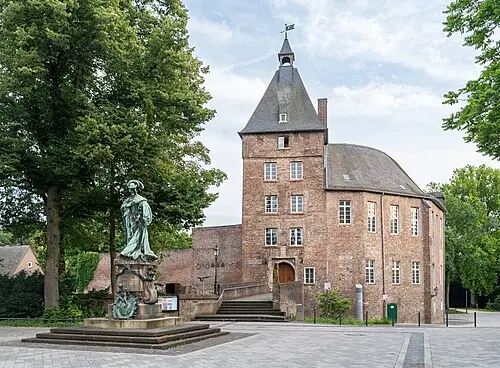
- Schloss Moyland in Bedburg-Hau: a moated castle with a museum of modern art and a park, focusing on Joseph Beuys.
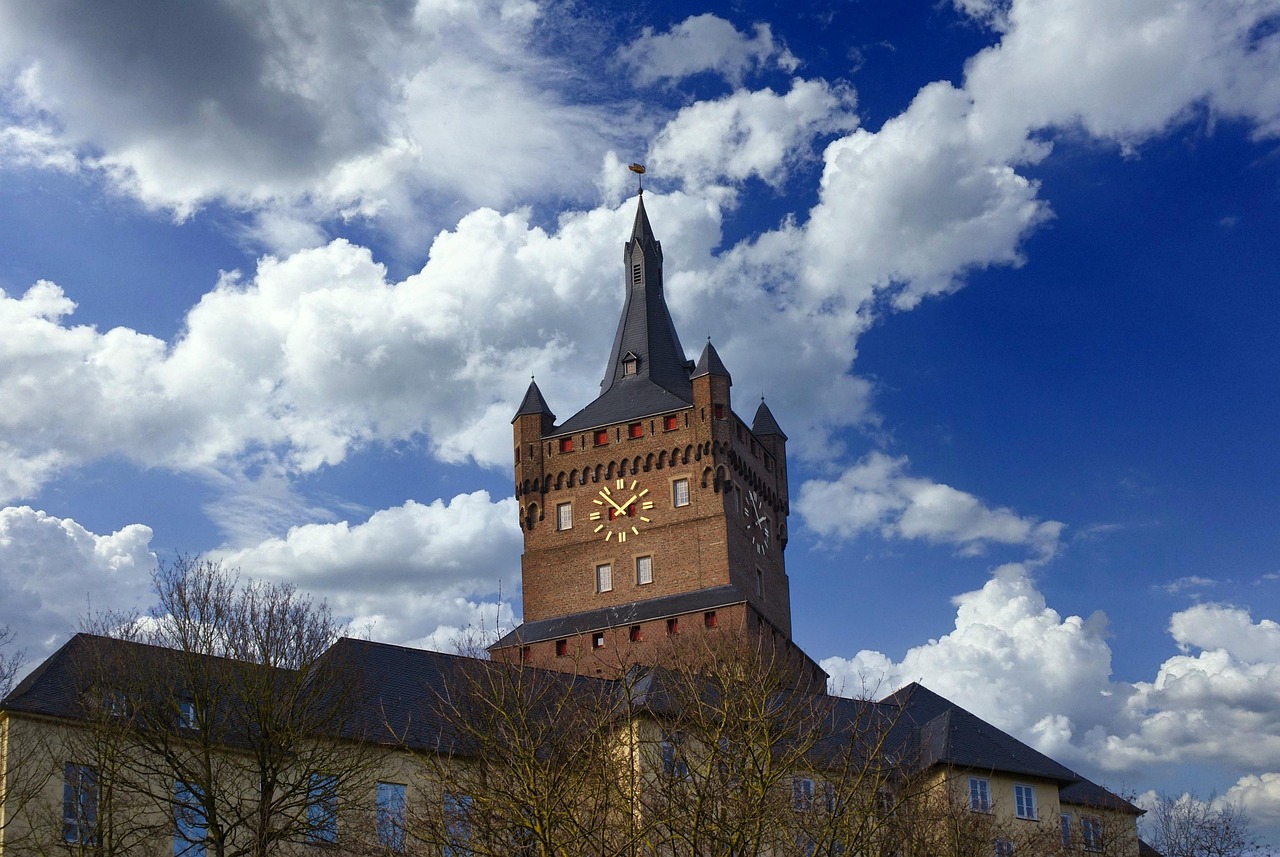
- Kleve: the Schwanenburg above the old town with views as far as the Netherlands, plus the Museum Kurhaus and the Baroque gardens.
- Prinz-Moritz-Kanal: a walk along the historic canal through the park landscape.
- CampingSpirit overnight tip
-
Official campsite or RV park: Wohnmobilstellplatz at Schloss Moyland near Bedburg-Hau: a simple site with fresh water and waste disposal. In Kleve there is the Reisemobilstellplatz on the van-den-Bergh-Straße, the Reisemobilpark at Camping Park Kleve and smaller sites such as the one on the Tiergartenstraße; the number of pitches is limited, so arrive early in high summer.
Free camping or nature tip (where legal): In the Kleve parks and on the fringes of the Reichswald you should not park or stay overnight; stay on the designated sites.
- Insider tip for campers
- You can reach the Schwanenburg and the Kurhausgarten on foot or by bike from the motorhome sites; a motorhome in the centre is unnecessary and, because of the narrow streets, impractical. It is best to take care of water and waste disposal already in Moyland.
5Stage 5: Kleve to Emmerich am Rhein (approx. 35 km)
- The drive
- From Kleve on the B220 through the Rhine lowlands to Emmerich; the Emmerich Rhine bridge takes you to the right bank, and from there the country road continues to Elten. Flat and well built, but slow at peak times. Around 45 minutes of driving.
- Highlights & must-sees
- Emmerich Rhine promenade: a long promenade with views of the river, the ships and the Rhine bridge.
- Emmerich Rhine bridge: opened in 1965 and the longest suspension bridge in Germany, with a main span of 500 m (the longest span of any German bridge); including the approach bridges it measures over 1,200 m. The view from the promenade is enough.
- Hochelten: a viewpoint over the Rhine and the Netherlands with the collegiate church.
- CampingSpirit overnight tip
-
Official campsite or RV park: Stellplatz at the Yachthafen Emmerich: right on the Rhine, with fresh water and waste disposal. On the Rhine promenade (“Kleiner Wall”) there is a small, merely provisional site with a few pitches; ask the town beforehand whether and for how long you may stay there. Another municipal Stellplatz is on the Eltenberg.
Free camping or nature tip (where legal): Directly on the Rhine bank and in the dike car parks you may park but not camp. On the Rhine promenade time limits apply in places; the public order office carries out checks.
- Insider tip for campers
- In high water, mostly in winter and spring, the promenade can be flooded. Observe the times for cycle traffic on the dike and do not leave vehicles on cycle paths.
6Stage 6: Emmerich am Rhein to Reichswald (approx. 40 km)
- The drive
- From Emmerich over the Rhine bridge and on country roads through the lowlands to Kranenburg on the Dutch border, then into the Reichswald, one of the largest continuous forests on the Lower Rhine. There are hardly any bends; forest tracks are usually closed to motor vehicles, so drive only on public roads and walkers’ car parks. A good hour.
- Highlights & must-sees
- Reichswald: walking trails through beech and pine stands with gentle hills, a shady retreat in summer.
- Kranenburg: a small border town with a church, starting point for the Kranenburger Bruch.
- Reichswald Forest War Cemetery in Kleve: a large British Second World War military cemetery; a quiet stop.
- CampingSpirit overnight tip
-
Official campsite or RV park: Wohnmobilstellplatz Kranenburg: a simple municipal site with fresh water and waste disposal. In the area there is also the Reisemobilstellplatz Reichswalde (Stadt Kleve); facilities vary, so check beforehand.
Free camping or nature tip (where legal): Overnighting is not permitted in the Reichswald; you should park only in the designated walkers’ car parks. Violations can be punished with a fine. Open fires are forbidden in the forest, especially in dry summers.
- Insider tip for campers
- You should plan a trip across the border to Nijmegen as a day out: CampingSpirit’s Netherlands guide “Sturmflutwehr, Mühlenreihen und Tulpenfelder – mit dem Camper durch Hollands Küsten und Polder bis Friesland” has details on rules and sites in the neighbouring country. As things stand, Nijmegen has no low-emission zone; before you travel, check the Dutch zones for older diesels at milieuzones.nl.
7Stage 7: Reichswald to Kevelaer (approx. 35 km)
- The drive
- From the Reichswald via Goch and Weeze to Kevelaer, on country roads through farmland and islands of woodland. Town centres are easy; in Weeze, traffic to the airport can be slow at arrival times. About 45 minutes of driving.
- Highlights & must-sees
- Schloss Wissen in Weeze: a moated castle in a park, worth seeing from outside and on walks; find out beforehand whether and when the park or castle is open.
- Kevelaer: an important place of pilgrimage with the Gnadenkapelle, the Marienbasilika and the Kerzenkapelle.
- Niederrheinisches Museum Kevelaer: local culture and pilgrimage history, good when it rains.
- CampingSpirit overnight tip
-
Official campsite or RV park: Reisemobilstellplatz Europaplatz in Kevelaer: close to the centre, a simple site. Smaller is the Reisemobilstellplatz at the Solegarten St. Jakob. Both are basic sites; check facilities and capacity before you arrive.
Free camping or nature tip (where legal): Around Weeze airport you should not stay overnight in airport or supermarket car parks; heed the signs and house rules. In Kevelaer, stay on the Stellplatz.
- Insider tip for campers
- Kevelaer is very crowded on pilgrimage days, and parking is scarce then. It is better to cycle from the Stellplatz into town. The pilgrimage season runs roughly from May to early November; find out beforehand.
8Stage 8: Kevelaer to Krefeld (approx. 50 km)
- The drive
- From Kevelaer via Geldern and Kempen to Krefeld, through farmland, village centres with cobbles and the Rhine plain. Kempen is narrow in the old town lanes, so use a car park on the edge; the last stretch to Krefeld is on country roads or the A57. Around 1.5 hours.
- Highlights & must-sees
- Geldern: Stadtpark, Holländersee and a small old town.
- Kempen: Kurkölnische Landesburg with remains of the town wall, Propsteikirche and Thomas-a-Kempis-Haus.
- Krefeld: art museums with Haus Lange and Haus Esters, plus the zoo.
- CampingSpirit overnight tip
-
Official campsite or RV park: Reisemobilstellplatz Geldern at the Holländer See: quiet, with electricity. The Reisemobilpark Kempen at the Aquasol is next to the leisure pool and offers fresh water and waste disposal. In Krefeld-Linn the route ends at the Reisemobilstellplatz Linn.
Free camping or nature tip (where legal): Even at the end of the route the rule holds: no camping behaviour outside designated sites. Supermarket car parks are not overnight places, and the owners have vehicles towed.
- Insider tip for campers
- If you want to continue east, the CampingSpirit guide “Schwebebahn, Talsperren und Drachenfels – mit dem Camper durchs Bergische Land ins Siebengebirge” is the right connection. To the north, the guide “Gräften, Giebel und Pättkes – mit dem Camper durch das Münsterland ins Tecklenburger Land” picks up.
Camping practice & local rules
Wild camping & overnight parking
- In Germany you may park a motorhome wherever parking is allowed; to restore fitness to drive you can generally stay one night. Camping behaviour – chairs, awning, grill – is forbidden, and municipalities can restrict overnighting by bylaw.
- On the Lower Rhine, the Rhine bank, dikes, gravel-pit lakes and nature reserves such as the Bislicher Insel are in many places not meant for overnighting or have parking bans; heed the signs. In the Reichswald, parking makes sense only at walkers’ car parks, and open fires are forbidden.
- You can overnight legally on campsites and on municipal and private Stellplätze. park4night, Campercontact and the Stellplatz directories of the associations are helpful.
Waste disposal & supplies
- Fresh water and waste disposal are available at most Stellplätze for coins or tokens; some sites are for guests only. Empty grey water and the cassette only at the station.
- Tap water is drinkable everywhere in Germany; at Stellplätze there is often a standpipe.
- Gas: German exchange bottles are available at petrol stations and DIY stores; for refillable tanks you will find LPG stations with a suitable adapter. If you travel to the Netherlands, you will need an adapter there.
Vehicle size & traffic rules
- Speed limits: motorhomes up to 3.5 t 100 km/h outside built-up areas, recommended speed 130 km/h on the motorway; over 3.5 t, 80 km/h outside built-up areas and 100 km/h on the motorway generally apply. Combinations with a trailer may drive 80 km/h, 100 km/h with a Tempo 100 approval.
- Low-emission zones: the city of Krefeld still lists a low-emission zone with a sticker requirement (green sticker) on its website; in other towns of the region, zones have been lifted or are no longer signposted. Check the current status with the respective city before you set off. As things stand, Nijmegen has no low-emission zone; some Dutch cities bar older diesels.
- Tolls: there is no toll for cars and motorhomes on German motorways and federal roads. The lorry toll applies to goods vehicles; genuine motorhomes are exempt even above 3.5 t, and for conversions on a lorry chassis, registering in advance with Toll Collect can make sense.
- Bike racks must not cover the number plate and lights; if a load projects more than one metre to the rear, it must be marked. No mobile phone while driving, alcohol limit 0.5 per mille for all drivers; 0.0 for novice drivers.
CampingSpirit packing & preparation checklist
- Bicycles or e-bikes with a rear rack: the Lower Rhine is cycling country, and many sights are hard to reach on foot.
- Rain jacket and wellies: floodplain meadows and forest paths are muddy after rain, especially in the Reichswald.
- Binoculars for geese, cranes and waterfowl in the floodplains.
- Coins and tokens for Stellplatz water and waste disposal; cards are not accepted everywhere.
- Levelling ramps and a cable reel: meadow pitches are uneven, and electric posts are often far away.
As of 2026-10. Closures, fees and booking rules change: check official sources before you go.