

In-depth guide · CampingSpirit
From Sparta via Gythio and Areopoli to the Diros Caves, on to Vathia and Cape Tenaro, then via Monemvasia to Mystras: a good 600 kilometres in the south of the Peloponnese, on which you will spend more time in lanes and on footpaths than behind the wheel.
The spirit of the route
South of Areopoli the landscape turns hard and quiet. Terraces of stacked stones, prickly pears along the roadside, and in between the tower houses of the Mani, built by families feuding with one another in the 18th and 19th centuries. Vathia sits in the evening light like a rock fortress above the sea, and at Cape Tenaro the mainland ends in the wind. The road continues east: orange groves in the plain of Elos, then Monemvasia, a great block of rock with the medieval town clinging to its foot. Last comes Mystras, the Byzantine ghost town in the shadow of the Taygetus, where cypresses stand among painted churches. In between there are pebble coves, a boat trip through a labyrinth of caves and tavernas where the owner already knows what is fresh today. This route calls for short stages, early starts before the heat and plenty of patience on narrow roads – and it rewards you with a Greece free of package-tour crowds.
Stage-by-stage plan
1Stage 1: Sparta to Gythio (approx. 47 km)
- The drive
- From Sparta (junction with the A71 motorway) take the country road through the Evrotas valley and over low hills down to the coastal land around Gythio. Well built, with moderate traffic; driving time about 45 minutes. The last few kilometres run through olive groves and orange plantations, and in Gythio itself the harbour promenade gets tight.
- Highlights & must-sees
- Leonidas Monument on the edge of Sparta: a bronze warrior in front of the Taygetus – a short stop for a photo, as there is hardly anything left to see of the ancient city above ground.
- Valtaki beach south of Gythio with the stranded freighter “Dimitrios”, which has been rusting half-buried in the sand for decades – at its best in the evening light.
- Gythio harbour promenade with waterside tavernas and colourful neoclassical façades, ideal for an evening stroll to start with.
- CampingSpirit overnight tip
-
Official campsite or RV park: South of the town, campsites line the long bay of Mavrovouni: Camping Meltemi, Gythion Bay and Mani Beach lie on the long beach of Mavrovouni (sand and pebbles) and have electricity and sanitary facilities, in some cases service points and shade under olive and pine trees; the season runs roughly from April to October, so ask for exact dates beforehand. Camping Dias and Camping Kronos are also further south in the bay, but we could not confirm whether they are still open. Book in high summer.
Free camping or nature tip (where legal): Wild camping is banned in Greece (Law 5170/2025, fines of up to €300 per person). Anything outside the outline of the vehicle counts as camping – awning, table, chairs, grill, washing line. At Valtaki beach or on the harbour promenade, park only during the day for a visit; sleep at a campsite. Local parking bans always take precedence.
- Insider tip for campers
- Fill up and shop thoroughly in Sparta or Gythio – from Areopoli on, supermarkets and petrol stations become scarce. In Gythio, the supermarkets on the edge of town are easier to reach by motorhome than the shops on the promenade. If you arrive early in Sparta, you can also visit Mystras right at the start (see stage 7) and drive the rest of the route afterwards.
2Stage 2: Gythio to Stoupa (via Areopoli and Diros) (approx. 90 km)
- The drive
- From Gythio head south-west on the coast road via Mavrovouni to Areopoli (about 32 km): flat at first, then gentle climbs through barer hillsides. Beyond Areopoli, a short detour to Limeni (about 4 km), then on to Pyrgos Dirou (about 10 km from Areopoli) and from there a good 4 km to the bay with the caves. Back via Areopoli and the west coast to Stoupa: narrow, winding, with walls right at the edge of the carriageway. Driving time a good 2 hours; with sightseeing it takes a full day.
- Highlights & must-sees
- Areopoli: the Church of the Taxiarchs with its bell tower, the lanes between the tower houses and the square with the statue of Petrobey Mavromichalis – this is where the uprising against Ottoman rule began on 17 March 1821.
- Limeni: a small fishing harbour below Areopoli, overlooked by the towers of the Mavromichalis family; fishing boats and tavernas with harbour views line the quay.
- Diros Caves (Glyfada or Vlychada cave): a boat trip along underground waterways between stalactites, plus a stretch on foot; the guided tour of about 1.5 km takes around 45 minutes in total, and it is cool inside – bring a light jacket. When the water level is high, only a shorter route is run.
- CampingSpirit overnight tip
-
Official campsite or RV park: Camping Kalogria in Stoupa near the beach of the same name: electricity and sanitary facilities, service points; ask about shade and season beforehand, as we had no current proof of operation. We know of no campsite in the Deep Mani itself (south of Areopoli), which is why Stoupa serves as a base for two nights.
Free camping or nature tip (where legal): The Diros Caves have a car park for day visitors; whether motorhomes find room there depends on how busy it is, and overnight stays are not allowed. Under Law 5209/2025 and police circular 1246/26, motorhomes up to 7.5 m may park within built-up areas without a time limit, longer ones for no more than 24 hours at a stretch; camping behaviour remains banned. In Areopoli and Limeni, local parking bans may also apply in the lanes.
- Insider tip for campers
- In Areopoli, park outside the old town and walk in – the lanes are unsuitable for motorhomes. In high season the cave tours are often overcrowded from late morning; early in the morning or later in the afternoon it is quieter, and in bad weather operations may be restricted – check opening times, which change with the season, beforehand. The Alepotrypa Cave with its Stone Age finds belongs to the same cave system; find out beforehand whether and how it can be visited, as we could not confirm that. The Museum of Prehistory in Diros displays the finds.
3Stage 3: Stoupa to Stoupa (day loop to Cape Tenaro) (approx. 140 km)
- The drive
- A long day loop with no change of base: from Stoupa via Itilo to Areopoli, then along the west side of the Deep Mani via Pyrgos Dirou and Gerolimenas to Vathia and on via Porto Kagio to Kokkinogia at the end of the road. Narrow road with stone walls and terraces at the edge, with no centre line in the villages. Driving time there and back 4 to 5 hours; plan for the whole day and start early.
- Highlights & must-sees
- Gerolimenas: a village in an almost closed bay, formerly an important port of the Mani – a quiet spot for lunch by the water.
- Vathia: the abandoned stone towers on the ridge, almost unreal in the evening light; some houses have since been restored and are lived in.
- Cape Tenaro (Tainaron): the footpath from the end of the road at Kokkinogia over limestone to the lighthouse at the southern tip of the mainland, past the remains of a sanctuary of Poseidon and the cave that in antiquity was regarded as the entrance to the underworld – a good half to three quarters of an hour each way, about an hour and a half there and back, with no shade.
- CampingSpirit overnight tip
-
Official campsite or RV park: As the day before: Camping Kalogria in Stoupa as your starting point. Closer to the cape, Porto Kagio and Kokkinogia have rooms and tavernas, but no campsite we could confirm.
Free camping or nature tip (where legal): The Mani feels remote, but the camping ban applies here just as in the rest of the country. The parking areas in Vathia, Porto Kagio and at the cape are small and meant for day visitors; if you stand there with an awning or chairs, you risk up to €300 per person. In summer the wildfire risk is also considered especially high, and open fires and grills are off limits.
- Insider tip for campers
- Fill the tank and top up water before you leave Areopoli, and take plenty of drinking water with you: on the cape path there is neither a kiosk nor shade. With large motorhomes (from about 7 m, a rule of thumb rather than an official limit) it is better to skip the narrow road south of Gerolimenas and visit Vathia and the cape by car or taxi. The loop is also described in the guide “Tower villages, castle rocks and olive groves: once around the Peloponnese by motorhome” as part of a larger tour; here it is the main focus.
4Stage 4: Stoupa to Gythio (approx. 55 km)
- The drive
- From Stoupa via Itilo and Areopoli back to Gythio: winding as far as Areopoli, then increasingly flat and wide. Around 1.5 hours driving time, an easy day after the long loop.
- Highlights & must-sees
- Itilo (Oitylo): the large village on a rocky ridge above the bay, with the mighty Ottoman-era Kelefa Castle on a hill next to it.
- Marathonisi (Kranae) near Gythio: the little island linked to the mainland by a causeway, with the tower of the Grigorakis family (Museum of Mani History) and the spot where, according to legend, Paris and Helen spent their first night.
- Ancient theatre of Gythio, a small Roman theatre on the edge of town, with a view of the harbour.
- CampingSpirit overnight tip
-
Official campsite or RV park: Back in the bay of Mavrovouni: Camping Meltemi, Gythion Bay or Mani Beach, as in stage 1. If you want peace and quiet, ask for pitches at the back of the site, away from the coast road.
Free camping or nature tip (where legal): Daytime parking for Marathonisi is possible on the harbour road and at the quay, but spaces are scarce and the signage changes. According to the police, a night in a correctly parked motorhome is not an offence as long as no camping behaviour is involved and no local ban applies; in the harbour area of Gythio this is uncertain in season, so it is better to stay at the campsite.
- Insider tip for campers
- Use the afternoon for shopping, laundry and emptying tanks at the campsite. In summer the tavernas in Gythio are full late into the evening – if you want to sleep peacefully, choose a pitch at the back of the campsite. If you visit Marathonisi, it is best to take the footpath over the causeway in the morning; the light is clearer then, and it is less busy.
5Stage 5: Gythio to Monemvasia (approx. 100 km)
- The drive
- From Gythio on the coast road via Skala and through the plain of Elos to Molaoi, then down to the east coast and over the causeway to Monemvasia. Well built, winding only on the mountain sections; driving time just under 2 hours. On the last few kilometres the view opens up onto the rock in the sea.
- Highlights & must-sees
- Plain of Elos between Skala and Molaoi: orange and lemon groves; in winter and spring the fruit glows among the dark foliage.
- Molaoi: supermarkets and petrol stations for your last shopping before Monemvasia.
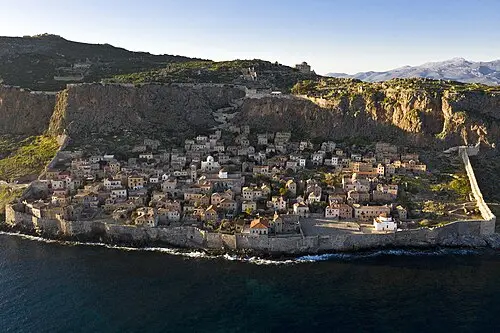
- Monemvasia: the lower town with lanes, churches and narrow archways, reached through its only gate, at its best in the evening after the day visitors have left.
- CampingSpirit overnight tip
-
Official campsite or RV park: To the editors’ knowledge there is no confirmed campsite in Monemvasia itself; camping apps sometimes list pitches near Gefyra, but we could not confirm whether motorhomes may legally stay there or what facilities exist. One alternative is Simos Camping on the island of Elafonisos (season roughly mid-April to the end of October, behind Simos beach, about 4 km from the ferry port), reached by car ferry from Pounta (check the timetable and vehicle length beforehand; large vehicles often need to talk to the site) – but that is a considerable detour. If you want to be sure, drive on the same day to Mystras (stage 6), a long day’s stage.
Free camping or nature tip (where legal): At the mainland village of Gefyra and at the causeway there are car parks; whether motorhomes may stay there is not certain, so follow the signs. Wild camping is banned, including on the beaches and in the coves around Gefyra. Overnighting without camping behaviour is only possible in legally designated areas.
- Insider tip for campers
- The approach to the gate of the lower town is narrow and the car parks in front of it are small; leave large motorhomes in Gefyra and walk or cycle (about 1.5 km). The climb to the upper town with the Church of Agia Sofia takes about 20 minutes over steps and stones and is very hot at midday – go early or late. In the lower town, try Malvasia wine: the name comes from Monemvasia (Venetian “Malvasia”).
6Stage 6: Monemvasia to Mystras (approx. 105 km)
- The drive
- From Monemvasia back via Molaoi, then on the country road to Sparta and on to the village of Mystras at the foot of the Taygetus. Mostly wide and well surfaced; driving time around 2 hours. The last few kilometres from Sparta to Mystras are narrow and marked by traffic heading for the archaeological site.
- Highlights & must-sees
- Geraki (detour from the main route, check the road condition beforehand): Frankish castle and Byzantine churches with frescoes – a quiet counterpart to Monemvasia.
- Sparta: the Museum of the Olive and Greek Olive Oil shows how oil is made – useful if you want to take some oil home to taste.
- View of Mystras from the village: the Kastro fortress, with walls and domes in front, and the setting sun behind the Taygetus.
- CampingSpirit overnight tip
-
Official campsite or RV park: Camping Paleologio lies on the road between Sparta and Mystras, a good 3 km from the excavation site: we could not confirm whether the site is open; ask beforehand about facilities (electricity, sanitary, service points) and space for large motorhomes.
Free camping or nature tip (where legal): Around Mystras, parking for a visit is possible at the lower car park; overnighting is not intended there. Law 5170/2025 bans camping outside campsites; checks are made near archaeological sites. If you want to go on, Sparta has hotels and guesthouses, but no known pitch for motorhomes.
- Insider tip for campers
- Arrive in the afternoon and visit the site early the next morning: the grounds are extensive and offer little shade in summer. Fill up in Sparta; in the village of Mystras there is hardly any choice. If you are continuing from Mystras to Kalamata, you can take the mountain road over the Langada Pass (a good 1,500 m); in winter it is often snow-covered or closed, it is full of bends and only advisable for smaller motorhomes – check its condition beforehand. The motorway via the A71 and A7 is more comfortable.
7Stage 7: Mystras to Tripoli (via Sparta) (approx. 85 km)
- The drive
- From Mystras to Sparta (about 6 km) and from there on the A71 motorway north-west to the junction near Megalopoli, then on the A7 towards Tripoli, where the ways to Athens and Corinth part. A good, fast route, driving time a good 1 hour. The A71 is a toll road. Shorter but more winding is the country road from Sparta to Tripoli (EO39).
- Highlights & must-sees
- Mystras, a Byzantine city of the 13th–15th centuries (World Heritage site): Pantanassa Monastery, where nuns still live today, the Church of Perivleptos with frescoes, the Metropolis with the stone on which the last Byzantine emperor is said to have been crowned, and the Palace of the Despots.
- Climb to the Kastro of Mystras: from the top you see the Sparta valley and the peaks of the Taygetus.
- Archaeological Museum in Sparta: finds from ancient Sparta and Laconia, cool and quick to visit.
- CampingSpirit overnight tip
-
Official campsite or RV park: If you want to experience Mystras without time pressure, a second night in the area is worthwhile (Camping Paleologio, if open). If you want to make full use of the day, drive to Tripoli and on towards Corinth or Nafplio, where there are campsites – see the guide “Tower villages, castle rocks and olive groves: once around the Peloponnese by motorhome”.
Free camping or nature tip (where legal): Camping is banned on motorway verges and at service areas; sleeping in the vehicle in car parks is tolerated only without camping behaviour. Stopping on the hard shoulder is prohibited on motorways.
- Insider tip for campers
- Mystras has two entrances, each with a car park: the upper one is at the Kastro and saves the climb, the lower one by the Metropolis is the classic starting point; according to travel reports, toilets are only at the lower entrance. Allow three to four hours for an unhurried tour, and wear shoes with good tread: the cobblestones are slippery. Take water with you; there is hardly any shade on the site.
Camping practice & local rules
Wild camping & overnight parking
- Wild camping is banned in Greece (Law 5170/2025, fine of up to €300 per person). Anything outside the outline of the vehicle counts as camping: awning, table, chairs, grill, extended levelling jacks, washing line.
- Parking is governed by the Road Traffic Law 5209/2025 (Art. 38) with police circular 1246/26: within built-up areas, motorhomes up to 7.5 m may park without a time limit, longer motorhomes and caravans for no more than 24 hours at a stretch; outside built-up areas, in designated areas or at the right-hand edge of the road without a time limit, provided no ban applies. According to the police, staying in a correctly parked motorhome, including overnight, is not an offence. Local bans take precedence.
- In the Mani, on beaches, at archaeological sites and in nature reserves, checks are made in high season; residents report campers. Use apps such as park4night or Campercontact only as a guide and check the signage on the spot.
- In summer the wildfire risk is high. Open fires, grills and gas burners outdoors are off limits outside campsites; when the civil protection authority issues an alert, access bans apply in wooded areas. The emergency number 112 works across Europe.
Waste disposal & supplies
- Service points at campsites are the most reliable source; public stations are rare in the Mani and in Laconia. Ask beforehand whether campsite guests may empty their tanks and whether non-guests are admitted for a fee.
- Empty grey water and the cassette only at designated places; dumping into roadside ditches or on the beach is banned and can bring heavy fines.
- Whether tap water is drinkable depends on the place; look out for notices and fill up with drinking water at campsites or buy canisters at the supermarket. Take plenty of water with you in the Deep Mani and at Cape Tenaro.
- Gas: autogas (LPG) is available at many petrol stations in Greece, but the connectors vary – take an adapter with you. German-type propane bottles cannot simply be exchanged; Campingaz cartridges are available in supermarkets and DIY stores. Fill up in Areopoli before you head into the Deep Mani.
Vehicle size & traffic rules
- Speed limits: outside built-up areas generally 90 km/h for motorhomes up to 3.5 t; motorhomes over 3.5 t and vehicle combinations may drive no faster than 80 km/h outside built-up areas and on the motorway. Within built-up areas the general limit has been 30 km/h since January 2026 (50 km/h on multi-lane or divided main roads). Follow the signs, which are often lower in villages.
- Tolls: motorways are toll roads; two-axle vehicles over 2.20 m in height count as class 3 and pay a good double the car rate. Payment at the toll stations is usually in cash or by card; some sections have unstaffed toll points; follow the signs.
- Dimensions and weights: on the roads of the Deep Mani, large vehicles (as a rule of thumb from about 7 m in length and 3 m in height) run into pinch points such as archways, power lines and overhanging balconies; we know of no official limits. Measure your height before setting off.
- Equipment: a warning triangle and first-aid kit are mandatory. A fire extinguisher is also compulsory in Greece; it is usually not demanded of foreign vehicles but is strongly recommended. Low-emission zones are not known in the south of the Peloponnese; Athens has its own rules.
- Alcohol: limit 0.5 per mille (considerably lower for novice and professional drivers); phone at the wheel only with a hands-free kit, seat belts compulsory in all seats. In winter, snow chains may be needed on mountain roads such as the Langada Pass.
CampingSpirit packing & preparation checklist
- Sturdy shoes with tread: in Mystras the cobblestones are slippery, in Monemvasia the steps are steep, and at Cape Tenaro the path runs over sharp-edged limestone.
- At least 2–3 litres of drinking water per person for day trips, plus a reserve of fresh water in a canister: on the way to the cape and in the Deep Mani there are no fountains or shops.
- Sun hat, sun cream and light long-sleeved clothing: there is hardly any shade on the paths, and the midday heat in summer is fierce.
- Small radios, or at least clear hand signals, for guiding the vehicle in the narrow lanes of Areopoli and Vathia.
- Small change and cash: in villages of the Mani, in small car parks and in tavernas, payment is often cash only.
As of 2026-10. Closures, fees and booking rules change: check official sources before you go.