



In-depth guide · CampingSpirit
From Florence via Fiesole into the green Mugello, through the vineyard slopes of Chianti Rufina and down into the Valdichiana as far as Chiusi: around 345 kilometres of Tuscany where you will meet tractors more often than coaches.
The spirit of the route
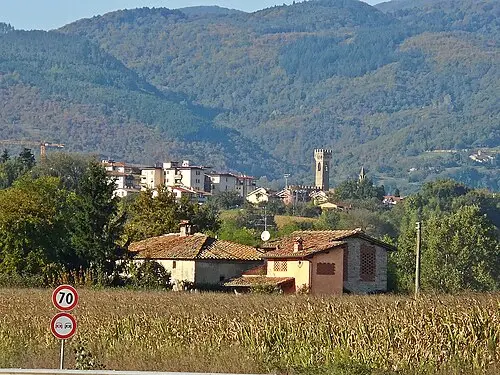
This Tuscany begins where the postcards end. North of Fiesole the landscape tips into a wide basin of chestnut woods, wheat fields and rows of poplars along the Sieve, with the Apennines standing above it like a blue wall. The Medici came here long before they ruled Florence – their hunting villas and monasteries still lie among the farm tracks. In the Val di Sieve the vine rows of Chianti Rufina crowd up to the road, and in the evening the air smells of cut grass and wood smoke. Further south the Valdichiana opens up: flat, bright, criss-crossed by canals, with Cortona, Castiglion Fiorentino and Lucignano on the edges of the hills above. From the sliding door you look out on sunflower fields, stone walls and sometimes Lake Trasimeno. Drive slowly and you end up among Etruscans, Giotto and knife makers – and in the evening on a farm where the wine comes from its own cellar.
Stage-by-stage plan
1Stage 1: Florence to San Piero a Sieve via Fiesole (approx. 40 km)
- The drive
- Florence is only the starting point here: the centre lies within a camera-controlled ZTL, and in a motorhome it is best not to go in at all. From the north side of Florence, climb to Fiesole on the main road via San Domenico, which the local bus also takes – the steep, narrow Via Vecchia Fiesolana is unsuitable for motorhomes. Then back down into the valley and north on the SS65 “Bolognese” via Pratolino and Vaglia into the Mugello. Winding but well built; a good hour of pure driving time.
- Highlights & must-sees
- Fiesole: Roman theatre and baths in the archaeological area, plus the climb to the monastery of San Francesco with a view across the Arno valley to the dome of Florence cathedral.
- The Bolognese between Pratolino and Vaglia with first views of the Apennines – there are few quiet lay-bys for a photo stop, so better to stop in a village.
- First look at the Medici landscape: around Cafaggiolo and San Piero a Sieve, villa, castle and fortress lie within a few kilometres of each other.
- CampingSpirit overnight tip
-
Official campsite or RV park: Camping Mugello Verde near San Piero a Sieve: large, terraced site with electric hook-ups, sanitary facilities, service point and pool, a good base for the next two days. If you want to see Florence first, stay at Camping Village Panoramico in Fiesole (bus connection into the city) – the access road climbs through Fiesole, so large vehicles should ask in advance.
Free camping or nature tip (where legal): In the Florence area wild camping is not an option: many car parks carry motorhome bans, and in Fiesole there is nowhere overnight stays would be tolerated. For a city visit, the large Villa Costanza park-and-ride near Scandicci is a good choice; it can only be reached from the A1 and sits on tram line T1 into the centre. According to aire directories, motorhomes are accepted there, but there is no service point; check the overnight rate and rules in advance.
- Insider tip for campers
- The ZTL cameras in Florence record every number plate, foreign ones included, and the fines arrive by post months later. Set your satnav to avoid the historic centre and use the Viali (ring roads) only as a through route.
2Stage 2: San Piero a Sieve to Lago di Bilancino (Barberino di Mugello) (approx. 30 km)
- The drive
- A short loop on back roads: from San Piero to the Bosco ai Frati monastery in the woods north of the village, back via Cafaggiolo and on the SS65 or the lakeside roads to the Bilancino reservoir. Narrow, partly single-track access roads to Bosco ai Frati and Il Trebbio – with a large motorhome, better to park below and walk the last stretch. Pure driving time under an hour.
- Highlights & must-sees
- Convento di Bosco ai Frati: Franciscan monastery in an oak wood, rebuilt by Michelozzo for Cosimo de’ Medici, with a wooden crucifix attributed to Donatello.
- Villa Medicea di Cafaggiolo and Castello del Trebbio: two early Medici residences, both UNESCO World Heritage as part of the Medici villas. Both are privately owned and open only on certain dates or on guided tours – check the current situation beforehand.
- Lago di Bilancino: reservoir on the Sieve with swimming spots, lakeside paths and a cycle path; water sports in summer, quiet in the shoulder season.
- CampingSpirit overnight tip
-
Official campsite or RV park: Area sosta camper Bilancino in Barberino di Mugello (Viale Antonio Gramsci) at the western end of the lake, fee payable; check service point, electricity and season in advance. Alternative: a second night at Camping Mugello Verde.
Free camping or nature tip (where legal): The lakeside car parks at Bilancino are designed for bathers and full on summer weekends; for the night the area sosta is the better choice. Camping behaviour on the shores is prohibited.
- Insider tip for campers
- At the Barberino exit of the A1 there is a large outlet centre with matching weekend traffic – better to do your shopping and refuelling on weekdays. In high summer, get to the lake early: from midday the plain becomes oppressively hot, and shade is scarce on the shores.
3Stage 3: Barberino di Mugello to Vicchio via Scarperia and Borgo San Lorenzo (approx. 40 km)
- The drive
- Via Galliano or San Piero to Scarperia, then across the Mugello plain to Borgo San Lorenzo and along the Sieve on the SR551 to Vicchio. Flat to hilly, good roads, narrow in the village centres. A good hour of pure driving time. From Scarperia the SP503 branches off over the Passo del Giogo to Firenzuola: a twisting mountain road, full of motorbikes at weekends – only as a detour if it interests you.
- Highlights & must-sees
- Scarperia: Palazzo dei Vicari with its coat-of-arms façade and the Museo dei Ferri Taglienti on the knife-making tradition; in some workshops in the village knives are still made by hand.
- Borgo San Lorenzo: Pieve di San Lorenzo with its Romanesque bell tower and the Art Nouveau ceramics of the Manifattura Chini, whose traces you find on many façades in the town.
- Vicchio: Casa di Giotto in the hamlet of Vespignano, where the painter is said to have been born, and in Vicchio itself the museum honouring Beato Angelico, who also came from the Mugello.
- CampingSpirit overnight tip
-
Official campsite or RV park: East of Borgo San Lorenzo the choice is thin. Borgo San Lorenzo currently has no motorhome aire: the former service point at the Foro Boario fell victim to redevelopment, and a new site is planned but not yet decided. In Vicchio, camping portals list Campeggio Vecchio Ponte, said to open only in summer (roughly June to mid-September) – check operation and facilities beforehand. More reliable are agriturismi with agricampeggio pitches in the hills around Vicchio and Dicomano, or returning to Camping Mugello Verde (a good 20 km).
Free camping or nature tip (where legal): In the Mugello, spending the night on public car parks is generally tolerated as parking under Italian law, as long as there is no prohibition sign and you are not camping. In Scarperia and Borgo San Lorenzo you are better off on large car parks on the edge of town than in the historic centres. On race weekends at the Autodromo del Mugello near Scarperia, car parks, roads and campsites are full throughout the valley – avoid those days.
- Insider tip for campers
- The Palazzo dei Vicari is in the pedestrian zone; park the camper on the edge of town towards the Autodromo and walk in. Only tackle Firenzuola and the Passo del Giogo with a compact vehicle and in dry weather; the Le Fornaci camper area in Firenzuola has been closed at times, so check the current situation in advance.
4Stage 4: Vicchio to Vallombrosa via Dicomano, Rufina and Pontassieve (approx. 50 km)
- The drive
- On the SS67 through the narrow Sieve valley via Dicomano and Rufina to Pontassieve, where the Sieve flows into the Arno; then via Pelago on twisting mountain roads through chestnut and fir forest up to Vallombrosa at almost 1,000 m. Below, a wide but busy valley road with lorries; above, narrow, winding and without passing places. Around 1.5 hours.
- Highlights & must-sees
- Rufina: Museo della Vite e del Vino in the Villa di Poggio Reale, a good introduction to the smallest Chianti subzone – wine estates offering tastings lie on the slopes around Rufina, Pomino and Pelago.
- Pontassieve: the Ponte Mediceo over the Sieve and the old town-gate street with its clock tower.
- Vallombrosa: abbey of the Vallombrosan monks in the state forest reserve, walking paths under silver firs and beeches – pleasantly cool even in high summer.
- CampingSpirit overnight tip
-
Official campsite or RV park: In Vallombrosa, on the site of the former sawmill around 500 metres from the abbey, the municipality of Reggello runs a camper area with one section with and one without service facilities; in summer (June to September) a fee is charged. Check facilities and current rates in advance. In the Val di Sieve itself, a number of wine estates and agriturismi offer pitches for guests, often with electricity and water, sometimes only with a wine purchase or tasting – asking the day before is usual.
Free camping or nature tip (where legal): Camping is prohibited in the Vallombrosa forest reserve, and forest tracks are closed. Park in the car parks at the abbey during the day and use a designated site for the night.
- Insider tip for campers
- Between Dicomano and Pontassieve the SS67 is the only valley road and slow at commuter times – drive in the morning. For buying wine in Rufina: many smaller estates have no fixed opening hours, so phone ahead. Only take the mountain roads to Vallombrosa in fog or in winter with winter equipment. From Pelago the road leads over the Passo della Consuma into the Casentino – that region, with Camaldoli and La Verna, is covered by the CampingSpirit guide to the Casentino and Valtiberina.
5Stage 5: Vallombrosa to Cortona via Arezzo and Castiglion Fiorentino (approx. 105 km)
- The drive
- Down to Reggello and onto the A1 at Incisa as far as the Arezzo exit (alternatively toll-free but slower on the SR69 through the Valdarno via Figline and Montevarchi). From Arezzo on the SR71 through the Valdichiana to Castiglion Fiorentino and on to Camucia, then up in hairpins to Cortona. Quick as far as Arezzo, country road with roundabouts on the SR71, and the climb to Cortona steep and narrow. Around 2 hours.
- Highlights & must-sees
- Arezzo in brief: Piazza Grande with the Loggia Vasari and, in San Francesco, Piero della Francesca’s frescoes of the “Legend of the True Cross” (timed entry, book in advance).
- Castiglion Fiorentino: the Cassero with its tower and the Loggiato Vasariano on the piazza, from which the view reaches far across the Valdichiana.
- Castello di Montecchio Vesponi south of Castiglion Fiorentino, the castle of the English mercenary captain John Hawkwood, clearly visible from the SR71.
- CampingSpirit overnight tip
-
Official campsite or RV park: Cortona has a municipal, equipped camper area down in the valley by the Parco Archeologico del Sodo; it is a long way from the upper town and there was no shuttle at last check – verify facilities and connections on site. Arezzo offers a municipal area attrezzata on Via Giovanni da Palestrina, from which the centre can be reached on foot – good for a lunch break.
Free camping or nature tip (where legal): In Castiglion Fiorentino, park on the edge of the historic centre for your visit, not in the narrow lanes. The large Spirito Santo car park below Cortona’s historic centre charges a fee and is often full during the day, and there are no motorhome service facilities; for the night the camper area at the Sodo is the right choice.
- Insider tip for campers
- Arezzo and Cortona have ZTL zones with cameras; in Cortona the upper town is too narrow for motorhomes anyway. Do not drive into the historic centre on the narrow hairpins from the west; take the signposted main approach to the car parks. In the Valdichiana, filling stations on the SR71 are cheaper than those on the motorway.
6Stage 6: Cortona to Lucignano via Foiano della Chiana (approx. 35 km)
- The drive
- Morning on foot in Cortona, then down to Camucia and across the flat Valdichiana on country roads between canals, fields and farmhouses to Foiano della Chiana and on up to Lucignano. An easy stage, just under an hour of driving.
- Highlights & must-sees
- Cortona: Museo dell’Accademia Etrusca e della Città di Cortona (MAEC) with the Etruscan bronze lamp and the Tabula Cortonensis, plus the Etruscan tombs at the Sodo (“Meloni”) and the Tanella di Pitagora.
- Climb to the church of Santa Margherita and the Fortezza del Girifalco: views over the whole Valdichiana as far as Lake Trasimeno.
- Lucignano: historic centre with an elliptical plan in concentric rings and, in the Museo Comunale, the “Albero di Lucignano”, a gilded reliquary tree of goldsmith’s work.
- CampingSpirit overnight tip
-
Official campsite or RV park: Lucignano has a free camper area on grass at the foot of the historic centre (on the SP19), a few minutes’ walk from the village centre, with drinking water, service point and a few electricity bollards; after rain the ground quickly turns soft, and road noise can be heard during the day. In the surroundings, agriturismi in the hills between Lucignano and Marciano della Chiana offer pitches for motorhomes.
Free camping or nature tip (where legal): In Foiano della Chiana there is a camper area listed on map portals at the large outlet centre near the motorway – handy for a stopover, but noisy and bright in the evening. Wild camping on the farm tracks of the Valdichiana is not tolerated; the tracks usually belong to farms.
- Insider tip for campers
- In Foiano, the Collegiata di San Martino is worth a visit for a late altarpiece by Luca Signorelli, who came from Cortona. In July and August temperatures in the Valdichiana regularly climb well above 30 degrees: do your sightseeing in the morning, seek shade at midday and top up with water wherever there is a fountain marked “acqua potabile”.
7Stage 7: Lucignano to Chiusi (approx. 45 km)
- The drive
- South via Sinalunga and Torrita di Siena, past Montepulciano (the town and its surroundings are covered by the CampingSpirit guide to Chianti and the Val d’Orcia; further west runs the pilgrim route to which the CampingSpirit guide to the Via Francigena in Tuscany is devoted) and through gently rolling country via Acquaviva to Chiusi. Good country roads, hardly any climbs; Chiusi’s historic centre sits on a hill with narrow lanes. Around an hour.
- Highlights & must-sees
- Museo Archeologico Nazionale di Chiusi with urns, sarcophagi and bucchero pottery; the guided tours to the Etruscan tombs of the necropolis are organised from here – Tomba del Leone, Tomba della Pellegrina and Tomba della Scimmia.
- Labirinto di Porsenna: Etruscan water tunnels and a Roman cistern beneath Piazza Duomo, then up the bell tower for a view over the Valdichiana.
- Lago di Chiusi: reed-fringed lake near the necropolis, with lakeside paths and birdwatching in the evening.
- CampingSpirit overnight tip
-
Official campsite or RV park: Chiusi in Camper: family-run aire on a wine and olive farm on the SP146, around a kilometre from the historic centre, open all year, with electricity, service point, showers and a small pool; only about a dozen pitches, so enquire in advance. The Area sosta Il Chiaro is also located on the Lago di Chiusi.
Free camping or nature tip (where legal): The necropolis can only be reached with your own vehicle, the access roads are narrow and there are only a few parking bays at the tombs – do not stay there overnight. Avoid Chiusi’s upper town with a motorhome.
- Insider tip for campers
- Reserve the tomb tour at the museum in advance; places are limited and the tombs can only be visited accompanied. For the journey home, the Chiusi-Chianciano Terme exit of the A1 is a few kilometres away; if you want to continue south, Lake Bolsena connects to the CampingSpirit guide to the Tuscia.
Camping practice & local rules
Wild camping & overnight parking
- Italian law (Codice della Strada, Art. 185) distinguishes between “sosta” and “campeggio”: a motorhome with occupants may stand wherever parking is permitted. What is prohibited is camping behaviour – chairs, table, awning, lowered steadies, levelling blocks or grey water on the ground.
- Municipalities may exclude motorhomes from car parks by ordinance; signs showing a crossed-out camper apply. Wild camping outside authorised sites is not allowed in Tuscany, and in forests and protected areas such as the Vallombrosa reserve there is an additional ban on fires and camping.
- Around Florence and at the hotspots there are checks, in the countryside less often – fines in the hundreds of euros are still possible, and on race weekends in the Mugello the police enforce the rules strictly.
- Tuscany has a dense network of agriturismi; many take motorhomes on their own land (agricampeggio or pitches for guests). Networks such as Agricamper Italia arrange farm pitches much like France Passion. Apps: park4night, CamperOnline (Italian aire directory with forum), Campercontact.
Waste disposal & supplies
- Service points are called “camper service” or “carico e scarico”. There is currently no station in Borgo San Lorenzo; plan to fill and empty at campsites, in Lucignano or in Chiusi, and check facilities at Bilancino, in Arezzo and in Cortona in advance.
- Empty grey water and cassette only at stations – at agriturismi, ask where you may dispose of waste.
- Tap water is generally drinkable, often excellent in the Mugello and in Vallombrosa; watch for “acqua non potabile”. In summer, top up early; water can be scarce on the farms of the Valdichiana.
- Gas: German exchange cylinders are not swapped. Refillable cylinders and gas tanks can be filled at GPL (LPG) stations with the Italian dish adapter; at many stations only staff do the filling. GPL stations are found along the A1 and on the arterial roads out of Florence and Arezzo.
Vehicle size & traffic rules
- Speed limits: motorhomes up to 3.5 t 90 km/h outside built-up areas, 110 km/h on expressways, 130 km/h on motorways (in rain 110 and 90 km/h respectively); over 3.5 t 80 km/h outside built-up areas and 100 km/h on motorways. Vehicles with trailers 70 km/h outside built-up areas and 80 km/h on motorways. Dipped headlights also by day outside built-up areas.
- A1 Florence–Rome (Autostrade per l’Italia): tolls by number of axles and height at the front axle (threshold 1.30 m) – most two-axle motorhomes pay class B. Payment in cash, by card or with Telepass or a compatible EU toll box; do not use the yellow Telepass lanes without a device. The main exits: Barberino di Mugello, Incisa-Reggello, Arezzo, Valdichiana, Chiusi-Chianciano Terme.
- ZTL: Florence, Fiesole, Arezzo, Cortona and other historic centres have camera-controlled limited traffic zones. Entering without a permit costs a fine per passage, which is also delivered abroad. For Florence, use park-and-ride on the edge of the city.
- Mountain roads: the Passo del Giogo and Passo della Futa are winding and full of motorbikes at weekends; from 15 November to 15 April winter equipment is compulsory on many Apennine routes and on the Apennine section of the A1.
- If a load sticks out beyond the rear (bike rack), the red-and-white 50 × 50 cm warning panel is compulsory. Blood alcohol limit 0.5, 0.0 for drivers who have held a licence for less than three years; using a phone at the wheel has been punished severely since the reform of the Codice della Strada.
CampingSpirit packing & preparation checklist
- Italian GPL adapter (dish) and two full gas cylinders on arrival – on the road there is no cylinder exchange for German systems.
- Sunshade or thermal screens for the windscreen and a 12 V fan: in the Valdichiana, nights in July and August are often above 25 degrees.
- Red-and-white warning panel for the rear rack if bikes stick out – the cycle paths at Bilancino and in the Valdichiana make it worth bringing them.
- Short levelling ramps and a long water hose with adapters: farm and municipal sites are often uneven, and taps have different threads.
- A good torch and sturdy shoes for the Etruscan tombs in Cortona and Chiusi and the forest paths at Bosco ai Frati and Vallombrosa.
- Cool box or padding for wine boxes: Chianti Rufina, olive oil and Mugello salami are bought direct from the producer.
As of 2026-10. Closures, fees and booking rules change: check official sources before you go.