


In-depth guide · CampingSpirit
From Berlin via Neuruppin, Rheinsberg and Lake Stechlin into the Prignitz and back through the Havelland to Nauen: around 460 kilometres on tree-lined avenues and country roads, with nights by lakes, at castles and on motorhome pitches in old brick towns.
The spirit of the route
Northern Brandenburg is not a land of grand gestures. It shows itself on cobblestones, under lime-tree avenues that stand so close to the road that the branches brush the over-cab, and by lakes whose shores smell of pine resin and reeds. Theodor Fontane walked this Mark in his “Wanderungen” (Ramblings), and much has changed less since then than you might think: Rheinsberg’s palace is still reflected in the Grienericksee, the Stechlin is still clear and cold, the fieldstone churches still stand in the middle of the village. From the sliding door you see mist over the Luch fens in the morning, and in the evening cranes flying in wedges to their roosts. In between lie the brick towns of the Prignitz with town walls and cathedral, a memorial site that demands silence, and the flat Havelland, where great bustards stride across the meadows. This route rewards slow driving, short stages and mosquito repellent.
Stage-by-stage plan
1Stage 1: Berlin to Neuruppin (approx. 90 km)
- The drive
- Leave Berlin preferably via the A111 and the Berliner Ring heading north, then take country roads to Oranienburg. Continue west to Kremmen and through the flat Rhinluch, with meadows and drainage ditches, to Neuruppin. Well-built roads; from Kremmen onwards the first tree-lined avenues without hard shoulders. Around 1.5 hours’ driving without stops.
- Highlights & must-sees
- Schloss Oranienburg, the oldest baroque palace in Brandenburg, with palace museum and palace park – as a short stop in the morning. Oranienburg is also home to the Sachsenhausen Memorial, for which you should set aside a separate half day.
- Kremmen’s Scheunenviertel (barn quarter): dozens of half-timbered and brick barns that were built outside the old town because of the fire risk; today with farm cafés, workshops and small shops.
- Neuruppin: Fontane’s birthplace in the former Löwen-Apotheke (Lion Pharmacy), the Fontane and Schinkel monuments, the Klosterkirche St. Trinitatis right on the Ruppiner See and the lakeside promenade with the Bollwerk quay.
- CampingSpirit overnight tip
-
Official campsite or RV park: In Neuruppin there is the municipal motorhome stopover at the Sportcenter south of the old town, with a footpath into the centre; ask the tourist information about facilities and fees in advance. Quieter spots by the water are the campsites around the Ruppiner See, such as the Campingplatz am Ruppiner See in the south or the Campingplatz Stendenitz in the forest north of town, both with electricity and sanitary facilities, season usually spring to autumn.
Free camping or nature tip (where legal): Within the town and at the bathing spots on the Ruppiner See, overnight stays outside designated sites are not intended; parking and stopping bans apply in many places along the lakeshore. If you need a stopover in Oranienburg, the Reisemobilstellplatz am Schlosshafen is the legal choice, not the lakeside car parks.
- Insider tip for campers
- The Berlin low-emission zone inside the S-Bahn ring requires the green sticker, foreign vehicles included. If you arrive without a green sticker, you may not enter the zone and should bypass it on the outer Berliner Ring (A10). Kremmen’s Scheunenviertel has its own car park on the edge; do not drive into the narrow lanes.
2Stage 2: Neuruppin to Rheinsberg (approx. 45 km)
- The drive
- Take country roads east to Lindow, which lies between three lakes, then north on narrow country roads through pine forest and small round villages to Rheinsberg. Many sections are tree-lined avenues with no passing places, in parts with cobblestones through the villages. Just under an hour of pure driving time.
- Highlights & must-sees
- Lindow (Mark): ruins of the Cistercian convent founded around 1230 on a peninsula in the Wutzsee, and short shoreline paths between the Wutzsee, Gudelacksee and Vielitzsee.
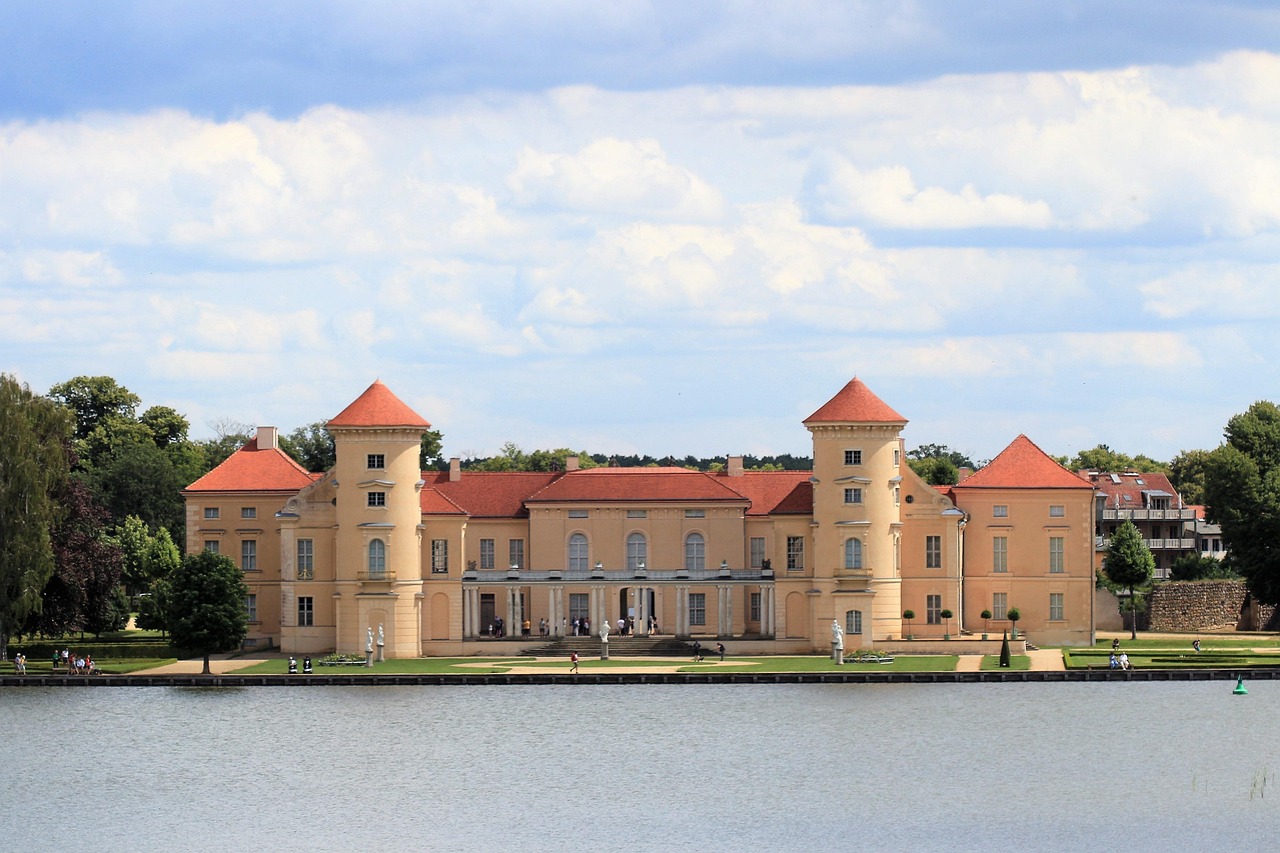
- Schloss Rheinsberg on the Grienericksee, crown prince’s residence of Frederick II and later seat of Prince Henry, with the Kurt Tucholsky Literature Museum in the palace; the park with its obelisk and hedge theatre is freely accessible.
- Rheinsberg ceramics: a manufactory, workshops and a ceramics museum in the town recall the long tradition of earthenware and ceramics production.
- CampingSpirit overnight tip
-
Official campsite or RV park: The Campingplatz Warenthin lies a few kilometres north-west of the palace on the Rheinsberger See, with electricity, sanitary facilities and service point; in summer, book waterside pitches early. More sites lie to the north along the chain of lakes around Kleinzerlang and Zechlinerhütte. Lindow also has a motorhome stopover and the Campingplatz Weißer Sand on the Gudelacksee.
Free camping or nature tip (where legal): Rheinsberg is busy in summer, and the car parks at the palace are meant for day visitors. Around the lakes, the shores often belong to landscape or nature reserves; you may not drive your vehicle on forest tracks. Stay overnight on campsites or motorhome pitches.
- Insider tip for campers
- The area around the palace and the old town have narrow streets; park on the edge of town and walk. If you come in summer, you will find opera performances by the Kammeroper Schloss Rheinsberg in the palace theatre – check the programme and dates on the website in advance. Shop in Neuruppin or Rheinsberg: in the villages towards the Stechlin, supplies become scarce.
3Stage 3: Rheinsberg to Fürstenberg/Havel (approx. 35 km)
- The drive
- East to Menz on the edge of the Stechlin-Ruppiner Land Nature Park, a detour to Neuglobsow on the Großer Stechlinsee and on through beech and pine forest to Fürstenberg/Havel. A short stage on quiet, partly narrow roads with deer crossing. Allow time for a hike.
- Highlights & must-sees
- NaturParkHaus Stechlin in Menz with an exhibition on the lakes, forest and bog of the nature park – a good introduction before the hike.
- Großer Stechlinsee near Neuglobsow: one of the clearest lakes in northern Germany, setting of Fontane’s late novel “Der Stechlin”; a circular trail through beech forest along the shore, around 14 kilometres and about 4 hours for the full loop, starting at the Stechlinsee-Center in Neuglobsow.
- Fürstenberg/Havel: the Ravensbrück Memorial on the Schwedtsee, site of the largest women’s concentration camp in the German Reich. Plan enough time, behave with restraint and take photos with consideration.
- CampingSpirit overnight tip
-
Official campsite or RV park: The Naturcampingplatz am Roofensee near Menz lies in the forest on the lakeshore, with electricity and sanitary facilities, quiet and close to nature. In Fürstenberg, the Reisemobilstellplatz at the Marina Fürstenberg offers waterside pitches with electricity and service point, close to the centre. The Wasserwanderrastplatz (paddlers’ rest area) in town is intended for canoeists and tents, not for motorhomes.
Free camping or nature tip (where legal): Lake Stechlin and its shores are under strict nature protection; there are no overnight stays at the hiking car parks in Neuglobsow. Staying overnight in the car parks of the Ravensbrück Memorial is inappropriate – drive to the motorhome stopover in town.
- Insider tip for campers
- The Stechlin attracts many day visitors in summer; arrive early, otherwise the car parks in Neuglobsow are full. Swim only at the designated spots. Check the opening hours of the exhibitions at the Ravensbrück Memorial on the website beforehand. Fürstenberg is also the link to two neighbouring routes: the Mecklenburg Lake District begins just to the north, the Uckermark to the east – CampingSpirit covers both in separate travel guides, on the Mecklenburg Lake District and on Schorfheide, Uckermark and Oderbruch.
4Stage 4: Fürstenberg/Havel to Wittstock/Dosse (approx. 70 km)
- The drive
- Back via Menz towards Rheinsberg, then north along the chain of lakes via Zechlinerhütte and Flecken Zechlin, through the Wittstock-Ruppiner Heide to Wittstock. Many tree-lined avenues; on the heath section long straight stretches through pine forest. Around 1.5 hours’ driving.
- Highlights & must-sees
- Zechlinerhütte: a small Alfred Wegener Museum at the place where the later polar explorer and founder of the theory of continental drift spent summers as a child – ask about opening in advance, as the museum has been closed at times; plus shoreline paths on the Schlabornsee and Tietzowsee.
- Wittstock-Ruppiner Heide: a former military training area, today a large heathland with viewpoints on its edge; do not leave the paths, as there is still unexploded ammunition on the site.
- Wittstock: an almost completely preserved brick town wall with the Gröper Tor gate, which you can walk around the old town, plus the Marienkirche.
- CampingSpirit overnight tip
-
Official campsite or RV park: The Reisemobilstellplatz Wittstock/Dosse lies close to the old town, with electric hook-ups and service point; the number of pitches is limited, fees on site. A few kilometres north of town there is also a small, basic stopover at the Daberturm. If you prefer to stay by a lake, you will find several campsites around Zechlinerhütte, for example on the Großer Zechliner See.
Free camping or nature tip (where legal): Because of ammunition contamination, the Wittstock-Ruppiner Heide may only be entered on approved paths; vehicle access is closed. Lakeshores around Zechlin are often nature reserves. Free camping is not an option here.
- Insider tip for campers
- Fill up and shop in Wittstock – there is little until Pritzwalk. On the heath the ground is pure sand; do not follow the satnav onto unpaved tracks, as a heavy motorhome quickly gets stuck there.
5Stage 5: Wittstock/Dosse to Plattenburg (approx. 60 km)
- The drive
- West into the Prignitz to Heiligengrabe, on to Pritzwalk and south-west across flat farmland and villages with fieldstone churches to the Plattenburg. Mostly good country roads, cobblestones in the villages. A good hour of pure driving time.
- Highlights & must-sees
- Museum of the Thirty Years’ War in the Alte Bischofsburg in Wittstock: an exhibition on the Battle of Wittstock in 1636 and on life during the war – visit before you set off.
- Kloster Stift zum Heiligengrabe: a former 13th-century Cistercian convent with enclosure, cloister and Holy Sepulchre chapel, today a Protestant women’s foundation.
- Plattenburg: considered the oldest surviving moated castle in northern Germany, surrounded by ramparts and a double moat, once the summer residence of the bishops of Havelberg; with chapel, knights’ hall and castle café.
- CampingSpirit overnight tip
-
Official campsite or RV park: Right next to the Plattenburg there is a small motorhome stopover with only a few pitches; ask the castle management or the Prignitz tourism association about electricity and fees in advance. More space is offered by the Caravanstellplatz at the Kristall-Therme in Bad Wilsnack, a few kilometres west, with electricity and service point. In Pritzwalk, the stopover on the Dömnitzinsel is close to the centre for a short stop.
Free camping or nature tip (where legal): The Prignitz is sparsely populated, but the rule applies here too: no camping on farm tracks and meadows. Farm tracks belong to the farmers, and harvesters need the full width. A single overnight stay in public car parks without a ban is tolerated, as long as nothing looks like camping.
- Insider tip for campers
- Pritzwalk is a good supply stop: supermarkets, petrol stations and a service point at the Dömnitzinsel stopover. The Heiligengrabe convent has a car park on its edge; guided tours of the enclosure only at set times, ask in advance.
6Stage 6: Plattenburg to Havelberg (approx. 40 km)
- The drive
- Via Bad Wilsnack into the Elbe valley meadows to the stork village of Rühstädt and on minor roads along the Elbe dyke and the Havel lowlands to Havelberg, which already lies in Saxony-Anhalt. Flat with few bends, but narrow; some dyke and farm roads are closed to motor vehicles or weight-restricted – watch the signs and do not follow the satnav blindly. Just under an hour’s driving.
- Highlights & must-sees
- Wunderblutkirche St. Nikolai (Church of the Miraculous Blood) in Bad Wilsnack, in the late Middle Ages the destination of one of the largest pilgrimages in northern Europe.
- The stork village of Rühstädt in the UNESCO Flusslandschaft Elbe Biosphere Reserve, with numerous stork nests on roofs and barns in summer.
- Havelberg: the Dom St. Marien high above the island town, a Romanesque building with Gothic remodelling and a richly decorated rood screen; the Prignitz-Museum is in the former enclosure. View from the cathedral hill over the old-town island in the Havel.
- CampingSpirit overnight tip
-
Official campsite or RV park: The Campinginsel Havelberg lies on an island in the Havel opposite the old town, within walking distance of the cathedral, with sanitary facilities and its own motorhome area; ask the site about season, electricity and service point in advance. The island can be affected by flooding – ask about the water level.
Free camping or nature tip (where legal): The Elbe valley meadows are a biosphere reserve with nature reserves; dyke paths and meadows are not pitches, and you may not drive on the dykes. In Havelberg: parking yes, camping only at the campsite.
- Insider tip for campers
- Havelberg is a Hanseatic town with a tight island old town and cobblestones; park the motorhome on the edge and walk across the bridges. In Bad Wilsnack the Kristall-Therme offers a day of brine bathing – handy if the weather turns.
7Stage 7: Havelberg to Rathenow (approx. 55 km)
- The drive
- Back into Brandenburg and south on the east side of the Havel through the Westhavelland, with meadows, oxbow lakes and small villages, via Rhinow to Rathenow. Narrow country roads, in parts tree-lined avenues and cobblestones; lots of wildlife at dusk. A good hour of pure driving time.
- Highlights & must-sees
- Gülper See in the Westhavelland Nature Park: a resting area for geese and cranes, with observation from designated points. The nature park is also designated a dark-sky park, with a very dark night sky.
- Gollenberg near Stölln: the flying ground where Otto Lilienthal tested his gliding flights, with a memorial and the airliner “Lady Agnes”, which landed there, as a museum.
- Rathenow, the “City of Optics”: the Optikpark on the bank of the Havel and exhibitions on the optical industry, which began here around 1800 with Johann Heinrich August Duncker.
- CampingSpirit overnight tip
-
Official campsite or RV park: The Wohnmobilstellplatz Rathenow lies centrally on the Havel, with electricity and service point; check the fee and number of pitches on site. The Campingplatz “Am Steggel” west of town offers more comfort with sanitary facilities and pitches close to the water.
Free camping or nature tip (where legal): The Westhavelland contains large bird sanctuaries; meadows and dykes are off-limits, especially during breeding and resting seasons. For a starry sky without light pollution, a campsite on the edge is enough – or an evening detour to a public car park, without staying there overnight.
- Insider tip for campers
- Mosquitoes: in early summer and after rain, the Havel lowlands are full of mosquitoes – close the fly screens before the lights go on. Fill up and shop in Rathenow; the villages between Havelberg and Rhinow have hardly any supplies.
8Stage 8: Rathenow to Nauen (approx. 65 km)
- The drive
- East via Nennhausen into the Havelländisches Luch near Buckow and Garlitz, on north-east to Paulinenaue and south-east to Ribbeck and Nauen. Flat grassland with ditches, dead-straight roads and rows of poplars, with tree-lined avenues in between. A good hour of pure driving time; from Nauen it is still around 40 kilometres to Berlin.
- Highlights & must-sees
- Great bustards in the Havelländisches Luch: two freely accessible observation towers around 2 kilometres south-east of Buckow towards Garlitz offer views over the display and grazing areas of these rare birds. Park the motorhome only on paved surfaces, not on field entrances; bring binoculars or a spotting scope, be patient and keep quiet on the tower.
- Paulinenaue: manor park and starting point for tours into the open Luch landscape with its meadow-nesting birds.
- Ribbeck: the village from Fontane’s ballad of Herr von Ribbeck, with manor house, village church and the pear tree beside it; the stump of the old tree can be seen in the church.
- CampingSpirit overnight tip
-
Official campsite or RV park: There is a small motorhome stopover at Schloss Ribbeck; ask the Schloss about the number of pitches and facilities in advance. South-east of Nauen, the Campingplatz am Havelkanal is an alternative for the last night before Berlin.
Free camping or nature tip (where legal): The Havelländisches Luch is a European bird sanctuary. Great bustards are extremely sensitive to disturbance: stay on the paths and towers, do not stop at the roadside next to the fields, and leave drones in the cupboard. Overnight stays at the towers are not intended.
- Insider tip for campers
- The best time for great bustards is the display season from about mid-March to mid-May, in the early morning; the Förderverein Großtrappenschutz offers guided tours. Nauen has supermarkets, petrol stations and an old town with town hall and parish church – a good place to stock up before heading back into the Berlin low-emission zone.
Camping practice & local rules
Wild camping & overnight parking
- Germany has no right to free camping. As a rule, a single night in public car parks to restore fitness to drive is tolerated, as long as there is no prohibition sign and nothing looks like camping – no awning, no chairs, no levelling jacks.
- Brandenburg: forest and farm tracks are closed to motor vehicles, and parking in the forest is not permitted under the state forest act. Open fires in or near the forest only at approved spots; when the forest fire risk is high, do without barbecues and cigarettes entirely – pine forest on sand burns quickly.
- Protected areas on this route: the Stechlin-Ruppiner Land Nature Park, the Westhavelland Nature Park, the Havelländisches Luch bird sanctuary and the Flusslandschaft Elbe Biosphere Reserve. In nature reserves you must stay on the paths; tents and overnight stays outside designated sites are prohibited.
- Havelberg belongs to Saxony-Anhalt; the basic rules are the same, and you may not drive on dykes and floodplains.
- Wasserwanderrastplätze (paddlers’ rest areas) are intended for boaters; you may only park there where an area is expressly designated for motorhomes. Useful tools: park4night, Campercontact, the motorhome pages of Reiseland Brandenburg and of the regional tourism associations Ruppiner Seenland, Prignitz and Havelland.
Waste disposal & supplies
- Service points are available at most town motorhome stopovers, for example in Oranienburg, Wittstock, Pritzwalk, Rathenow and Fürstenberg, often coin-operated or for a fee. In the countryside the stations are far apart – fill up and empty before longer stages.
- Empty cassettes and grey water only at stations; lakes and ditches are sensitive waters, and many are used for swimming.
- Tap water in Germany is drinking water; at taps on campsites, look out for signs.
- Gas: German exchange cylinders are available at petrol stations, DIY stores and gas dealers; LPG stations for refillable tanks are mainly found in the larger towns. Check locations in an app beforehand.
Vehicle size & traffic rules
- Speed limits: motorhomes up to 3.5 t 100 km/h outside built-up areas, on motorways an advisory speed of 130 km/h; over 3.5 to 7.5 t 80 km/h outside built-up areas and 100 km/h on motorways; over 7.5 t 60 km/h outside built-up areas and 80 km/h on motorways. Car-and-caravan combinations 80 km/h, with Tempo 100 approval 100 km/h on motorways.
- Tree-lined avenues: the trees often stand right at the edge of the road, without hard shoulders or crash barriers. Reduced speed limits apply on many avenues and are enforced; keep your distance from the right-hand edge, keep an eye on mirrors and over-cab, and expect oncoming farm machinery.
- Low-emission zones: Berlin inside the S-Bahn ring only with a green sticker, foreign vehicles included. There is no low-emission zone on the route itself.
- Tolls: motorhomes pay no tolls in Germany. Winter equipment is required according to conditions: in icy conditions, winter or all-season tyres with the Alpine symbol are mandatory.
- Alcohol: 0.5 per mille, 0.0 for novice drivers in their probationary period and drivers under 21. Mobile phones only with a hands-free kit. Mark loads that overhang by more than 1 m; if the rear rack covers the number plate or lights, it needs an additional number plate and a light bar.
CampingSpirit packing & preparation checklist
- Fly screens for door and windows plus mosquito repellent: along the Havel, in the Luch and by the lakes, the mosquitoes are fierce in early summer.
- Traction aids or traction mats: Brandenburg sand on access tracks and grass pitches does not readily let go of heavy vehicles.
- Binoculars or a spotting scope for great bustards in the Luch, cranes at the Gülper See and white-tailed eagles over the lakes.
- Green low-emission sticker for Berlin – get it before the trip; it is not sold at the boundary of the low-emission zone.
- Bikes on the rear rack with a light bar: cycle paths around Lake Stechlin, along the Havel and in the Havelland are flat and save you manoeuvring in narrow old towns.
- Waterproof hiking boots for sandy shoreline paths and damp meadows in the Luch.
As of 2026-10. Closures, fees and booking rules change: check official sources before you go.