


In-depth guide · CampingSpirit
From Turku via Naantali and the islands of Pargas, Nagu, Korpo, Houtskär and Iniö to Kustavi, then on the northern line via Brändö to Åland and back by large ferry: around 340 road kilometres, but nine ferry crossings on which the timetable sets the pace.
The spirit of the route
In the largest archipelago of the Baltic Sea you never drive straight for long. After twenty minutes of tarmac over humps of red granite, past pines, reedy bays and jetties, the road ends at a ramp, and then you wait – sliding door open, a coffee in hand and a view of the water dotted with hundreds of islands. The ferries set the rhythm: small yellow road ferries shuttling back and forth, a tiny connecting vessel with room for only a handful of vehicles, and finally the hours-long passage of the Åland northern line between skerries holding nothing but a red wooden house and a flagpole. In the evening the air smells of seaweed and sauna, and the sun sets late and low over the sea. On Åland people speak Swedish, Kastelholm Castle stands among meadows, and in Mariehamn a four-masted barque lies at the quay. This route rewards slowness.
Stage-by-stage plan
1Stage 1: Turku to Naantali (approx. 20 km)
- The drive
- A city day in Turku (Swedish: Åbo), Finland’s oldest city, then a short hop via Raisio to Naantali: around 20 km on a well-built road, just under half an hour’s drive. In central Turku, parking for large vehicles is scarce and multi-storey car parks are too low – better to leave the vehicle on the outskirts or at the campsite and take the buses of the regional transport network Föli, which also serves Raisio and Naantali.
- Highlights & must-sees
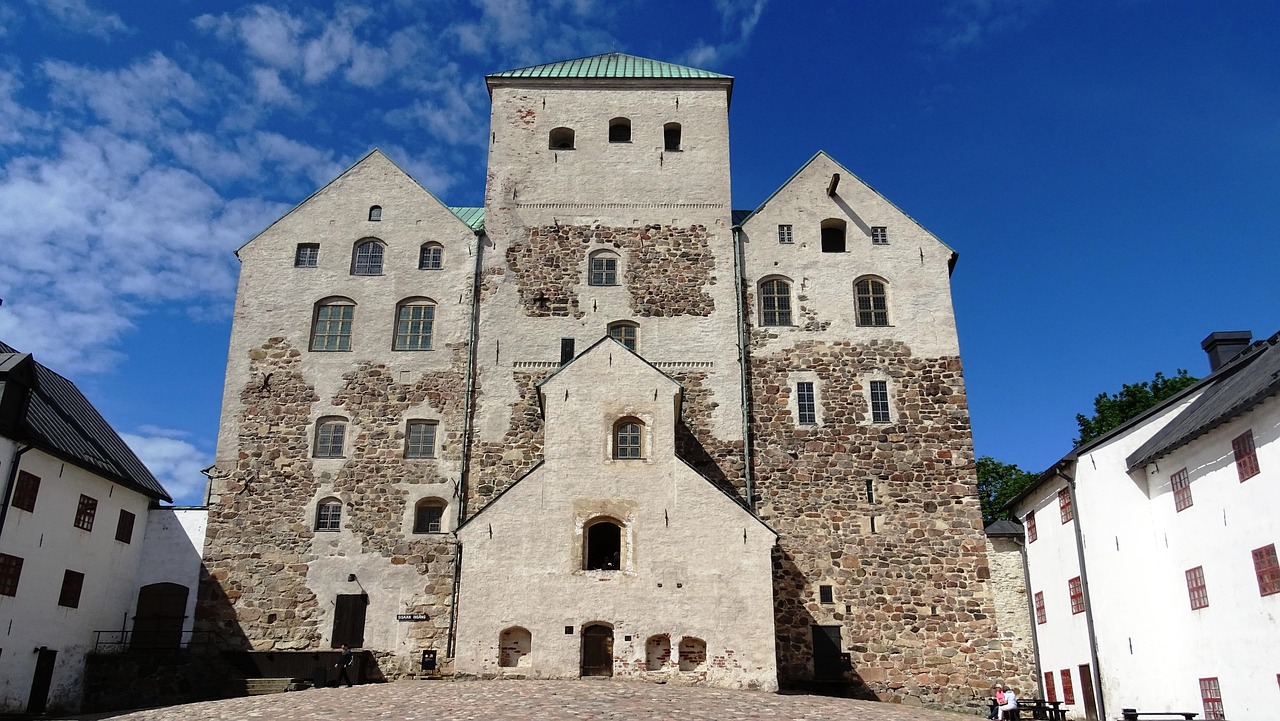
- Turku Castle (Turun linna) at the mouth of the Aura near the harbour: a medieval main castle with a Renaissance bailey, now a museum.
- Turku Cathedral, Finland’s brick-built national shrine, and the walk along the Aura with museum ships, bridges and riverside restaurants; the small free ferry Föri takes pedestrians and cyclists across the river.
- Naantali Old Town: wooden houses with gardens in the lanes behind the guest harbour, above them the convent church of the former Bridgettine convent; opposite, on the island of Luonnonmaa, lies Kultaranta, the President’s summer residence (garden tours in summer).
- CampingSpirit overnight tip
-
Official campsite or RV park: Naantali Camping, a few hundred metres south of the Old Town on the water, with pitches for motorhomes, electricity, sanitary facilities and sauna; check season, water/waste services and prices with the operator in advance. In Turku itself, Ruissalo Camping lies on the green island of Ruissalo with a swimming beach and, in summer, a bus link to the centre. A Matkaparkki network aire is in Raisio, between the two towns.
Free camping or nature tip (where legal): There is no room for wild camping within Turku and Naantali: parking is possible in permitted areas, camping behaviour (chairs, awning, barbecue) is not, and many waterfront car parks are time-limited or pay-and-display. If you want to stay cheaply, use the aires in the surrounding area or the sites of the SF-Caravan clubs, which also take guests.
- Insider tip for campers
- Turku is the departure point for the ferries to Åland and Stockholm; if you arrive by ferry, head to a large supermarket on the outskirts for your first shop, where motorhomes can also find room to park. An outing for maritime fans: the Forum Marinum museum centre on the Aura near the castle.
2Stage 2: Naantali to Pargas (Parainen) (approx. 45 km)
- The drive
- Back towards Turku, along the ring road to Kaarina and there onto road 180, which as the Archipelago Trail (Saariston rengastie) leads over bridges and causeways to Pargas. Well built, slow in rush-hour traffic around Turku; pure driving time under an hour. From Kaarina the landscape opens up: fields, rocks, the first sea bays.
- Highlights & must-sees
- Kuusisto Castle ruins in Kaarina, a short detour off road 180: remains of the medieval bishop’s castle by the water, freely accessible.
- The Pargas limestone quarry: one of the largest open-pit mines in Finland, with a viewpoint on the edge of the pit in the middle of town.
- Medieval Pargas Church with its massive buttresses, and the quarter of wooden houses around it.
- CampingSpirit overnight tip
-
Official campsite or RV park: Camping Solliden on the shore near Pargas, with pitches for motorhomes and tents; check facilities, electricity and season with the operator in advance. Pargas is the last town before the islands – use the water and waste services here once more.
Free camping or nature tip (where legal): The Finnish everyman’s right covers tent camping, not overnighting in a motorhome on someone else’s land. On the islands almost all land is private or summer-cottage property; tracks with a barrier or the sign “yksityistie”/“privat väg” are off-limits. Overnighting in the ferry waiting and marshalling lanes is not intended.
- Insider tip for campers
- Fill up and do a big shop in Pargas: further out there are only small shops with short opening hours outside the summer holidays, and filling stations become rare. You hardly need cash, but you do need a card with a PIN, including at unmanned pumps.
3Stage 3: Pargas to Houtskär (via Nagu and Korpo) (approx. 50 km)
- The drive
- Three road ferries in one day: from Pargas to the Lillmälö ramp, by ferry (around ten minutes, frequent service during the day) to Prostvik on Nagu (Nauvo), on via Nagu Kyrkbacken to the Pärnäs landing, by the short ferry to Retais on Korpo (Korppoo) and across the island to Galtby, and from there by ferry to Kittuis on Houtskär (Houtskari), a good half-hour and less frequent than the first two. The road is narrow and winding, with blind crests and no hard shoulder. The road ferries on these three routes are free and take motorhomes and car-and-caravan combinations without any problem; in summer long queues form before weekends.
- Highlights & must-sees
- Nagu Kyrkbacken: guest harbour with jetties, shops and cafés, and behind it the medieval stone church on the hill.
- Korpo Church, also medieval, on a rise above the island.
- Skärgårdscentrum Korpoström on the road to Galtby: visitor centre with an exhibition on the Archipelago National Park, boat trips and harbour life in summer; opening hours seasonal.
- CampingSpirit overnight tip
-
Official campsite or RV park: Kittuis Camping & Caravan on Houtskär, right by the Kittuis ferry landing, with pitches for motorhomes and tents, electricity and sanitary facilities according to the operator; limited season, check the current status in advance. On Korpo, Rumarstrand is another small site on the water.
Free camping or nature tip (where legal): The Archipelago National Park (Saaristomeren kansallispuisto) lies almost entirely on islands reachable only by boat; there is nowhere to stand with a vehicle. Wild camping at the roadside quickly becomes a problem for residents and ferry traffic on the narrow islands – better to use campsites and guest harbours with parking spaces, and ask first.
- Insider tip for campers
- Ferry timetables are posted at the ramps and online at Finferries; departures from Galtby to Houtskär are thinned out, especially in the evening. Galtby is also the port of the Åland southern line via Kökar to Långnäs – the alternative route to Åland if the Archipelago Trail further north cannot be driven.
4Stage 4: Houtskär to Kustavi (via Iniö) (approx. 50 km)
- The drive
- Across Houtskär north to the Mossala landing, where the bottleneck of the loop awaits: a small connecting vessel (yhteysalus) to Dalen on Iniö, three-quarters of an hour or a little more, with room for only a few vehicles and running to a frequent timetable only in the summer season; outside that it runs a reduced service, partly only on advance notice. On Iniö a short island road to the road ferry from Kannvik to Heponiemi on Kustavi (a good 20 minutes, year-round), then over bridges and causeways into the church village of Kustavi.
- Highlights & must-sees
- Iniö, a municipality in its own right until 2009 and now part of the town of Pargas: church village with a wooden church, shop and harbour, surrounded by open water – on the crossing, the loneliest stage of the loop.
- Kustavi’s 18th-century wooden church with votive ships, a testament to the municipality’s seafaring tradition.
- The fortress island of Katanpää off Kustavi: a Russian fortification from the First World War era, now a nature reserve with trails, reachable by boat in summer.
- CampingSpirit overnight tip
-
Official campsite or RV park: Camping Lootholma on the edge of Kustavi church village by the water, with pitches for motorhomes; other sites are Lomavalkama and Kustavin Lomapalvelut. Check facilities and season in advance – in the shoulder season many sites only keep their cabins open.
Free camping or nature tip (where legal): As on all the islands: overnighting in the vehicle only on sites or with the landowner’s permission. Many farms and guest harbours in Kustavi let motorhomes stay for a fee if you ask.
- Insider tip for campers
- For the Mossala–Iniö connecting vessel without a booking: first in the lane, first on board; whether and when advance notice is required is stated in the current timetable. Be there early, check your vehicle’s length, height and weight against the operators’ current information beforehand, and have a plan B: if the vessel is out of season or full, the only way is back via Korpo, Nagu and Pargas, or alternatively the southern line from Galtby to Åland. Timetables and season dates of the Rengastie connections change every year.
5Stage 5: Kustavi to Bomarsund (via Brändö and Vårdö) (approx. 45 km)
- The drive
- A ferry day: from the port of Vuosnainen (Swedish: Osnäs) by Ålandstrafiken ship to Åva on Brändö, along the Brändö island chain over bridges and causeways to Torsholma, then on the northern line via Lappo, Kumlinge and Enklinge to Hummelvik on Vårdö – a passage of around two and a half to three hours between open skerries. From Hummelvik across the island and by the short cable ferry to Prästö; a few kilometres further on, Bomarsund lies on the Åland mainland. The Ålandstrafiken ships on these lines charge fares; vehicles should be booked in advance, some departures run only on prior booking, and if you turn up without a booking you pay the full fare on board and only travel if there is space. Vehicles must be ready in the departure port no later than 15 minutes before departure.
- Highlights & must-sees
- Brändö: Åland’s northernmost archipelago municipality, with fishing villages, rocky bays and hardly any traffic.
- Kumlinge with St Anne’s Church and its late-medieval wall paintings – reachable only if you break the journey there and book the onward ship separately.
- Bomarsund fortress ruins: remains of the Russian fortress destroyed by British and French troops in the Crimean War in 1854, with cemeteries on Prästö and a visitor centre in the summer season.
- CampingSpirit overnight tip
-
Official campsite or RV park: Puttes Camping right by the Bomarsund fortress ruins on the water, with pitches for motorhomes and tents; check electricity, sanitary facilities and season with the operator in advance.
Free camping or nature tip (where legal): On Åland the everyman’s right is governed by the province’s own legislation and interpreted more narrowly than on the Finnish mainland: you should get the landowner’s permission even for tent camping, and in a motorhome you overnight on campsites and designated aires. The Bomarsund ruins are a protected cultural monument – the car parks there are for visitors only.
- Insider tip for campers
- Book the crossing with Ålandstrafiken in good time; for vehicles you need a customer registration with a mobile number, which is also used to send service disruption alerts. Separate rules apply to through journeys from terminal port to terminal port within one day: such through journeys can only be booked via the Ålandstrafiken office, the quota is limited and applies only to lighter vehicles up to 13.5 m without a trailer; car-and-caravan combinations and other vehicles need a separately approved booking right – check with Ålandstrafiken beforehand. If you spend a night on Brändö or Kumlinge, you book individual legs and travel in a more relaxed way.
6Stage 6: Bomarsund to Eckerö (via Kastelholm and Geta) (approx. 80 km)
- The drive
- Via Sund to Kastelholm, then through the farmland of Saltvik north to the Geta hills and via Hammarland to Eckerö on the western edge of the islands. Quiet, well-surfaced country roads with crests and bends, plenty of cyclists, and on Åland lower speed limits than on the mainland; pure driving time just under an hour and a half.
- Highlights & must-sees
- Medieval Kastelholm Castle on the sound, next to it the Jan Karlsgården open-air museum with farmhouses and windmills, and the Vita Björn prison museum.
- Getabergen in Geta: a viewpoint high above the northern skerries, with a nature trail through rocks and crevices.
- The Post and Customs House in Eckerö: the monumental building designed by Carl Ludvig Engel recalls the old postal route across the Åland Sea to Stockholm, with a small museum, café and exhibitions in summer.
- CampingSpirit overnight tip
-
Official campsite or RV park: Käringsunds Camping in Eckerö on Käringsund bay with its boathouses, with pitches for motorhomes, electricity and sanitary facilities according to the operator. Alternatives in Eckerö are Eckerö Camping & Stugor and Degersand on the sandy beach in the south; check season and current status in advance.
Free camping or nature tip (where legal): Beaches and bathing spots such as Degersand are open during the day; overnighting in the vehicle outside the sites is not intended on Åland. When there is a forest fire warning, a ban on outdoor fires applies here too.
- Insider tip for campers
- The ferry to Grisslehamn in Sweden leaves from Eckerö – the shortest connection to the Swedish mainland, if your journey continues west from here. Watch out on the islands: deer and other game cross the roads, especially at dusk.
7Stage 7: Eckerö to Mariehamn (approx. 40 km)
- The drive
- Via Hammarland and Jomala to the capital Mariehamn, which lies on a narrow peninsula between the West and East Harbours. A short stage on a wide country road, just under an hour; time for Mariehamn, the beach and shopping.
- Highlights & must-sees
- The four-masted barque “Pommern” in the West Harbour, open to visitors as a museum ship, and the maritime museum right next to it.
- Sjökvarteret on the East Harbour: boatyard, workshops and wooden boats, a testament to Åland’s seafaring culture.
- Ålands museum, covering the islands’ history from the Stone Age to autonomy, plus the linden-lined Esplanaden avenue in the middle of town.
- CampingSpirit overnight tip
-
Official campsite or RV park: Gröna Uddens Camping by the sea in the south of Mariehamn, within walking distance of the centre, with pitches for motorhomes, electricity, sanitary facilities and water/waste services according to the operator; limited season, book in summer.
Free camping or nature tip (where legal): In Mariehamn parking is regulated by parking disc or by signage; overnighting in the vehicle outside the campsite and aires is not tolerated. For the early ferries, a pitch near the harbour makes sense.
- Insider tip for campers
- Empty the tanks and fill up with fresh water before the return trip. If you buy alcohol or tobacco on Åland, bear the tax border in mind: Åland is part of the EU but lies outside the EU tax area – which is why ferries stopping here may sell duty-free, and allowances apply on the way to Turku.
8Stage 8: Mariehamn to Turku (ferry) (approx. 10 km)
- The drive
- By large ferry from Mariehamn to Turku, around five to six hours through the Archipelago Sea – several shipping lines run the Stockholm–Åland–Turku route daily, and some ships call at Långnäs at night instead of Mariehamn. Alternatively from Långnäs (a good 30 km east of Mariehamn) to Naantali. The road kilometres are only for the harbour approaches.
- Highlights & must-sees
- The passage through the Turku archipelago from the outer deck: narrow fairways between Korpo, Nagu and Pargas, which you drove around by road in the days before.
- Arrival in Turku up the Aura, with the castle right by the harbour.
- To round things off, sauna culture by the water: Turku and Naantali have public saunas with sea access.
- CampingSpirit overnight tip
-
Official campsite or RV park: Back in Turku, Ruissalo Camping is again a good choice, a few kilometres from the ferry port; if you arrive in Naantali, the site there.
Free camping or nature tip (where legal): Overnighting in the harbour lanes or in terminal car parks is not permitted; for an early departure, better to stay on a site near the harbour.
- Insider tip for campers
- Book the ferry early and state length and height honestly, as fares depend on them. Keep gas bottles closed during the crossing, fridge on electricity or off – the exact rules are in the shipping line’s conditions of carriage. On arrival from Åland, Finnish Customs may carry out checks at the port; if you bring more than the allowances, declare the goods. If you continue inland afterwards, you’ll find the Lakeland and Lapland in the CampingSpirit travel guide “Lakes, taiga and the Arctic Circle” from Helsinki through the Saimaa Lakeland to Lapland.
Camping practice & local rules
Wild camping & overnight parking
- Finland: the everyman’s right (jokamiehenoikeus) allows hiking, berry picking and temporary tent camping at a reasonable distance from homes, but not leaving vehicles on someone else’s land or driving off roads and tracks. Parking overnight is possible where parking is allowed; on private roads and land you need the owner’s permission. On the archipelago islands almost all land is privately owned.
- Åland: the autonomous province has its own laws on nature and traffic, and the everyman’s right is interpreted more narrowly there. Expect to need the landowner’s consent even for tent camping; in a motorhome you overnight on campsites and aires.
- National parks and protected areas (Archipelago National Park, Katanpää) have their own rules: overnighting and fires only at designated spots; current information from Metsähallitus (nationalparks.fi). When there is a forest fire warning, open fires are banned, including barbecues in the countryside.
- Useful tools: park4night, Campercontact and the Finnish aire network Matkaparkki; plus the sites of the SF-Caravan clubs, which often take guests too. Farms and guest harbours in the archipelago let motorhomes stay for a fee if you ask.
Waste disposal & supplies
- Water and waste services are available at campsites and aires in Turku, Naantali, Pargas and Mariehamn; on the small islands they are scarce and tied to site operation and season. Before every island day, empty the cassette and grey water and fill up with fresh water.
- Tap water is drinkable in Finland and on Åland. Never empty grey water into ditches or the sea – the shallow bays of the archipelago are fragile.
- Gas: Finnish bottles are their own types, foreign exchange bottles are not swapped, and autogas (LPG) is practically unavailable in Finland. Arrive with full bottles; for longer stays, buy a Finnish bottle with an adapter or rely on electricity at sites.
- Fuel and shopping: large supermarkets and filling stations in Turku, Naantali, Pargas and Mariehamn, but only a few pumps and small shops on the islands in between. On the mainland, alcoholic drinks above the supermarket limit are only sold at Alko; Åland has its own alcohol laws, so check outlets and opening hours there in advance.
Vehicle size & traffic rules
- Speed limits on the mainland: 50 in built-up areas, generally 80 km/h outside them, up to 100 on signposted roads and up to 120 km/h on motorways in summer, reduced in many places in the winter half of the year. Motorhomes up to 3.5 t follow car limits; car-and-caravan combinations and heavier motorhomes are restricted to lower maximum speeds, usually 80 km/h – check your vehicle documents and the signs. Åland has its own road traffic law with lower limits, mostly between 70 and 90 km/h – follow the signs.
- Dipped headlights are compulsory all year round, the blood alcohol limit is 0.5, and phone calls only with a hands-free kit. There are no tolls or vignettes in Finland or on Åland. The Finferries road ferries on the Archipelago Trail are free; the Ålandstrafiken ships and the large ferries to Åland charge fares, which depend on vehicle type and size.
- Tax border: Åland lies outside the EU tax area for VAT and excise duties. Travel allowances apply to alcohol, tobacco and other goods you bring from Åland to mainland Finland; if you exceed them, you must pay duty. Check the current limits with Finnish Customs (Tulli). Carry ID.
- Wildlife: white-tailed deer, roe deer and elk frequently cross the roads in south-west Finland, and roe deer on Åland too, especially at dusk. Collisions with large wild animals must be reported immediately on 112, even if the animal runs off.
- Winter tyres are compulsory from 1 December to the end of February in wintry road conditions; outside the summer season some connecting vessels do not run at all and the island campsites are closed. The best time for this route is between late May and late August.
- Ticks and mosquitoes: the Turku and Åland archipelagos are among the areas with a higher risk of TBE – on Åland the tick-borne encephalitis is even named “Kumlinge disease” after an archipelago island. Discuss vaccination with your GP before you travel. Mosquitoes are a nuisance on still evenings in June and July, less so on open rocks than in the forest.
CampingSpirit packing & preparation checklist
- Tick tweezers and vaccination card: the Turku and Åland archipelagos are among Finland’s TBE risk areas, and the meadows at castles and bathing spots are full of ticks.
- Mosquito nets for roof vents and sliding door, plus a high-strength repellent for the still June evenings.
- Bikes on the rack: Åland is flat, the archipelago roads are short, and on many ferries you travel more comfortably by bike than with the vehicle.
- Storm straps and weights for the awning: pegs don’t hold in granite, and on the islands the wind picks up quickly.
- Full gas bottles and a suitable adapter: exchange bottles are not accepted, and autogas is hard to find.
- Printed timetables and booking confirmations for Ålandstrafiken and the large ferry – at the landings, an overview of the day’s last departures helps.
As of 2026-10. Closures, fees and booking rules change: check official sources before you go.