

In-depth guide · CampingSpirit
From Wellington over the Remutaka Hill Road to Martinborough, to the end of the world at Cape Palliser, to Castlepoint and over the new highway past the Manawatū back to the Kāpiti Coast: around 690 kilometres of driving on the left between pinot noir vines, gravel coast and wind-turbine ridges.
The spirit of the route
Barely 60 kilometres beyond Wellington, things go quiet. The road climbs in tight loops over the Remutaka Range, at the top the northwesterly tugs at the bodywork, and then the Wairarapa lies below you: pasture, rows of poplars, the shallow Lake Wairarapa and behind it the blue Tararua Ranges. In Martinborough the vines reach right to the edge of town, and in the evening the air smells of warm dust and lavender. At Cape Palliser the tarmac ends, bulldozers push fishing boats into the surf, and next to the gravel road fur seals sleep on the rocks, while from the sliding door you see nothing but Cook Strait and, on clear days, the peaks of the South Island. Castlepoint with its lighthouse on the reef, kiwi and kōkako in the forest at Pūkaha, the wind turbines above the Manawatū Gorge – this loop shows rural New Zealand without coach car parks, driven in short stages with plenty of time for the coast and a glass of wine.
Stage-by-stage plan
1Stage 1: Wellington to Martinborough via the Remutaka Hill Road (approx. 80 km)
- The drive
- From Wellington take SH2 through the Hutt Valley to Upper Hutt and on past Kaitoke. Then comes the Remutaka Hill Road: around 20 km of winding mountain road with tight hairpins, crash barriers right at the edge and a summit of just over 550 m; on the eastern side it drops steeply to Featherston. From there take SH53 across the flat country to Martinborough. Just under 1.5 hours of pure driving time, more on the pass in strong wind and fog.
- Highlights & must-sees
- Car park at the summit of the Remutaka Hill Road with a view back into the Pakuratahi valley – starting point for walks on the former railway line.
- Fell Locomotive Museum in Featherston: the only surviving Fell locomotive, which until 1955 used a centre rail to tackle the steep incline over the Remutaka Range.
- Wineries around Martinborough: dozens of small pinot noir producers lie so close together that you can tour the cellar doors by bike – the camper stays on its pitch.
- CampingSpirit overnight tip
-
Official campsite or RV park: Martinborough TOP 10 Holiday Park on the edge of town, a few minutes’ walk from the Square and the first wineries: powered sites, kitchen, bathrooms. If you would rather drive the pass the next morning, spend the night before at the campground in Kaitoke Regional Park (Greater Wellington) at the foot of the Remutaka Range – book ahead, check facilities and season.
Free camping or nature tip (where legal): The South Wairarapa District Council freedom camping bylaw (2024) allows only certified self-contained vehicles in the urban areas of Featherston, Greytown and Martinborough, for a maximum of three nights within four weeks at the same location or within a 500 m radius. Prohibited areas include the Martinborough Square Reserve, and in Featherston the Clifford Square Reserve and Fitzherbert Street (SH2). The same applies at the Fell Museum car park: self-contained only, three nights in four weeks.
- Insider tip for campers
- The Remutaka Hill Road is unpleasant for tall, light vehicles in a storm; NZTA then issues wind warnings, and the road is occasionally closed – check road status on NZTA Journeys. Slower vehicles use the pull-over bays. Trains on the Wairarapa Line to Wellington stop in Featherston, Carterton and Masterton: an alternative for a later city day without the camper.
2Stage 2: Martinborough to Putangirua Pinnacles via Lake Ferry and Cape Palliser (approx. 105 km)
- The drive
- Take Lake Ferry Road south through sheep farms to Lake Ferry on Lake Onoke, then follow Cape Palliser Road along Palliser Bay: narrow, winding, with no centre line along the coast, gravel and sand on the road surface and sections where storms eat away at the embankment. From Ngawi to the lighthouse it becomes gravel and single-lane – drive slowly and wait in bays for oncoming traffic. Back to the Putangirua Stream. A good 2.5 hours of pure driving time.
- Highlights & must-sees
- Lake Ferry: view across Lake Onoke and the gravel bar, behind which the surf of Palliser Bay breaks; the old hotel on the shore is an institution in the area.
- Ngawi, a fishing village where bulldozers push the boats over the gravel beach into the water, and just beyond it the fur seal colony (kekeno) on the rocks right next to the road – keep at least 20 m away and never step between an animal and the sea.
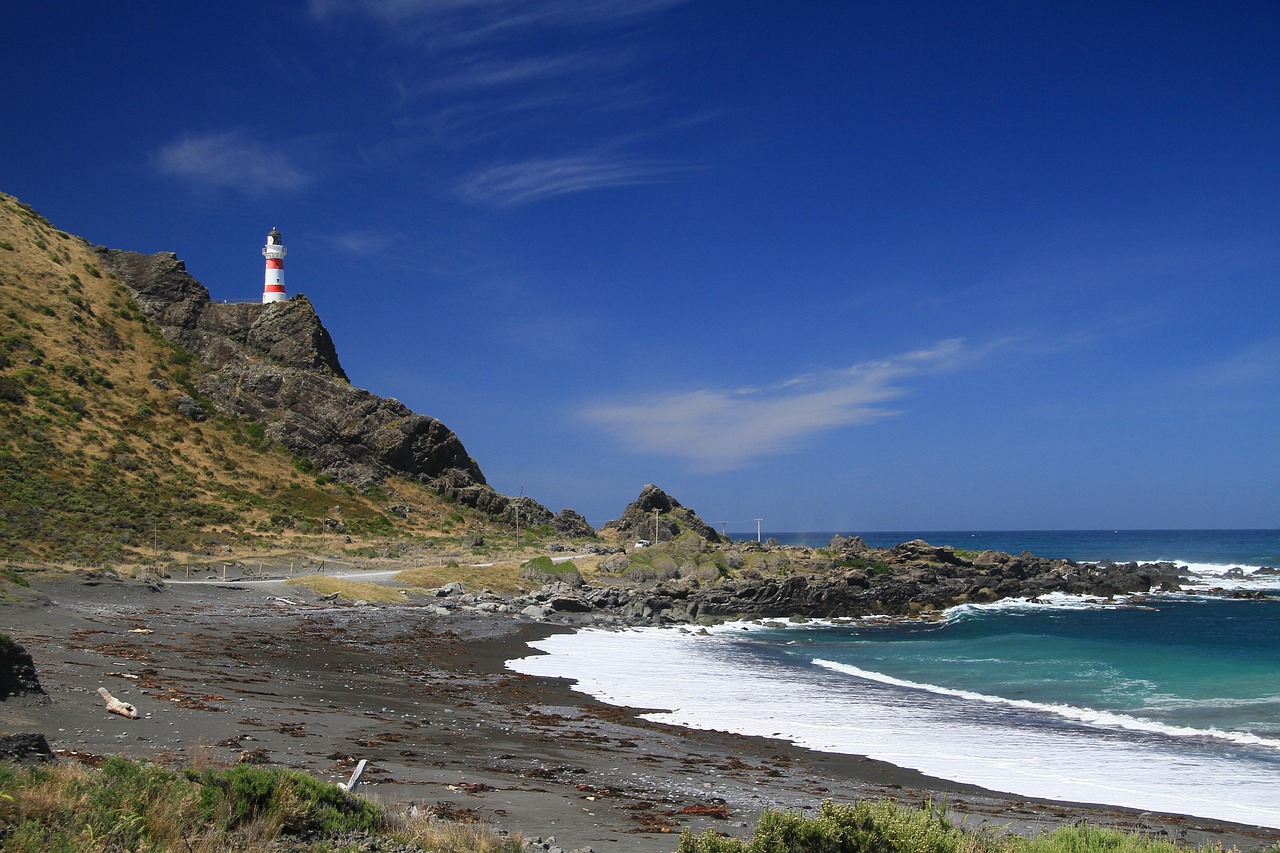
- Cape Palliser Lighthouse: red-and-white striped lighthouse at the top of around 250 steep wooden steps, with views from the top across Cook Strait to the South Island.
- CampingSpirit overnight tip
-
Official campsite or RV park: Putangirua Pinnacles Campsite (DOC, Standard category) between Lake Ferry and Cape Palliser, suitable for campervans, cars and caravans. Booking online and in advance only; no sites are held for walk-in arrivals; same-day booking is possible until 8 pm while space is available. The tap water is not drinking water and not always available, and fires are banned at all times. Alternative with power and showers: Lake Ferry Holiday Park.
Free camping or nature tip (where legal): Cape Palliser Road, including the roadside, is a prohibited area from house number 1271 up to and including the lighthouse car park. Under the South Wairarapa District Council bylaw, two areas near Ngawi are permitted – the Ngawi Reserve and the Ngawi Surf Breaks – where non-self-contained vehicles and tents are also allowed, for a maximum of 28 nights in twelve months. Toilets are scarce; without your own toilet, the DOC campsite is the better choice.
- Insider tip for campers
- Fill up and shop in Martinborough: there is no petrol station and no supermarket on the coast, and mobile coverage is patchy. Visit the lighthouse in the afternoon, when the light falls on the rocks from the west; in a southerly storm there is spray on the road. Rental agreements often exclude gravel roads from insurance cover – check the conditions for the section beyond Ngawi beforehand.
3Stage 3: Putangirua Pinnacles to Masterton via Greytown and Carterton (approx. 100 km)
- The drive
- In the morning walk to the Pinnacles, then drive back via Lake Ferry to Martinborough and on minor roads to Greytown. From there take SH2 through the wide, flat Wairarapa plain via Carterton to Masterton – a good road, but with 50 km/h limits and plenty of cross traffic through the towns. Around 1.5 hours of driving time.
- Highlights & must-sees
- Putangirua Pinnacles: walk up the gravel bed of the Putangirua Stream to the towering, eroded earth pillars where scenes from “The Lord of the Rings” films were shot; the Pinnacles Ridge Track leads to a lookout above the rock formations. Wear sturdy shoes and watch for rockfall after rain.
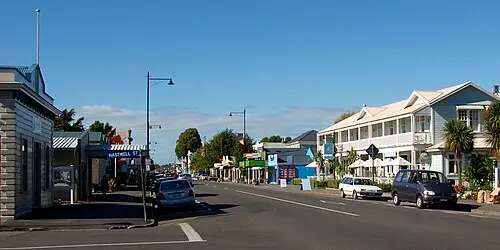
- Greytown: Main Street with Victorian wooden buildings, cafés and the Cobblestones open-air museum on the settlement history of the Wairarapa.
- Waiohine Gorge near Carterton: swing bridge across the gorge on the edge of Tararua Forest Park, reached via a narrow access road that is gravel towards the end – with a large camper only in dry weather.
- CampingSpirit overnight tip
-
Official campsite or RV park: Mawley Holiday Park in Masterton on the Waipoua River, near Queen Elizabeth Park: powered sites, kitchen, bathrooms. Along the way are the Greytown Campground and Carterton Holiday Park on Belvedere Road. For a night closer to nature, use the DOC campsites Holdsworth and Kiriwhakapapa at the foot of the Tararua Ranges west of Masterton – basic facilities, fee payable in cash according to the council.
Free camping or nature tip (where legal): In Greytown, Main Street (SH2) and the Hastwell Street car park are prohibited areas; elsewhere in town the rule is self-contained only, three nights in four weeks. The Carterton District Council bylaw (2023) prohibits freedom camping on several sites in town (including Sparks Park, Memorial Square and Carrington Park) and on the coast at Flat Point; elsewhere self-contained only, for a maximum of three consecutive nights at the same location or within a 500 m radius. The river reserves Gladstone, Kokotau and The Cliffs have toilets and can be used without a warrant, for a maximum of 21 nights in twelve months; their edge areas are closed. In Masterton, self-contained vehicles may park overnight at Henley Lake (Colombo Road) for a maximum of two nights.
- Insider tip for campers
- Set off early from the Pinnacles campsite: the stream bed is in shade in the morning, and the stream can rise in heavy rain. Masterton has large supermarkets and cheaper petrol stations than the south – stock up before Castlepoint.
4Stage 4: Masterton to Castlepoint (approx. 70 km)
- The drive
- Take Castlepoint Road northeast through hill country with sheep farms, via Tinui and through the Whakataki valley to the Pacific coast. Sealed throughout, but winding and narrow, with blind crests, stock gates and logging trucks. Around 1 hour of driving time; the road ends in Castlepoint – you return the same way.
- Highlights & must-sees
- Castlepoint Lighthouse on the limestone reef, reached via a boardwalk; beyond it the waves break over the cliffs.
- Castle Rock, the roughly 160 m high rock above the Deliverance Cove lagoon, with a climb along a steep ridge and views over the reef and coast.
- Tinui along the way: a village with a pub and a memorial cross on Tinui Taipo hill, which according to local tradition was erected as early as 1916 for one of the first ANZAC commemorations.
- CampingSpirit overnight tip
-
Official campsite or RV park: Castlepoint Holiday Park & Motels right behind the beach: powered and tent sites, bathrooms, kitchen. During the summer holidays and on public holiday weekends the park is full – book in good time.
Free camping or nature tip (where legal): At the car park in the Castlepoint Scenic Reserve (DOC), freedom camping is allowed only for self-contained vehicles, for a maximum of four nights per calendar month; from 1 November to 30 April a time window of 5 pm to 9 am also applies. On council land the Masterton District Council line applies: fully self-contained vehicles only; the council explicitly refers visitors to holiday parks and DOC campsites. Check the current status and signage on site.
- Insider tip for campers
- Rogue waves have swept people off the reef into the sea – in heavy seas and at high tide stay on the boardwalk and take the warning signs seriously. Choose calm morning hours for Castle Rock; the ridge at the top is narrow. Castlepoint has only basic supplies: bring water, gas and food from Masterton.
5Stage 5: Castlepoint to Woodville via Pūkaha and Eketāhuna (approx. 150 km)
- The drive
- Back to Masterton and north on SH2: over the forested Mount Bruce saddle to the Pūkaha National Wildlife Centre, then on through Eketāhuna, Pahiatua and the Mangatainoka valley to Woodville. A wide main road with truck traffic and some passing lanes. A good 2 hours of pure driving time.
- Highlights & must-sees
- Pūkaha National Wildlife Centre: kiwi in the nocturnal house, kōkako and other rare forest birds, loop walks through one of the last remnants of the Seventy Mile Bush and the daily eel feeding (tuna) at the stream; admission charged.
- Eketāhuna: a village with a larger-than-life kiwi sculpture at the entrance to town – a short stop for coffee and a picnic by the Makakahi River.
- Mangatainoka with its brewery visible from afar on SH2 and the rest area by the river, then Pahiatua with its strikingly wide Main Street.
- CampingSpirit overnight tip
-
Official campsite or RV park: Pahiatua Carnival Park Camping Ground, a simple community campground on the edge of town with power and bathrooms, lies right on the route between Eketāhuna and Woodville. Check facilities and payment in advance.
Free camping or nature tip (where legal): The Tararua District Council freedom camping bylaw has applied since 15 September 2025: self-contained vehicles may generally stay anywhere that is not prohibited or restricted, for a maximum of five nights in the same area within 30 days; cemeteries and playgrounds are off limits. Non-self-contained vehicles and tents only on designated sites, such as the Ferry Reserve in Woodville, the Mangatainoka Reserve on SH2 and the Alfredton Domain east of Eketāhuna (five nights in 30 days each). No fires; empty tanks only at approved dump points.
- Insider tip for campers
- Allow at least two hours for Pūkaha; the forest is cool and damp – take a jacket. The car park is large enough for campers. The Mount Bruce section of SH2 is winding and slippery when wet; let logging trucks pass.
6Stage 6: Woodville to Ōtaki via Te Ahu a Tūranga, Palmerston North and Foxton (approx. 110 km)
- The drive
- From Woodville take SH3 over Te Ahu a Tūranga, the roughly 11.5 km Manawatū Tararua Highway opened in June 2025: four lanes, across the Parahaki Bridge around 30 m above the Manawatū River and through the wind turbines to Ashhurst. The old road through the gorge has been closed since slips in 2017. Continue to Palmerston North, take SH56 to Foxton and SH1 via Levin to Ōtaki. Around 2 hours of driving time.
- Highlights & must-sees
- Te Āpiti – Manawatū Gorge Track: a good 10 km walking track through native forest high above the gorge between the car parks on the Ashhurst and Woodville sides, with side tracks to lookouts; can be done as an out-and-back section. Check track status with DOC; sections have been closed at times after slips.
- Lookouts on Te Ahu a Tūranga with Māori design and the shared path along the road, plus the Western Gateway Park at the Ashhurst end – its car park is locked at night (open roughly 5 am–9 pm in summer, 6 am–7 pm in winter).
- Foxton: De Molen, the replica Dutch windmill, and the Te Awahou Nieuwe Stroom cultural centre with exhibitions on the region’s iwi and on Dutch immigration.
- CampingSpirit overnight tip
-
Official campsite or RV park: Byron’s Resort at Ōtaki Beach, a few steps from the dunes: powered sites, bathrooms, kitchen. Quieter and closer to nature, but basic: the DOC campsite at Ōtaki Forks in Tararua Forest Park, reached via Ōtaki Gorge Road, which is open again after a long closure due to slips, but is narrow, partly gravel and has few turning places – check campsite status and booking with DOC in advance.
Free camping or nature tip (where legal): Palmerston North, Horowhenua and Kāpiti Coast each have their own rules with designated sites and prohibited areas; in practice you need the green warrant everywhere there. Reserves are generally off limits for vehicle camping. Council maps and CamperMate show permitted sites and stay limits.
- Insider tip for campers
- On SH1 between Levin and Ōtaki, construction is under way on the new Ōtaki to North of Levin expressway: roadworks, speed limits and changing traffic layouts. The government has decided on a toll for the southern section of the new road; opening is still some way off. Fill up in Palmerston North and restock for the Kāpiti Coast.
7Stage 7: Ōtaki to Wellington via the Kāpiti Coast (approx. 75 km)
- The drive
- Take the expressway (SH1) south along the Kāpiti Coast, with exits to Waikanae, Paraparaumu and Paekākāriki. From there via Transmission Gully to Porirua and on SH1 through the Ngauranga Gorge into Wellington – toll-free, multi-lane and busy at weekends with return traffic. Around 1 hour of driving time without stops.
- Highlights & must-sees
- Rangiātea in Ōtaki: the church built at the behest of Te Rauparaha in the 1840s, faithfully rebuilt after a fire in 1995 – respect visiting hours, as it is an active place of worship.
- Southward Car Museum near Paraparaumu with a large collection of historic cars and motorcycles.
- Queen Elizabeth Park near Paekākāriki: dune and beach paths, the Wellington Tramway Museum with restored trams (limited opening days) and the memorial to the US Marines who camped here during the Second World War.
- CampingSpirit overnight tip
-
Official campsite or RV park: The destination is Wellington. Holiday parks, the self-contained sites at Evans Bay Marina and tips for visiting the city are in the CampingSpirit travel guide to Taranaki, Whanganui and Wellington. If you want to spend another night on the coast, you will find several holiday parks on the Kāpiti Coast.
Free camping or nature tip (where legal): Wellington City Council allows freedom camping only with a green warrant on designated sites, for a maximum of four nights per calendar month. Overnight stays in vehicles are not permitted in Queen Elizabeth Park (a regional park).
- Insider tip for campers
- Before returning a rental camper or taking the ferry to the South Island: use the public dump station at Evans Bay Marina and empty your tanks. The drive through the Ngauranga Gorge is steep and prone to congestion in the morning – allow plenty of time for ferry departures.
Camping practice & local rules
Wild camping & overnight parking
- Self-Contained Motor Vehicles Legislation Act 2023: freedom camping in vehicles on council land is only permitted in a certified self-contained vehicle (green warrant), unless a council explicitly designates sites for other vehicles. For rental vehicles this has applied since 7 December 2024; for private vehicles the transition period ended on 7 June 2026. Requirements include a fixed toilet; the warrant card must be displayed visibly on the windscreen. The fine is NZ$400.
- This loop crosses seven councils with different bylaws: South Wairarapa (prohibited area on the Cape Palliser coast up to the lighthouse; Ngawi sites also without a warrant, 28 nights in twelve months), Carterton (several sites in town and Flat Point prohibited, three consecutive nights), Masterton (self-contained only, Henley Lake two nights), Tararua (since 15 September 2025, five nights in 30 days), plus Palmerston North, Horowhenua and Kāpiti Coast. In each case the maps on the council websites and the signage are what counts.
- DOC land has its own rules: at the Castlepoint car park, freedom camping is allowed only for self-contained vehicles, with a fixed time window in the summer half of the year; in scenic reserves and forest parks otherwise only at the campsites. Many DOC campsites, including the Putangirua Pinnacles Campsite, can only be used with an online advance booking; basic sites such as Holdsworth or Kiriwhakapapa work with cash payment on site.
- Short-term parking, day trips and a roadside rest break to avoid fatigue are not freedom camping within the meaning of the law – staying overnight with camping behaviour, however, is.
- Apps: CamperMate (with council data, dump stations, closure notices) and WikiCamps show holiday parks, DOC campsites and freedom camping sites; the bylaws change, so if in doubt open the council website.
Waste disposal & supplies
- Dump stations: the holiday parks in Martinborough, Masterton, Castlepoint and Ōtaki provide dumping for guests, some also for passing travellers for a fee; CamperMate shows public stations in the towns. Never empty grey water or cassettes into drains, rivers or onto the land – the Tararua bylaw explicitly requires approved dump points.
- Drinking water: generally drinkable in towns and at holiday parks. At the Putangirua Pinnacles Campsite the tap water is not drinking water and not always available; on the Cape Palliser coast and in Castlepoint there are hardly any refill options – set off with a full tank.
- Gas: 9 kg LPG bottles are standard and are swapped or refilled at petrol stations and hardware stores; only a bottle with a valid test date will be refilled. European bottles and connections do not fit; rental campervans have suitable bottles. The choice is greatest in Masterton and Palmerston North.
- Fuel: there is no petrol station between Martinborough, Cape Palliser and back (around 150 km), nor on the roughly 140 km Masterton–Castlepoint–Masterton. On SH2 and SH1 the network is dense; diesel rental vehicles usually include Road User Charges in the bill – clarify in advance.
Vehicle size & traffic rules
- Driving on the left: roundabouts are clockwise, and traffic from the right has priority. At one-lane bridges the large white arrow shows who has right of way; there are several on Cape Palliser Road and Castlepoint Road.
- Speed limits: 100 km/h on open roads, 50 km/h in towns, with many sections at 80 or 60 km/h. Vehicles over 3.5 t and vehicles towing may drive at a maximum of 90 km/h. Some expressway sections are signposted at 110 km/h – this does not apply to heavy vehicles or vehicles towing. Fixed and mobile speed cameras.
- Tolls: there are no toll roads on this route; Transmission Gully and Te Ahu a Tūranga are toll-free. A toll has been decided for the southern section of the Ōtaki–Levin expressway under construction.
- Animals and road conditions: sheep and cattle on the road, stock movements with right of way, possums at night; on the Cape Palliser coast seals also lie on or beside the road. The Remutaka Hill Road and the Mount Bruce section are winding and tricky in strong wind and wet conditions; road status on NZTA Journeys, weather from MetService.
- Rental campervans and insurance: many rental agreements exclude gravel roads wholly or partly from insurance cover – here this mainly affects the stretch beyond Ngawi to the lighthouse and access roads such as Waiohine Gorge or Ōtaki Forks. Foreign driving licences are valid for up to twelve months if they are in English or presented with an approved translation or an International Driving Permit.
- Alcohol and phones: for drivers aged 20 and over the limit is 0.5 per mille, below that zero – leave the camper parked for wine tastings in Martinborough. Phones only in a fixed mount; seat belts are compulsory in all seats. Emergency number 111.
CampingSpirit packing & preparation checklist
- Bike or e-bike: in Martinborough the wineries are so close together that the camper should stay parked after the first tasting.
- Windproof jacket and a warm layer: at Cape Palliser, on the reef at Castlepoint and over the Remutaka Range it blows hard even in summer.
- Binoculars and a telephoto lens: for the fur seals at Ngawi, seabirds on the reef and kōkako at Pūkaha – without getting close to the animals.
- Large water container in addition to the fresh water tank: there is no drinking water at the Pinnacles campsite and hardly any refill options on the coast.
- Sturdy walking shoes with grippy soles: for the gravel bed to the Putangirua Pinnacles, the ridge on Castle Rock and the Te Āpiti Track.
- Printed or offline-saved DOC booking and council maps: reception is patchy at Cape Palliser and on Castlepoint Road.
As of 2026-10. Closures, fees and booking rules change: check official sources before you go.