

In-depth guide · CampingSpirit
Around 900 kilometres from the magnates’ palaces of Łańcut and Krasiczyn, over the mountain meadows of the Bieszczady and through the Lemko villages of the Beskid Niski to the ideal city of Zamość and on to the Vistula – on roads where one oncoming vehicle every quarter of an hour counts as busy.
The spirit of the route
South-east Poland is a land of quiet transitions. Beyond Przemyśl the villages get smaller, the road follows the San in wide loops, and suddenly wooden churches with onion domes stand at the edge of the forest where hardly anyone has lived since 1947. In the Bieszczady the air smells of beech leaves, wood smoke and wet grass; in the evening bands of mist drift across the połoniny, the treeless mountain meadows, and from the sliding door you see more stars than anywhere else in Poland. Further west, in the Beskid Niski, abandoned Lemko cemeteries and larch-wood churches tell of a vanished world. Then the land opens up: grain fields, loess gorges, the pine forests of Roztocze, the arcades of Zamość in the evening light and, at the end, the Vistula at Kazimierz Dolny. This route rewards those who drive slowly, pay cash, learn a few words of Polish and would rather spend the night on a tent meadow by a stream than on a large campsite.
Stage-by-stage plan
1Stage 1: Rzeszów to Przemyśl (approx. 90 km)
- The drive
- From Rzeszów take national road 94 to Łańcut, then continue via Przeworsk and Jarosław on the DK77 to Przemyśl. Flat to rolling foothills, well surfaced but with many village through-roads, traffic lights and lorry traffic; the A4 motorway runs parallel and is toll-free on this section for vehicles up to 3.5 t. Pure driving time just under two hours; with the palace and old towns, a full day.
- Highlights & must-sees
- Łańcut Castle: the residence of the Lubomirski and Potocki families with its park, orangery and coach house, one of the largest carriage collections in Europe; in town, the synagogue with its baroque painted interior.
- Rzeszów: the Underground Tourist Route beneath the market square, a network of old merchants’ cellars – good for the morning before you set off.
- Jarosław: market square with the Renaissance Orsetti House and cellar passages beneath the old town – a quiet stop away from the big sights.
- CampingSpirit overnight tip
-
Official campsite or RV park: In Przemyśl there is a small motorhome stopover at the aquapark (Park Wodny) on ul. Sanocka, about 1 km west of the old town: only about four pitches, length limit around 10 m, electricity for a fee, water and toilets; camping behaviour is not allowed there, and it opens seasonally – check beforehand. If you want to stop earlier, you will find Camping Łańcut on the eastern edge of Łańcut.
Free camping or nature tip (where legal): In Poland, sleeping in your vehicle where parking is allowed is not banned nationwide – but camping with an awning, chairs or levelling jacks is. City-centre car parks in Rzeszów and Przemyśl charge during the day and are often noisy at night; you will have a quieter night on designated sites.
- Insider tip for campers
- Łańcut Castle shows its interiors only to limited groups with time slots – buy tickets early in the day. The large car park by the castle wall is usually fine for motorhomes up to 3.5 t; larger vehicles are better parked on the arterial roads. In Przemyśl the old town on the hillside is narrow and steep: park the motorhome down by the San and walk up.
2Stage 2: Przemyśl to Solina Reservoir (Polańczyk) (approx. 105 km)
- The drive
- First 11 km to Krasiczyn, then on the DK28 through the Przemyśl Foothills via Bircza to Sanok – winding, hilly, with forest sections and few overtaking opportunities. From Sanok take the DK84 to Lesko and country roads down to Lake Solina. Around two and a half hours’ driving.
- Highlights & must-sees
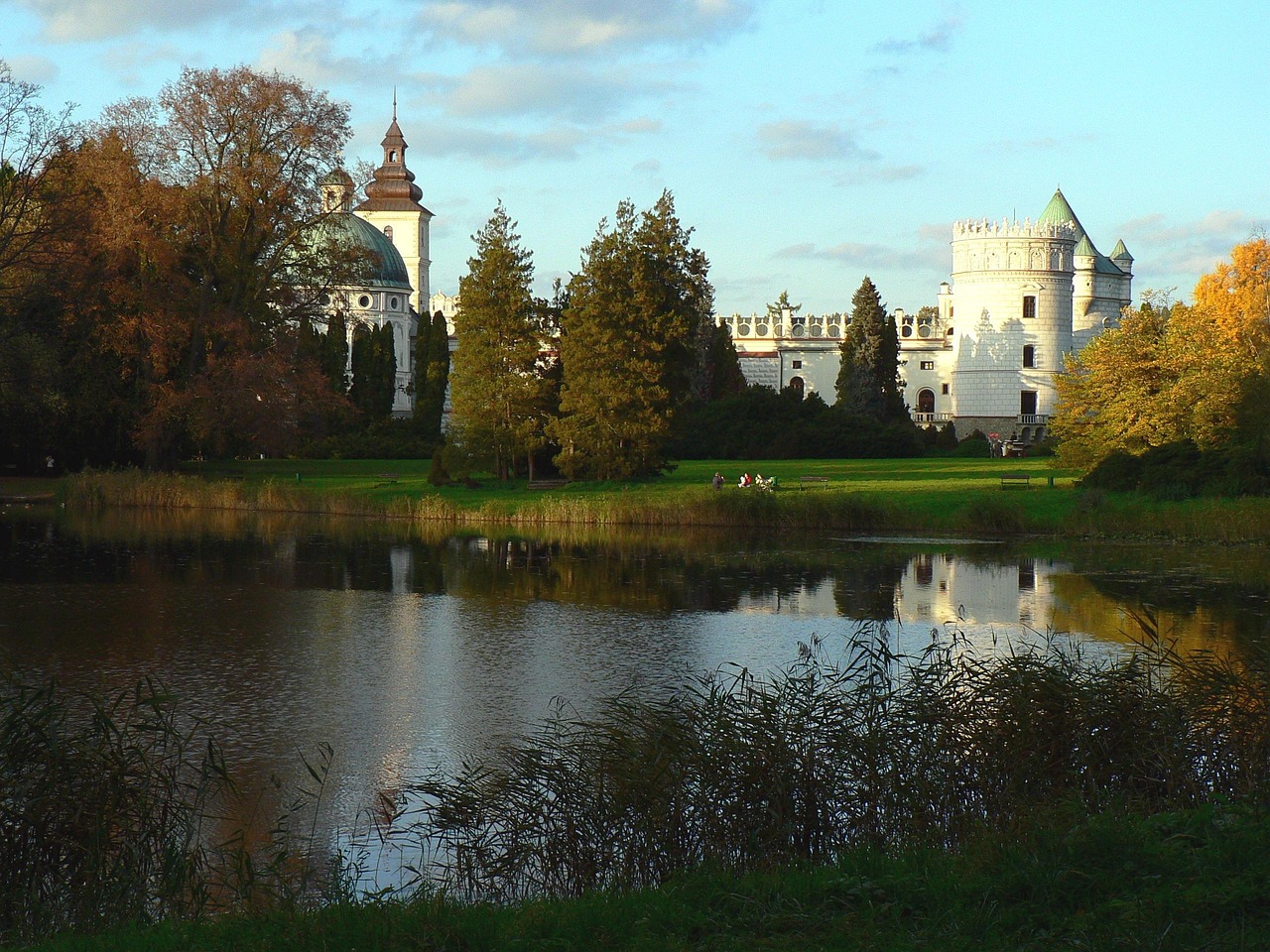
- Krasiczyn Castle: a four-winged Renaissance complex with sgraffito façades and four corner towers each crowned differently, surrounded by an old landscape park.
- Sanok open-air museum (Muzeum Budownictwa Ludowego): wooden houses, churches and farmsteads of the Boyko, Lemko and Pogórzanie people on a wide site by the San, plus a reconstructed Galician market square. Allow at least three hours.
- Sanok Castle with the Historical Museum and the large collection of the painter Zdzisław Beksiński, who came from Sanok.
- CampingSpirit overnight tip
-
Official campsite or RV park: There are several sites on Lake Solina: Kemping Solina-Jawor near the dam and, in Polańczyk, Blue Marine Kemping and the Wyspa Energetyk holiday area on a spit of land in the lake, among others. Facilities range from a simple meadow to electricity and waste disposal; most open only from about May to September and are full at weekends in July and August. Call ahead.
Free camping or nature tip (where legal): The shores of Lake Solina are densely built up or private land, and many access roads have barriers and no-entry signs. The car parks at the dam charge a fee and are not meant for overnight stays – here the campsite is worth it.
- Insider tip for campers
- The Sanok open-air museum has its own car park at the entrance in the Biała Góra district, reachable without driving through the old town. Fill up in Lesko or Sanok, check your gas and withdraw cash: in the Bieszczady, petrol stations and cash machines are rare, and small sites often take only złoty in cash.
3Stage 3: Solina Reservoir to Ustrzyki Górne (approx. 85 km)
- The drive
- Across the dam to Myczkowce and Uherce Mineralne, on the DK84 to Ustrzyki Dolne and then on voivodeship road 896 through the upper San valley via Ustjanowa, Lutowiska and Stuposiany to Ustrzyki Górne. This is the eastern half of the Great Bieszczady Loop: from Ustrzyki Dolne narrow, winding, with poor verges and timber lorries, and hardly any villages. A good two hours’ pure driving time.
- Highlights & must-sees
- Solina Dam: a walk across the crest of Poland’s highest dam with views over the branching lake; from the Plasza valley station by the dam a gondola runs up to the Jawor top station with its observation tower.
- Wooden church in Smolnik on the San: an 18th-century Boyko Greek Catholic church, part of the UNESCO World Heritage Site “Wooden Tserkvas of the Carpathian Region” since 2013, standing alone on a hill above the valley.
- Bieszczady Starry Sky Park around Lutowiska and Ustrzyki Górne: one of the darkest areas in Poland; viewpoints by the road are good for stargazing on clear nights.
- CampingSpirit overnight tip
-
Official campsite or RV park: In Ustrzyki Górne you will find Camping PTTK nr 150 by the Hotel Górski (PTTK), a simple meadow with sanitary facilities in the building and limited electric hook-ups; nearby there is also the Kremenaros tent meadow. Water supply and waste disposal for motorhomes are rudimentary here – arrive with empty tanks. Season about May to September; check the current status beforehand.
Free camping or nature tip (where legal): Ustrzyki Górne is surrounded by land belonging to Bieszczady National Park: overnight stays are only allowed at designated spots, and forest tracks and hiking car parks are not camper pitches. Barriers and signs of the national park and the State Forests are binding, and park rangers and forest guards carry out checks.
- Insider tip for campers
- Ustrzyki Dolne has the last well-stocked supermarkets and petrol stations before the high mountains. Road 896 has tight bends without a centre line – timber lorries often drive fast and in the middle of the road here. Brown bears live in the region: keep food and rubbish in the vehicle, not in the awning.
4Stage 4: Ustrzyki Górne to Wetlina (approx. 35 km)
- The drive
- A hiking day with short drives: in the morning the 7 km to Wołosate, the starting point for Tarnica, and back, then on road 897 over the Przełęcz Wyżna pass to Wetlina. Between Ustrzyki Górne and Wetlina the road climbs in hairpins through beech forest and over open saddles, with car parks at the trailheads.
- Highlights & must-sees
- Tarnica (1,346 m), the highest peak of the Polish Bieszczady: a good three hours’ ascent from Wołosate on a waymarked trail, with an all-round view at the top far into Ukraine and Slovakia.
- Połonina Caryńska or Połonina Wetlińska: the treeless ridge meadows of the national park, reached from Brzegi Górne and from the Przełęcz Wyżna pass respectively; in late summer the colours of bilberry and grass, in autumn glowing red beech slopes.
- Wetlina: a scattered mountain village with wooden houses, small bars and a view up to the Połonina Wetlińska.
- CampingSpirit overnight tip
-
Official campsite or RV park: In Wetlina there are several simple tent and camping meadows (pole namiotowe), such as “Górna Wetlinka” at the upper end of the village or “Stare Sioło” on the western edge of the village. Usually toilets, showers and water, electricity only for some pitches, waste disposal for motorhomes often improvised. Seasonal operation; ask ahead.
Free camping or nature tip (where legal): In Bieszczady National Park (Bieszczadzki Park Narodowy) camping outside designated sites is prohibited, and overnight stays are not intended on the paid car parks at the trailheads. You need an entry ticket for the trails in the park, available at ticket booths and online.
- Insider tip for campers
- On summer weekends the car parks in Wołosate and at Przełęcz Wyżna are full by 9 am – go on a weekday and start early. Pack wind- and rainproof clothing for the połoniny: thunderstorms come quickly and there is hardly any shelter up top. Mobile coverage in the valleys is patchy; download maps for offline use.
5Stage 5: Wetlina to Krosno (approx. 115 km)
- The drive
- On road 897 via Cisna to Komańcza, from there on through the Beskid Niski westwards via Jaśliska to Tylawa and on the DK19 via Dukla to Krosno. As far as Komańcza a narrow mountain road through forests and valleys with few villages, then wide, almost deserted high valleys of the former Lemko villages. Around two and a half hours’ driving.
- Highlights & must-sees
- Bieszczadzka Kolejka Leśna: the narrow-gauge forest railway from Majdan near Cisna, with summer trips along the valley towards Przysłup and Balnica.
- Orthodox wooden church in Turzańsk near Komańcza: a UNESCO World Heritage Site with onion domes and a free-standing bell tower; in Komańcza, the convent of the Sisters of Nazareth where Primate Stefan Wyszyński was interned in 1955–56.
- Dukla: the Bernardine monastery and the Historical Museum in the Mniszech Palace, plus, just before Tylawa, the detour to Zyndranowa and its small museum of Lemko culture.
- CampingSpirit overnight tip
-
Official campsite or RV park: In Krosno the municipal sports and recreation centre MOSiR runs a motorhome stopover (Camper Park MOSiR Krosno) with electric hook-ups near the sports grounds; check facilities, waste disposal and prices on the operator’s website. Simpler options in the Beskid Niski are small tent meadows such as the one in Wisłoczek or farms with a camper pitch.
Free camping or nature tip (where legal): Many meadows in the Beskid Niski are private land, and many forest areas belong to the State Forests or lie within Magura National Park (Magurski Park Narodowy) west of Dukla. Vehicles belong only on public roads and approved car parks; if you want to spend the night in the forest with a tent, use the designated areas of the “Zanocuj w lesie” programme and leave the vehicle in the car park.
- Insider tip for campers
- The detour to Turzańsk is only a few kilometres from Komańcza via Rzepedź; the church is not always open, but the exterior is worth seeing anyway. On the Cisna–Komańcza–Jaśliska stretch there is practically no petrol station – fill up in Cisna or earlier. In Krosno, the Glass Heritage Centre (Centrum Dziedzictwa Szkła) in the old town is worth a visit.
6Stage 6: Krosno to Zwierzyniec (Roztocze) (approx. 240 km)
- The drive
- The long transfer from the edge of the Carpathians to Roztocze: first via Haczów and Brzozów to Blizne, then on country roads to Rzeszów, a stretch north on the S19 expressway to Sokołów Małopolski and on via Leżajsk, Tarnogród and Biłgoraj to Zwierzyniec. Hill country, later flat fields and long pine forests. With church visits a full driving day; pure driving time a good three and a half hours.
- Highlights & must-sees
- Haczów wooden church: a 15th-century Gothic log church with wall paintings inside, a UNESCO World Heritage Site as one of the wooden churches of southern Lesser Poland.
- Wooden church in Blizne: also a UNESCO World Heritage Site, the All Saints’ Church with its preserved parish ensemble of granary and presbytery.
- Leżajsk: baroque Bernardine basilica with one of the most famous organs in Poland.
- CampingSpirit overnight tip
-
Official campsite or RV park: In Zwierzyniec, Camping Echo lies on the south-western edge of town, near the path to the Echo Ponds in Roztocze National Park; sanitary facilities and electricity, season about May to September – check beforehand. Further simple sites and canoe bivouac sites can be found on the Wieprz and Tanew, such as “Nad rzeką Wieprz” on the north-western edge of Zwierzyniec.
Free camping or nature tip (where legal): Around Zwierzyniec the forests belong to Roztocze National Park or the State Forests: drive and park only on public roads and approved forest car parks. Overnight stays in the national park only on designated areas; fires in the forest are prohibited as a rule, except at designated spots.
- Insider tip for campers
- The wooden churches in Haczów and Blizne are often open only for services or by arrangement with the parish – ask about opening times in advance. If you take country roads instead of the S19, you will also reach your destination via Dynów and Przeworsk, but it takes considerably longer. If your vehicle is over 3.5 t: the S19 is subject to tolls in the e-TOLL system.
7Stage 7: Zwierzyniec to Zamość (approx. 55 km)
- The drive
- A short stage through Roztocze: from Zwierzyniec via Guciów to Krasnobród and on to Zamość, or alternatively via Szczebrzeszyn. Hilly country roads between pine forest, fields and loess sunken lanes, with little traffic. Pure driving time a good hour – leaving time for cycling and hiking trails in the national park.
- Highlights & must-sees
- Roztocze National Park: the Echo Ponds and Florianka with its breeding of the Polish Konik horse, plus the nature trail up Bukowa Góra through old beech and fir forest.
- Zwierzyniec: the baroque Church of St John of Nepomuk on an island in the pond, reached by a small causeway.
- Zamość: the Renaissance ideal city founded in 1580 by Jan Zamoyski and planned by the Italian Bernardo Morando, with the Great Market Square, the town hall staircase and the colourful Armenian merchants’ houses, a UNESCO World Heritage Site since 1992.
- CampingSpirit overnight tip
-
Official campsite or RV park: Camping Duet on ul. Królowej Jadwigi in Zamość, about 1 km or a ten-minute walk from the old town: electric hook-ups, water supply and waste disposal, showers, a washing-up area; the sanitary facilities are older but well kept. Check opening times outside the summer beforehand.
Free camping or nature tip (where legal): In Zamość the car parks by the old town charge a fee and are not intended for overnight stays. In Roztocze, outside the national park, motorhomes can often stay for a night at inns and agritourism farms – always ask, and no camping behaviour in public places.
- Insider tip for campers
- Roztocze is superb to explore by bike: the Green Velo cycle route and regional cycle paths link Zwierzyniec, Krasnobród and Zamość. In Zamość, stroll across the Great Market Square in the evening, when the arcades are lit up and the day-trip coaches have gone.
8Stage 8: Zamość to Lublin (approx. 190 km)
- The drive
- From Zamość north-west via Kraśnik and Opole Lubelskie to the Vistula at Kazimierz Dolny, then the last 50 km or so via Nałęczów to Lublin. Flat to rolling farmland, from Opole Lubelskie onwards orchards and deeply cut loess gorges. About three hours’ driving – or two relaxed days with a night in Kazimierz.
- Highlights & must-sees
- Kazimierz Dolny: market square with Renaissance town houses, old granaries on the Vistula, a castle ruin with a tower and the view from Three Crosses Hill over the river.
- Korzeniowy Dół: a loess sunken lane near Kazimierz whose walls are formed by exposed tree roots – a short, shady walk.
- Lublin: the old town with the Kraków Gate, the castle with the Chapel of the Holy Trinity and its Russo-Byzantine frescoes, plus the Majdanek memorial on the edge of the city.
- CampingSpirit overnight tip
-
Official campsite or RV park: In Kazimierz Dolny, Camping Spichlerz lies on the western edge of town near the Vistula, with sanitary facilities and electric hook-ups; another site is Camping Pielaka. In Lublin the small Camping Lublin is in the garden of a hotel on ul. Krochmalna, about 2 km from the Old Town Market Square: electricity for a fee, water and sanitary facilities; no waste disposal is listed there, so empty grey water and the cassette beforehand.
Free camping or nature tip (where legal): Kazimierz is overcrowded at weekends, the centre is traffic-calmed, and the car parks on the edge of town charge a fee and are not intended for overnight stays. In Lublin, free camping in the city makes no sense – use a campsite or a guarded car park.
- Insider tip for campers
- Do not drive the motorhome into the narrow lanes of Kazimierz: park on the edge of town and continue on foot or by bike. The ferry across the Vistula to Janowiec and its castle ruin carries cars as well as pedestrians and cyclists, but runs only seasonally and depending on weather and water level – ask locally whether a motorhome can go aboard. In Lublin the old town sits on a hill; multi-storey car parks have height limits, so larger vehicles are best parked outside the centre.
Camping practice & local rules
Wild camping & overnight parking
- Poland distinguishes between parking and camping: where parking is allowed, no national law forbids sleeping in your vehicle. If you put out an awning, table, chairs, levelling jacks or ramps, you are camping – and that is not intended outside campsites, tent meadows and motorhome stopovers. Municipalities and car park operators prohibit overnight stays by sign, frequently in the resorts on Lake Solina.
- National parks: in Bieszczady, Magura and Roztocze National Parks, overnight stays are only allowed in designated areas; vehicles stay on public roads and car parks. An entry ticket is required for the trails in Bieszczady National Park. Park rangers, forest guards and police carry out checks and issue fines.
- Forest: under the Polish Forest Act, motor vehicles may drive and park in the forest only on public roads and on tracks approved for that purpose; barriers of the State Forests (Lasy Państwowe) are binding. The State Forests’ “Zanocuj w lesie” programme allows overnight stays on foot with a tent, hammock or sleeping bag in marked forest areas of the forest districts – not in a vehicle, which stays in the car park. Up to nine people may stay at one spot for a maximum of two consecutive nights without registering; larger groups or longer stays generally register by email with the forest district at least two working days in advance, and the district must confirm. Driving motor vehicles into the forest is expressly prohibited. Open fires are prohibited except at designated spots; the map of the areas is available on the State Forests’ websites and in their app.
- Border areas: near Przemyśl, in the Bieszczady and in Roztocze, the route runs in places just a few kilometres from the border with Ukraine, an external border of the EU. The Polish Border Guard (Straż Graniczna) also checks vehicles and people in the hinterland of the border zone – always carry your ID. Do not enter the marked border strip, and do not leave the trails in the national park. Drone flights are prohibited in national parks and restricted in the border zone; check airspace restrictions in the official drone app before take-off.
- Finding places to stay: typical of the region are simple tent meadows (pole namiotowe), bivouac sites (pole biwakowe), student and scout bases and farms with a “miejsce kamperowe”. Many open only from May to September, and facilities vary widely. park4night, Campercontact and municipal websites help; prices in user reports are often out of date.
Waste disposal & supplies
- Service points (“punkt serwisowy dla kamperów”) are mainly found on campsites, for example in Zamość; in the Bieszczady and the Beskid Niski they are rare and basic. Before Ustrzyki Górne and Wetlina, fill up with fresh water and empty grey water and the cassette.
- Never empty grey water or the cassette into streams, ditches or onto the forest floor: the mountain streams of the Bieszczady, the San and Lake Solina are drinking-water reservoirs and bathing waters.
- Drinking water: tap water in towns is considered drinkable; at water points look out for “woda pitna” (drinkable) or “woda niezdatna do picia” (not drinkable). On simple mountain sites the water sometimes comes from springs – filter or boil it.
- Gas: German exchange cylinders are neither exchanged nor refilled in Poland. Autogas (LPG) is available cheaply at many petrol stations, but in the mountains only in larger towns such as Lesko, Sanok or Ustrzyki Dolne; fill refillable cylinders and gas tanks using an adapter set.
- Money and shopping: payment is in złoty. Petrol stations and supermarkets accept cards; tent meadows, farm shops and mountain huts often take only cash. You will find cash machines in Sanok, Lesko, Ustrzyki Dolne and Krosno, but hardly any in the mountain villages.
Vehicle size & traffic rules
- Speed limits for motorhomes up to 3.5 t: 50 km/h in built-up areas, 90 km/h outside built-up areas, 100 km/h (single carriageway) or 120 km/h (dual carriageway) on expressways, 140 km/h on motorways. Motorhomes over 3.5 t and vehicle-trailer combinations are limited to 70 km/h outside built-up areas and 80 km/h on expressways and motorways. Dipped headlights at all times, blood alcohol limit 0.2, phone calls only hands-free.
- e-TOLL: only vehicles with a maximum permissible weight over 3.5 t – including heavy motorhomes – are subject to tolls in the electronic e-TOLL system, on motorways, expressways and sections of national roads (DK); on this route, for example, on the S19 between Rzeszów and Lublin and on the A4. Register at etoll.gov.pl before entering the country and pay via the app or an on-board unit. Only the permissible gross weight of the towing vehicle counts: vehicle-trailer combinations with a towing vehicle up to 3.5 t are exempt from e-TOLL. Vehicles up to 3.5 t travel toll-free in south-east Poland; if you arrive via the A4, only the Katowice–Kraków section is chargeable for them (toll plazas or app).
- Roads: the voivodeship roads in the Bieszczady and the Beskid Niski are narrow, winding, sometimes without a centre line and with soft verges; timber lorries, wildlife crossing and cows on the road are normal. Vehicles over 7 m should check minor roads for weight and width restrictions beforehand.
- Equipment: warning triangle and fire extinguisher on board – compulsory for Polish vehicles, strongly recommended for foreign ones; mark protruding bike racks. There is no general winter tyre requirement, but in the mountains you should expect snow and ice from late October, and most sites close in autumn.
- Traffic enforcement: average-speed checks and mobile speed cameras are widespread, and fines are collected on the spot from foreign drivers too. Cities such as Rzeszów, Przemyśl and Lublin have paid parking zones, paid at a machine or by app. At the time of going to press Lublin had not introduced a low-emission zone (Strefa Czystego Transportu), and none is in force on the rest of the route either – if you arrive via Kraków, observe the zone there.
CampingSpirit packing & preparation checklist
- Cash in złoty in small notes – tent meadows, mountain bars, national park ticket booths and farm shops in the Bieszczady often do not take cards.
- A water filter or purification tablets and a 10-litre jerrycan – mountain sites sometimes have only spring water, and service points are few and far between.
- Wind and rain jacket, head torch and sturdy hiking boots for Tarnica and the połoniny; there is no shelter from thunderstorms up top.
- Bear-safe waste management: tightly closing boxes for food and rubbish that stay in the vehicle at night.
- Offline maps and a paper hiking map of the Bieszczady – the mobile network keeps dropping out in the valleys.
- Binoculars and a star chart or app for the nights in the Starry Sky Park and for bison, deer and birds of prey in the national park.
As of 2026-10. Closures, fees and booking rules change: check official sources before you go.