

In-depth guide · CampingSpirit
From Brno via the Moravian Karst, Kroměříž, Moravian Slovakia and Lednice-Valtice to Mikulov and the Dyje valley near Znojmo: around 430 kilometres of caves, palace gardens and vineyards, where the bike rolls more often than the camper.
The spirit of the route
South Moravia is a region you read slowly. In the morning you stand in the mist above the Macocha Abyss; in the afternoon the camper rolls east between sunflowers and apricot orchards, to where the Baroque gardens of Kroměříž and the brick façades of Bata’s company town of Zlín sit two centuries apart. Further south, whitewashed press houses huddle into the loess slopes, their doors open and cool, slightly sour air drifting out of the cellars. From the sliding door you look out at the limestone cliffs of the Pálava, at reservoirs full of herons and at poplar avenues that the Princes of Liechtenstein had planted as sightlines. Here the bike is part of the luggage: between Lednice, Valtice and Mikulov, cycle paths link a minaret, colonnades and wine villages. And because the Czech Republic has a 0.0 blood alcohol limit, every evening in the cellars ends where the camper is already parked.
Stage-by-stage plan
1Stage 1: Brno to Moravian Karst (Jedovnice) (approx. 45 km)
- The drive
- Out of Brno northwards on the I/43 and the country road through the Svitava valley to Blansko, then up into the karst on a narrow, winding road to Skalní mlýn, the gateway to the caves. From there across the plateau to Jedovnice. The roads in the karst are narrow, partly without centre lines, and at weekends full of day-trippers and cyclists. Around one hour of pure driving time.
- Highlights & must-sees
- Punkva Caves (Punkevní jeskyně): dripstone halls, the floor of the Macocha Abyss and a boat trip on the underground Punkva river. Places per tour are limited, so book tickets online with the cave administration (Správa jeskyní ČR) – in season, walk-up visitors often have no chance.
- The Macocha Abyss from above: you reach the viewing bridges Horní a Dolní můstek on foot or by cable car from the caves; the view down into the gorge, more than 130 metres deep, is most impressive early in the morning.
- Villa Tugendhat in Brno before you set off: Mies van der Rohe’s World Heritage villa can only be seen on a guided tour with tickets booked well in advance; Špilberk Castle and the Cathedral of St Peter and Paul on Petrov hill are within walking distance of the old town.
- CampingSpirit overnight tip
-
Official campsite or RV park: Camp Olšovec on the pond of the same name in Jedovnice, around 10 road kilometres south-east of Skalní mlýn: pitches for motorhomes, electricity, sanitary facilities, swimming pond; seasonal, check opening times in advance. For the night of arrival in Brno, Stellplatz Brno in the south of the city has electricity and service point; there are also campsites on the Brno Reservoir (Brněnská přehrada), such as Kemp Oáza and Camp Alpa.
Free camping or nature tip (where legal): The Moravian Karst is a protected landscape area (CHKO Moravský kras): tent and vehicle camping outside designated sites is prohibited, and forest and woodland tracks are closed to vehicles. The large car parks at Skalní mlýn and the other caves are paid day car parks, not overnight spots. Use a campsite for the night.
- Insider tip for campers
- Private cars cannot drive from Skalní mlýn to the Punkva Caves; the camper stays in the paid car park at Skalní mlýn. A little road train (ekovláček) runs the roughly 2 km to the caves, and from there the cable car goes up to the upper bridge of the Macocha Abyss; combined tickets are available for both. On foot through the gorge it takes about half an hour. It is around 8 °C in the caves – take a jacket, even in high summer. Get water and shopping in Brno or Blansko.
2Stage 2: Jedovnice to Kroměříž (approx. 80 km)
- The drive
- Via Rousínov and through hill country with fields and fruit-tree avenues down to Slavkov u Brna, then on the D1 motorway (vignette required) towards Ostrava as far as the Kroměříž exit on the Haná plain. Well built and flat; only the approaches into the old towns are narrow. About 1.5 hours of pure driving time.
- Highlights & must-sees
- Slavkov Castle (Austerlitz): the Baroque château where Napoleon took up quarters after the Battle of the Three Emperors in 1805, with a palace park and an exhibition on the battle.
- Mohyla míru (Peace Monument) on Pratzen Heights near Prace, west of Slavkov: an Art Nouveau memorial with a museum and a wide view over the battlefield.
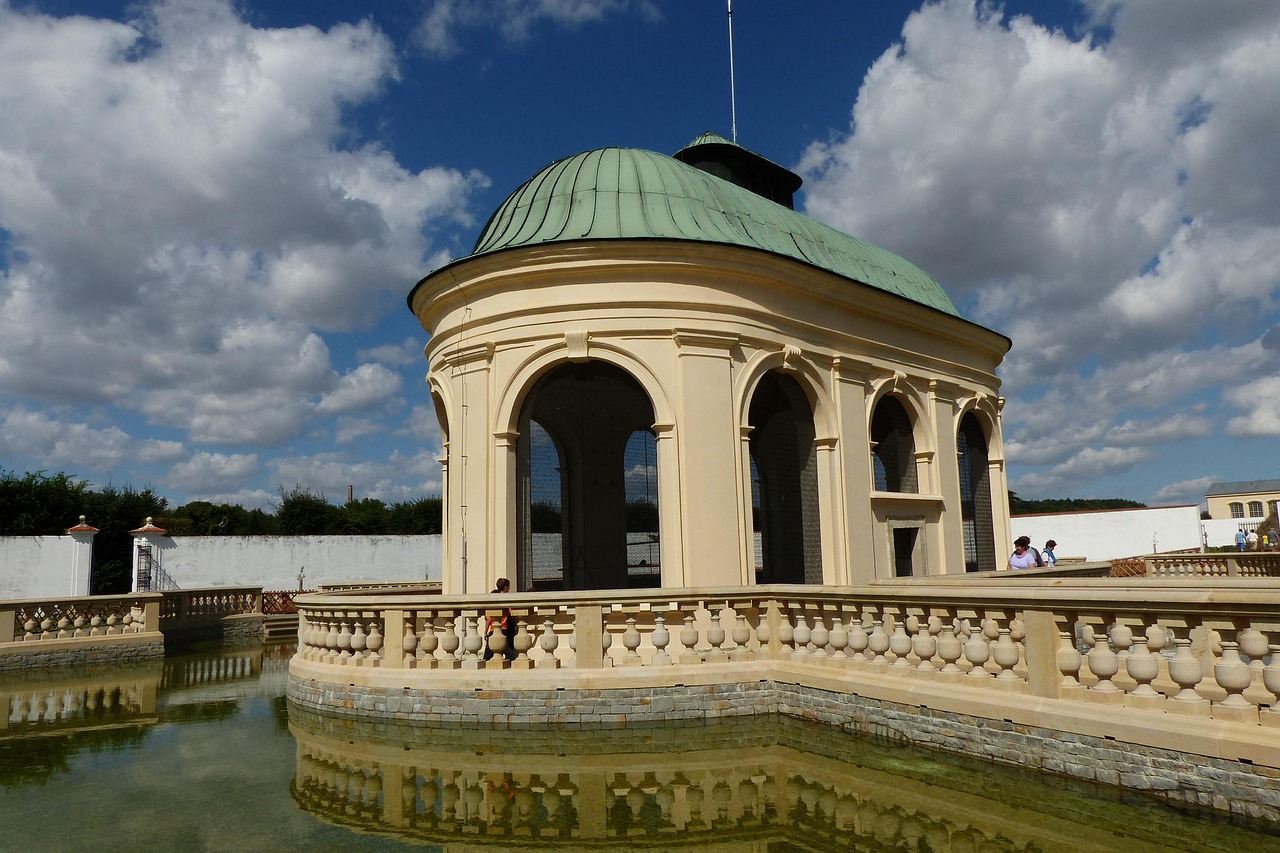
- Kroměříž (World Heritage): the Archbishop’s Palace with its picture gallery and assembly hall, the Castle Garden (Podzámecká zahrada) by the river and the Flower Garden (Květná zahrada) with its 244-metre colonnade and a rotunda in which a Foucault pendulum swings.
- CampingSpirit overnight tip
-
Official campsite or RV park: There is no conventional campsite for motorhomes in Kroměříž itself. Around 20 km south, near Otrokovice and slightly off the route of the next stage, lies the Skleníky recreation area in Spytihněv on the Bata Canal, and near Napajedla the Pahrbek recreation area – check season, facilities and suitability for motorhomes in advance.
Free camping or nature tip (where legal): The Czech Republic has no explicit right to free overnight parking, but one night in your vehicle in a public car park where parking is allowed is usually tolerated as long as you are not camping. In Kroměříž and Slavkov: observe signage and parking zones; the town car parks by the palace and gardens are meant for day visitors. Farm and forest tracks on the Haná plain are not overnight spots.
- Insider tip for campers
- In Kroměříž, park the motorhome on the edge of the old town; the streets around the main square (Velké náměstí) are narrow. The Flower Garden and the palace interiors have separate tickets and guided tours with limited numbers. Without a vignette, drive from Slavkov via Bučovice and Morkovice on country roads to Kroměříž – hardly slower than the D1 and with views over the fields of the Haná.
3Stage 3: Kroměříž to Luhačovice (approx. 60 km)
- The drive
- South via Hulín and Otrokovice into the Dřevnice valley to Zlín, then through the hills of the Vizovické vrchy and along the edge of the White Carpathians (Bílé Karpaty) to Luhačovice. Heavy town traffic in Zlín, then quiet, winding country roads through forest and orchard meadows. A good 1.5 hours of pure driving time.
- Highlights & must-sees
- Zlín: Bata’s 1930s company town of red brick and concrete – in the office tower “Building 21” the office of Jan Antonín Baťa travels between the floors as a lift, and from the roof terrace you look out over the factory grounds and the workers’ housing estates.
- Luhačovice: a spa town with the half-timbered buildings of architect Dušan Jurkovič, above all Jurkovič House, and the colonnade at the Vincentka spring – you taste the strongly mineralised water from a cup.
- Luhačovice Reservoir (Luhačovická přehrada) above the town: a circular path along the shore and hikes into the forests of the White Carpathians.
- CampingSpirit overnight tip
-
Official campsite or RV park: Autocamp Luhačovice by the reservoir above the spa town, with pitches, electricity and sanitary facilities; buses run down into the spa town, or you can walk or cycle. Seasonal – check dates. Further south near Bojkovice, Eurocamping Bojkovice lies on the edge of the White Carpathians.
Free camping or nature tip (where legal): The White Carpathians are a protected landscape area and biosphere reserve (CHKO Bílé Karpaty), and their orchid meadows are among the most species-rich in Central Europe: camping outside campsites is prohibited there, and meadows and farm tracks may not be driven on. In the spa town of Luhačovice, overnight stays in the car parks are not intended; the spa zone is traffic-calmed.
- Insider tip for campers
- In Zlín, do not drive the motorhome into the town centre – multi-storey car parks have height restrictions. There are larger car parks on the edge of the factory grounds; check the signage. In Luhačovice the spa district is closed to through traffic, so park on the edge of town. You will find supermarkets and filling stations in Zlín and Otrokovice, but hardly any in the hill country in between.
4Stage 4: Luhačovice to Strážnice (approx. 55 km)
- The drive
- Via Uherský Brod out of the hills onto the plain of the Morava and via Veselí nad Moravou to Strážnice in Moravian Slovakia (Slovácko). Quiet country roads, flat to gently rolling, many villages with 50 km/h limits and speed checks. Around 1.25 hours of pure driving time.
- Highlights & must-sees
- Petrov – Plže wine-cellar lane: rows of whitewashed cellars with blue-painted bases on the slope above the village of Petrov, protected as a heritage reserve; many winegrowers open in the afternoon and evening.
- Open-air museum in Strážnice (Muzeum vesnice jihovýchodní Moravy): farmhouses, vineyard huts and windmills of the region on the edge of the castle park.
- Bata Canal (Baťův kanál): the 1930s waterway links Otrokovice with the area around Hodonín; a cycle path runs alongside it, and excursion boats and hire boats operate in season.
- CampingSpirit overnight tip
-
Official campsite or RV park: Autokempink Strážnice on the edge of the castle park, a few minutes’ walk from the open-air museum and a good 2 km by bike to Petrov: electric hook-ups, sanitary facilities, motorhome pitches. In Veselí nad Moravou there is also Kemp Baťův kanál at the canal harbour.
Free camping or nature tip (where legal): The slopes with the cellar lanes are vineyards and private land; staying overnight by the cellars is only possible at a winegrower’s invitation and on their pitch. Some winegrowers in South Moravia offer motorhome pitches – look in the motorhome-spot apps and ask directly. Camping is not allowed on the banks of the Bata Canal; the locks and harbours are not overnight spots.
- Insider tip for campers
- For Petrov, leave the camper at the campsite in Strážnice and go by bike: the Czech Republic has a 0.0 blood alcohol limit with no tolerance – even the next morning, residual alcohol can still be too much. Buy wine in bottles or PET containers and transport it lying down and cool in the camper. In the cellars you can pay cash or by card, but not everywhere in the countryside takes cards – bring some crowns.
5Stage 5: Strážnice to Lednice (approx. 50 km)
- The drive
- Along the Morava to Mikulčice and Hodonín, then via Podivín or through the wine villages around Velké Bílovice west into the Lednice-Valtice Cultural Landscape. A flat route through floodplain forests, fields and vineyards, with some narrow village roads. About one hour of pure driving time.
- Highlights & must-sees
- Mikulčice Slavic hillfort: one of the centres of the Great Moravian Empire in the 9th century, with church foundations and a museum in the Morava floodplain.
- Velké Bílovice: one of the largest wine-growing municipalities in the country, with cellar lanes and vineyards as far as the eye can see.
- Lednice Castle and park: the Liechtensteins’ neo-Gothic castle, the glasshouse and the roughly 60-metre minaret in the park, which boats on the castle pond also sail to.
- CampingSpirit overnight tip
-
Official campsite or RV park: Hippoclub Lednice on the edge of the village with motorhome pitches, electricity, sanitary facilities and service point; a little further south by the Lednice fishponds is Autokemp Apollo, and near Břeclav-Poštorná the Františkův Rybník site by the pond. Velké Bílovice has a motorhome stopover in the village. Book in season and on wine-festival weekends.
Free camping or nature tip (where legal): The cultural landscape is World Heritage, and the floodplain forests and ponds are largely Natura 2000 sites and nature reserves. Camping and driving on forest and embankment tracks is prohibited, and the car parks at Lednice Castle are paid day car parks. For the night, use one of the sites in the village or a winegrower’s pitch.
- Insider tip for campers
- Lednice is overrun at weekends; visit the castle park early in the morning or late in the afternoon. From late spring, the ponds and floodplain forests along the Dyje and Morava release swarms of mosquitoes – insect repellent and fly screens in the camper are a must. Refuel and shop in Hodonín or Břeclav.
6Stage 6: Lednice to Mikulov (approx. 30 km)
- The drive
- Through the avenues of the cultural landscape to Valtice on the Austrian border and on via Sedlec or Bavory to Mikulov beneath the limestone cliffs of the Pálava. A short, flat stage; the stretch between Lednice and Valtice can also be done on cycle paths, with the camper staying put for a day. Under an hour of pure driving time.
- Highlights & must-sees
- Valtice: the Liechtensteins’ Baroque château, in whose cellars the Salon vín (National Wine Salon) offers tastings of an annually chosen selection of Czech wines.
- Small buildings of the cultural landscape by bike: the colonnade on Reistna hill above Valtice, the artificial castle ruin Janův hrad in the Dyje floodplain and the Three Graces (Tři Grácie) – linked by signposted cycle paths.
- Mikulov: the Dietrichstein château above the market square, Holy Hill (Svatý kopeček) with its Stations of the Cross and the Jewish quarter with its large cemetery.
- CampingSpirit overnight tip
-
Official campsite or RV park: Camping Mikulov on the edge of town, within walking distance of the old town; check facilities such as electricity and a motorhome service point in advance. On the edge of the Pálava there are small sites such as Tábořiště Klentnice, better suited to tents than to large motorhomes.
Free camping or nature tip (where legal): The Pálava is a protected landscape area and biosphere reserve (CHKO Pálava), and parts such as Děvín are National Nature Reserves. Camping outside campsites is prohibited, as is driving on farm and vineyard tracks. In Mikulov the old-town car parks are paid and very busy during the day; overnight stays are not intended there.
- Insider tip for campers
- Mikulov is full on wine-festival weekends and in autumn during the grape harvest – book in good time and arrive early. The old-town streets are steep, cobbled and unsuitable for motorhomes. If you are continuing to Austria: the Mikulov–Drasenhofen border crossing is directly south of the town; from there, Austria requires the vignette (motorhomes up to 3.5 t) or the GO-Box (over 3.5 t).
7Stage 7: Mikulov to Pasohlávky (Nové Mlýny) (approx. 30 km)
- The drive
- North around the Pálava via Klentnice and Pavlov to the shore of the Nové Mlýny reservoirs, then via Dolní Věstonice and the dam between the basins to Pasohlávky. Narrow village roads with tight spots in Pavlov and Klentnice, otherwise lakeside roads with views of water and limestone cliffs. Around 45 minutes of pure driving time.
- Highlights & must-sees
- Děvín (549 m) and the Dívčí hrady castle ruin: a hike from Pavlov or Klentnice on waymarked paths over rocky ridges with views of the reservoirs and, in clear weather, as far as the Alps; the Sirotčí hrádek ruin lies near Klentnice.
- Archeopark Pavlov: an underground museum at the site of Ice Age mammoth hunters, whose best-known find is the Venus of Dolní Věstonice.
- St Linhart’s Church, the last remnant of the flooded village of Mušov, on an island in the middle reservoir (Věstonická nádrž), visible from the shores – you may not set foot on the island. The middle basin is a nature reserve and bird area with herons, cormorants and, in winter, white-tailed eagles.
- CampingSpirit overnight tip
-
Official campsite or RV park: Autokemp Merkur in Pasohlávky on the upper basin: large, with electricity, sanitary facilities, fresh water and waste disposal and a bathing shore, next to the Aqualand Moravia thermal baths. Between Mikulov and the reservoirs, near Dolní Dunajovice, Stellplatz Pálava is a motorhome stopover with electricity, water and waste disposal (check season and facilities on the website); there are further kemps in Pavlov and Dolní Věstonice.
Free camping or nature tip (where legal): The shores of the three basins are partly nature reserve (especially the middle basin) and partly a leisure zone with campsites. Camping outside the sites is prohibited, many lakeside car parks have no-camping signs, and checks are carried out in season. In the Děvín nature reserve, stay on waymarked paths; climbing and leaving the paths are prohibited.
- Insider tip for campers
- The upper basin at Pasohlávky is the area for swimming and windsurfing; the middle basin is a nature reserve – do not swim there or go down to the shore off the paths. In Pavlov the streets are narrow and steep – with larger motorhomes, park down by the shore and walk into the village. The cycle path around the reservoirs and over the dams is part of the Moravian Wine Trails (Moravské vinařské stezky), a network of waymarked cycle routes through all the wine regions.
8Stage 8: Pasohlávky to Znojmo and Vranov nad Dyjí (approx. 80 km)
- The drive
- Via Pohořelice on the I/53 through fields and wine country to Znojmo, then on smaller roads along the edge of Podyjí National Park to Vranov nad Dyjí. Quick going as far as Znojmo, then winding with gradients down into the Dyje valley; the road through Vranov is narrow and steep. Around 1.5 hours of pure driving time.
- Highlights & must-sees
- Znojmo: the Romanesque Rotunda of St Catherine with 12th-century wall paintings, the passages of the Znojmo Underground (Znojemské podzemí) and the view from the castle rock over the Dyje valley.
- Podyjí National Park: the Hardeggská vyhlídka viewpoint above the Austrian town of Hardegg, the preserved section of the Iron Curtain near Čížov and the steep Šobes vineyard in a bend of the Dyje, reachable on foot from Podmolí or Havraníky.
- Vranov nad Dyjí Castle on the rock above the river, with the Baroque Hall of Ancestors by Johann Bernhard Fischer von Erlach; above it lies the Vranov Reservoir.
- CampingSpirit overnight tip
-
Official campsite or RV park: Camping Vranovská pláž on the Vranov Reservoir, with electricity and sanitary facilities, swimming and boating, open seasonally. Closer to Znojmo and on the edge of the national park is Camp Havraníky by the heath of the same name, a starting point for hikes to Šobes and Hardegg.
Free camping or nature tip (where legal): In Podyjí National Park, tent camping, vehicle camping and sleeping in your vehicle outside the sites are prohibited, as are open fires and driving on forest tracks; cycling only on designated routes. There are day car parks at access points such as Čížov, Lukov and Podmolí; parking in Čížov is paid. The shores of the Vranov Reservoir are also built up or closed off.
- Insider tip for campers
- The Dyje bridge at Hardegg, reachable on foot from Čížov, is open to pedestrians and cyclists – so you can combine the Czech Podyjí National Park and the Austrian Thayatal National Park in one circular hike. For the journey home to Austria, the Hatě–Kleinhaugsdorf border crossing near Znojmo leads straight onto the B303 towards Hollabrunn and Vienna. Fill up with fuel and water in Znojmo before the national park.
Camping practice & local rules
Wild camping & overnight parking
- The Czech Republic has no explicit right to free overnight parking. One night in your vehicle in a public car park where parking is allowed is usually tolerated as long as you are not camping: no awning, no chairs or tables, no levelling jacks, no grey water on the ground. Municipalities can ban camping and overnight stays by ordinance and signage – expect this in tourist towns such as Lednice and Mikulov and at the reservoirs.
- Under the Forest Act, driving and parking motor vehicles in the forest and lighting open fires in or near the forest are prohibited; farm, embankment and vineyard tracks are not overnight spots. The vineyards are private land.
- This route passes through Podyjí National Park and the protected landscape areas of Moravský kras, Pálava and Bílé Karpaty, plus numerous nature reserves along the Dyje and Morava. In the national park and protected areas, tent and vehicle camping outside designated sites is prohibited, and car parks at the access points are day car parks.
- Campsites (autokemp, kemp, tábořiště) are plentiful in South Moravia, often basic and only open from May to September. More and more winegrowers offer motorhome pitches at their cellars – a good solution for evenings in the cellars. You will find sites in park4night, Campercontact and motorhome-stopover guides; current information from municipalities and the national park administration takes precedence.
Waste disposal & supplies
- Public service points outside campsites are rare in the Czech Republic. On this route there are stations at Stellplatz Brno, at motorhome stopovers such as in Velké Bílovice and near Dolní Dunajovice, and at larger sites such as in Pasohlávky and Lednice; plan to empty grey and black water at the sites.
- Tap water is drinkable. The mineral water from the Luhačovice springs is very high in salt and minerals and is no substitute for drinking water in the tank.
- Gas: German and Austrian exchange cylinders are not exchanged in the Czech Republic, and local cylinders have different connections. Arrive with a reserve or use a refillable cylinder. Autogas is called LPG or Autoplyn and is available at many filling stations along the main roads and in towns such as Brno, Zlín and Znojmo; check the right adapter in advance.
- Shopping and fuel: large supermarkets in Brno, Zlín, Hodonín, Břeclav and Znojmo, smaller shops in the villages in between with short opening hours at weekends. Payment is in crowns (CZK); cash is still common in wine cellars and village shops.
Vehicle size & traffic rules
- Speed: motorhomes up to 3.5 t 50 km/h in built-up areas, 90 km/h outside, 130 km/h on motorways (usually 110 on expressways). Motorhomes over 3.5 t and vehicle-trailer combinations 80 km/h outside built-up areas and on motorways and expressways. Lower limits are signposted in many villages, and speed checks are frequent.
- Vignette: for vehicles up to 3.5 t, the electronic dálniční známka, linked to the number plate, is required on motorways and marked expressways – here mainly the D1, D2, D52 and D55. Vignettes are available for one day, 10 days, 30 days and one year; buy only via the official eDálnice portal or official sales points, not through third-party sites charging a mark-up. A car-and-caravan combination only needs a vignette for the towing vehicle. Vehicles over 3.5 t pay the distance-based electronic toll with an on-board unit (OBU) on motorways and selected first-class roads instead of the vignette; register the vehicle before entering the country.
- Alcohol: 0.0 limit with no tolerance – this also applies to cyclists out and about after a cellar visit. Plan wine tastings so that the camper stays parked until the next day, and allow for residual alcohol in the morning. Expect checks on the roads of the wine region.
- Other traffic rules: dipped headlights or daytime running lights all year round, mobile phone only with a hands-free kit, high-visibility vest, warning triangle and first-aid kit on board. There are currently no low-emission zones in the Czech Republic (as of 2026-10); in Brno, large parts of the city centre are residents’ parking zones. Rear carriers: number plate and lights must remain visible, otherwise use a light board with a repeater plate. From 1 November to 31 March, winter tyres are compulsory in wintry road conditions and on signposted routes.
- Border with Austria: Schengen, usually without checks, but carry ID; random checks are possible. Austria has a 0.5 blood alcohol limit, the vignette on motorways and expressways for motorhomes up to 3.5 t and the GO-Box for vehicles over 3.5 t. Main crossings on this route: Mikulov–Drasenhofen and Hatě–Kleinhaugsdorf near Znojmo, plus smaller road crossings such as Valtice–Schrattenberg.
CampingSpirit packing & preparation checklist
- Bikes with locks and a cycling map of the Moravian Wine Trails – between Lednice, Valtice, Mikulov and the reservoirs you can reach most destinations on cycle paths, and the camper stays put after the cellar visit.
- Insect repellent and fly screens for windows and door: in the floodplain forests along the Dyje and Morava and at the ponds around Lednice, mosquitoes are a real plague from May to September.
- A warm jacket for the caves of the Moravian Karst (around 8 °C) and for the cellar passages in Znojmo and Valtice.
- A cool box or wine carton with dividers so that bottles you buy survive cobblestones and farm tracks intact.
- Printed or offline-saved bookings for the Punkva Caves and Villa Tugendhat – both are often booked up weeks in advance in season.
- Some cash in crowns for winegrowers’ cellars, small kemps and parking meters in the countryside.
As of 2026-10. Closures, fees and booking rules change: check official sources before you go.