
Santa Monica Pier
Santa Monica, CA
The symbolic end of Route 66. There is an amusement park, a century-old carousel and the Pacific at your feet.
Santa Monica Pier in California is the famous wooden pier on Santa Monica Bay, west of Los Angeles. The municipal pier opened on 9 September 1909, at first mainly to carry sewage pipes beyond the surf. In 1916 Charles Looff built the amusement pier alongside it, with the Looff Hippodrome, which is now listed on the National Register of Historic Places. Inside turns a 1922 Philadelphia Toboggan Company carousel with 44 hand-carved wooden horses; in 1973 the carousel and Hippodrome served as a location for “The Sting”. Severe winter storms destroyed the lower deck in 1983 and damaged more than a third of the pier.
Since 1996 the Pacific Park amusement park, with a solar-powered Ferris wheel, has stood here. In 2009 the pier was officially designated the end of Route 66, and a sign marks the popular photo stop. Beneath the carousel, the Heal the Bay Aquarium shows marine life from the bay, and fishing is allowed without a licence. South of the pier, according to Lonely Planet, are Muscle Beach and the International Chess Park.
The pier is at its best at sunset; in summer, Lonely Planet says, there are free concerts and open-air movie nights. The South Bay Bicycle Trail runs about 1.5 miles (2.4 km) south from the pier to Venice Beach; bicycles can be rented on site. The nearest car parks are at the foot of the pier and just north of it and fill up quickly in season; with a bit of a walk, Lonely Planet says, you can find alternatives further inland.
- Nearest town
- Santa Monica, CA
- Category
- History & culture
- GPS
- 34.0100, -118.4960
Hours, fees and access change. Confirm with the operator or park before you go.
Good to know
Best time to go
The most pleasant months are usually September–May. Still fine, with some compromises, in June–August. (Estimate from long-term temperature averages, terrain and pass seasons)
Sources
Featured in these trip guides

 Photo by Pretty Pink on Unsplash
Route 66, part two: Oklahoma City to the Pacific

 © Dariusz Jemielniak ("Pundit") · CC BY-SA 4.0
Highway 1: San Francisco to Santa Monica

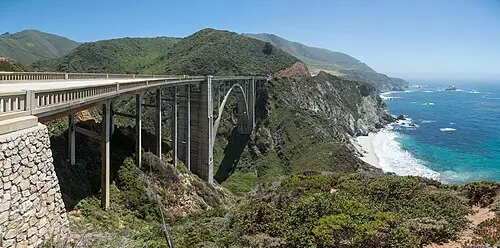 © Diliff · CC BY-SA 3.0
Fog, cliffs and elephant seals – the Pacific Coast Highway by camper
 © David Quigley · CC BY 4.0
Neon, diners and endless horizons – Route 66 by camper from Chicago to Santa Monica
Nearby









Campsites nearby
- Dockweiler RV ParkMotorhome stopover7 mi from Santa Monica PierMotorhomesElectricityWaste disposalWi-Fi
- Dockweiler Beach RV ParkMotorhome stopover7 mi from Santa Monica PierMotorhomesElectricityWaste disposalWi-Fi
- Musch Hike-In CampCampsite8 mi from Santa Monica Pier
- Malibu Creek Group Camp SiteMotorhome stopover14 mi from Santa Monica PierMotorhomesShowersToiletsWaste disposal
- Malibu Creek CampgroundMotorhome stopover14 mi from Santa Monica PierMotorhomesShowersToiletsWaste disposal
- Golden Shore RV ResortMotorhome stopover24 mi from Santa Monica PierMotorhomesElectricityDrinking waterToiletsWaste disposal
All campsites in California · Campsite data: © OpenStreetMap contributors, ODbL 1.0 · Updated October 3, 2026
FAQs
Where is Santa Monica Pier?
Santa Monica Pier is in Santa Monica, CA, at GPS 34.0100, -118.4960. It is about 15 mi from Los Angeles.
Can you camp near Santa Monica Pier?
Yes. The nearest campsite listed in OpenStreetMap is Dockweiler RV Park, about 7 mi away; within 25 mi there are 20 campsites and motorhome stopovers.
Which road trips pass Santa Monica Pier?
Santa Monica Pier is a stop on these CampingSpirit trip guides: Route 66, part two: Oklahoma City to the Pacific, Highway 1: San Francisco to Santa Monica, Fog, cliffs and elephant seals – the Pacific Coast Highway by camper and Neon, diners and endless horizons – Route 66 by camper from Chicago to Santa Monica.
What is there to see near Santa Monica Pier?
Places worth a stop nearby: Griffith Observatory (13 mi), Point Dume (18 mi), El Matador State Beach (22 mi) and Crystal Cove State Park (48 mi).
When is the best time to visit Santa Monica Pier?
The most pleasant months are usually September–May. Still fine, with some compromises, in June–August. (Estimate from long-term temperature averages, terrain and pass seasons)