



In-depth guide · CampingSpirit
Around 940 kilometres between Nidaros Cathedral, undersea tunnels, the Fosen coast and the farms along the Trondheimsfjord: a loop where ferries, toll cameras and elk set the pace – and the long evening light over the fjord.
The spirit of the route
Trøndelag is the Norway between the big postcard images, and that is exactly what defines this loop. In the morning you stand beneath the figures on the west front of Nidaros Cathedral; in the evening the camper rolls through a tunnel that dives more than 250 metres below the sea and resurfaces among skerries, salmon pens and lyme grass. On Fosen the ferry ports smell of seaweed and diesel; on the fjord side, of freshly cut grass, smoked salmon and wood-fired ovens. From the sliding door you see sea eagles over Hitra, oystercatchers on the mudflats of Ørland and the water of the Trondheimsfjord, which stays light until midnight in June. In between lie the battlefield of Stiklestad, where Norway's history as a Christian kingdom begins, farm shops along the “Golden Detour” on Inderøy and, in Snåsa, the culture of the Southern Sami. No mountain passes, no hairpins – instead wind, changeable weather and plenty of time.
Stage-by-stage plan
1Stage 1: Trondheim to Flakk (Byneset) (approx. 20 km)
- The drive
- A city day with a short drive: it is best to park the camper on a fixed pitch as soon as you arrive and explore Trondheim on foot, by bike or by bus. In the afternoon head west through the suburbs out onto the Byneset peninsula to the Flakk ferry quay – just under half an hour's drive. Note: around Trondheim, numerous toll stations of the Bomring record your number plate automatically.
- Highlights & must-sees
- Nidaros Cathedral with Erkebispegården: Norway's national shrine above the grave of St Olav; the west front with its rows of sculptures is best in the afternoon light, and the climb up the tower is worthwhile in clear weather.
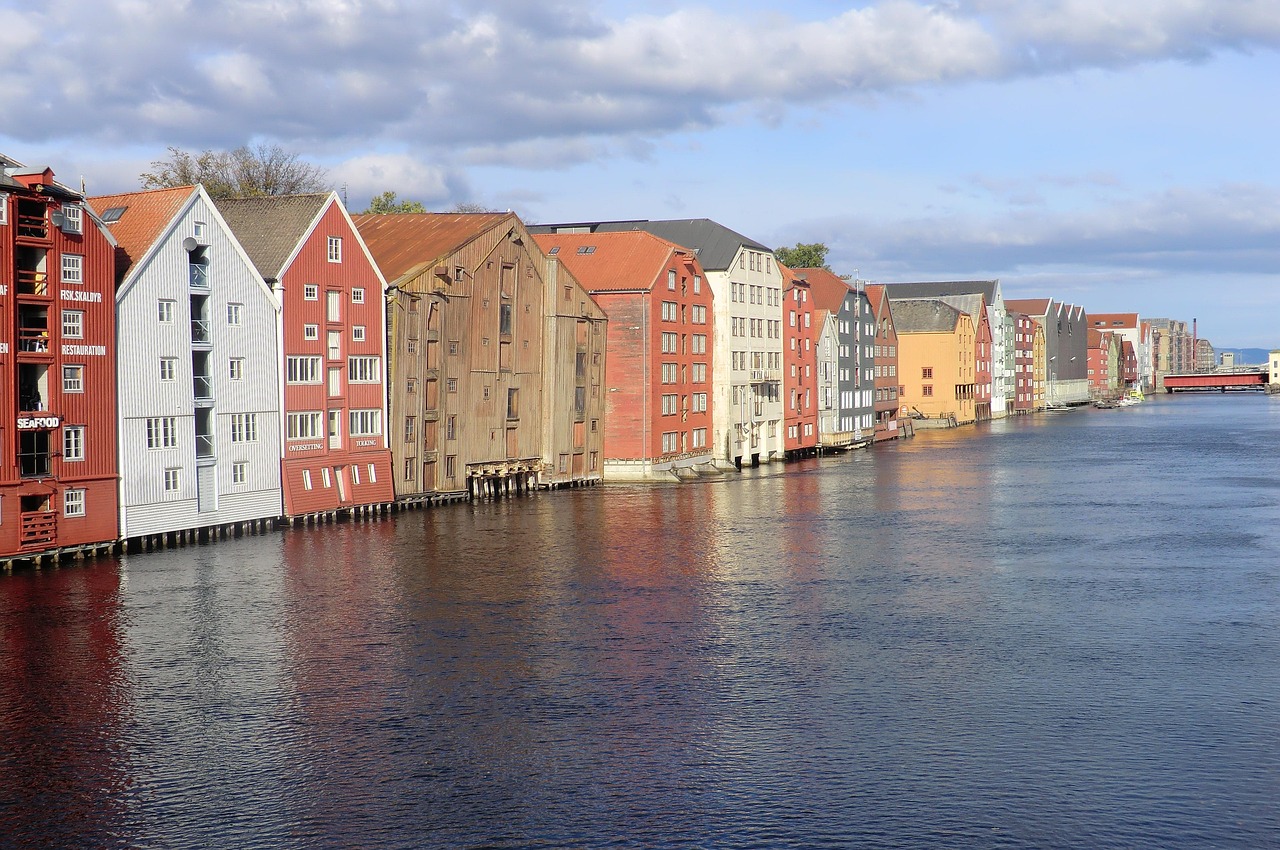
- Gamle Bybro and Bakklandet: cross the red wooden bridge of 1861 to the colourful wharf houses on the Nidelva and the wooden-house lanes of the old working-class district; at Brubakken the Trampe bicycle lift pulls cyclists up the steep slope.
- The 17th-century Kristiansten Fortress above Bakklandet, with views over the city, the fjord and Munkholmen – a 15-minute walk from Gamle Bybro.
- CampingSpirit overnight tip
-
Official campsite or RV park: For the city night, Dora Bobilplass on Maskinistgata in the Nyhavna harbour area, about 2 km from the centre, is a good choice: a tarmac, lit motorhome site with a barrier, fresh water, grey-water and cassette disposal, electricity for a fee, a maximum stay of 72 hours and, according to site directories, vehicles up to 8 m long; according to user reports it can be booked online in advance, with the access code sent by email. It is not quiet, but it is central. To spend the night out on Byneset, Flakk Camping lies right by the ferry quay with views of the fjord and a bus connection into the city; check the season and facilities in advance.
Free camping or nature tip (where legal): In Trondheim, free camping is not an option: parking in the centre is time-limited, charged and enforced, and many multi-storey car parks have height restrictions. The right to roam applies to tents in open countryside, not to motorhomes on urban parking areas. On Byneset the land around the farms is cultivated land (innmark) – farm tracks and meadows are off limits.
- Insider tip for campers
- Trondheim has no low-emission zone requiring a sticker; however, the Bomring toll is graded by drive type and vehicle class and is higher at peak times, and at many stations several passes within an hour are charged only once – check the current rules with the toll operator Vegamot. If you drive on studded tyres in winter, expect a municipal studded-tyre charge in Trondheim. The centre on the Midtbyen peninsula is cramped and criss-crossed by bus lanes: leave the camper outside and take the bus or the bike.
2Stage 2: Flakk to Hitra and Frøya (approx. 145 km)
- The drive
- Take the narrow road across Byneset with views of the fjord to Spongdal, back to the E39 and via Buvika to Orkanger in Orkland municipality. There turn west onto the Fv714: first through forest and along lakes, then past fjord arms through the former Snillfjord to the Hitra Tunnel. The tunnel is around 5.6 km long and descends on a steep gradient to more than 260 m below sea level; on the other side continue across Hitra to Fillan and through the Frøya Tunnel, a good 5 km long, to Frøya. Pure driving time a good 2.5 hours.
- Highlights & must-sees
- Thamshavnbanen near Orkanger: a historic electric ore railway between Thamshavn and the mining town of Løkken Verk, running as a heritage railway on selected days in summer – a short detour from the Fv714.
- Byneset kirke: a medieval stone church between fields and fjord, a quiet first stop after Flakk.
- Kystmuseet i Sør-Trøndelag in Fillan on Hitra, with boats, fishermen's houses and stories of life on the skerry coast.
- CampingSpirit overnight tip
-
Official campsite or RV park: Hitra and Frøya mainly have small sites and “fiskecamps” that primarily rent cabins and boats to anglers; pitches for motorhomes are limited. OpenStreetMap lists on Hitra, among others, Hitra Camping og Kro, Vågen Camping and Strømsvik Fiskecamp (listed there with tent pitches only); on Frøya itself no campsite is listed there. Phone ahead to ask whether there is room for a motorhome of your length and whether electricity and disposal are available. As a fallback on the mainland there is Orkla Camping near Orkanger.
Free camping or nature tip (where legal): The islands seem wide and empty, yet almost every level spot by the water belongs to a farm, a cabin or a fishing business. Overnighting in the vehicle is only permitted where parking is allowed and no sign prohibits it; in many places, lay-bys and car parks at bathing spots are signposted as closed to overnight stays. In high season the few tolerated spots fill up quickly – check the situation in park4night and on site.
- Insider tip for campers
- Drive the Hitra Tunnel with lights on, at a steady speed and in a low gear on the climb; with heavy motorhomes, keep an eye on the coolant temperature beforehand. Hitra has one of the densest red deer populations in Norway – drive slowly at dusk. On the Fv714 (“Laksevegen”), Vegamot collects tolls at the Våvatnet and Valslag toll stations, where cameras record the number plate automatically. Refuel and shop in Orkanger or Fillan.
3Stage 3: Frøya to Ørland (Austrått) via the Valset–Brekstad ferry (approx. 135 km)
- The drive
- Morning on Frøya with a detour to the flat, rocky west coasts, then back through both undersea tunnels and along the Fv714 to the Snillfjord area. From there take narrower fylkesveg roads north through Orkland municipality (formerly Agdenes) to the Valset ferry quay at the mouth of the Trondheimsfjord; the short ferry takes you to Brekstad on the Fosen peninsula. A good 2.5 hours' driving plus waiting time at the quay.
- Highlights & must-sees
- Titran and Sula: Titran at the western end of Frøya is an old fishing village with a memorial to the storm disaster of 1899; the island village of Sula out in the skerries can only be reached by boat – both are simply a pointer for anyone planning an extra island day.
- Agdenes at the fjord mouth: views of the fjord entrance with the Agdenes fyr lighthouse and the remains of the coastal fortifications that guarded the sea route to Trondheim.
- Sea eagles over the skerries of Hitra and Frøya – visible with binoculars from almost every sound.
- CampingSpirit overnight tip
-
Official campsite or RV park: Austrått Camping in Ørland, a few hundred metres from the Austråttborgen manor, according to OpenStreetMap with pitches for tents and caravans as well as electricity; ask the site in advance about the season, sanitary facilities and disposal. Alternatively, Breivika Camping on the Agdenes side before the ferry.
Free camping or nature tip (where legal): There is no overnighting at the Valset ferry quay or in Brekstad – these areas are waiting space for ferry traffic. Ørland is flat farmland with meadows down to the water, so mostly innmark. Around the Grandefjæra wetlands there is a nature reserve where consideration for breeding birds takes priority.
- Insider tip for campers
- On the Brekstad–Valset ferry (AtB route 870) foot passengers travel free; vehicles are charged by overall length, on the AtB ferries in broad bands up to 6 m, 6–12 m and over 12 m – a car and caravan counts at its combined length. The number plate is recorded; a prepaid AutoPASS ferry account gives substantial discounts. Turn off the gas before driving on and follow the crew's instructions. Brekstad lies next to Ørland military air station – expect aircraft noise during the day.
4Stage 4: Ørland to Stokkøya (Stokksund) (approx. 85 km)
- The drive
- From Austrått via Brekstad and Bjugn north along the coast: alternating open farmland, fjord bays and small patches of forest. From Bjugn the road becomes curvier and narrower; the last kilometres via Lysøysund and the bridge to Stokkøya run along skerries and sounds. Around 1.5 hours' driving.
- Highlights & must-sees
- Austråttborgen: a 17th-century Renaissance manor, seat of Fru Inger, to whom Ibsen devoted a play; next to it the Second World War Austrått Fort with the triple turret of a German battleship. Both offer guided tours in season.
- Grandefjæra and Ørland Våtmarkssenter: mudflats and wetlands with observation points, thousands of waders in spring and late summer.
- Uthaug: a small harbour on the outer coast of Ørland looking out over the open Frohavet bay.
- CampingSpirit overnight tip
-
Official campsite or RV park: Stokkøya Sjøsenter on the island's beach, known for its modern timber architecture, is listed in OpenStreetMap as a campsite; ask in advance whether there are pitches for motorhomes and how many, as well as about facilities, season and permitted length. A little way inland, Åfjord Laksecamping lies on the salmon river, conveniently placed for the next day.
Free camping or nature tip (where legal): The outer coast of Fosen is sparsely populated, but it is not no man's land: tracks to the beaches often end at private farm and cabin driveways. Where car parks are expressly open to motorhomes, the sign says so; beach car parks are often intended for day use only. Keep your distance from houses and do not spread anything out on the ground.
- Insider tip for campers
- Refuel and shop in Brekstad or Bjugn before continuing onto the outer coast; after that, shops become rare. The sounds around Stokkøya are good paddling waters – but with offshore wind and strong currents only for the experienced. Reindeer from the Fosen grazing area may be on the fell above the coast and on the road.
5Stage 5: Stokkøya to Levanger (approx. 195 km)
- The drive
- The long driving day of the loop: via Åfjord inland and through the Stjørna valley to Rissa, then east along the north side of the Trondheimsfjord via Leksvik and Mosvik. At Mosvik the Skarnsundbrua, one of the longest cable-stayed bridges in Norway, spans across to Inderøy; from there take the E6 south to Levanger. Mostly good, winding country road with fjord views, about 3.5 hours' pure driving time.
- Highlights & must-sees
- Rein kloster near Rissa: remains of a medieval convent next to Rein church, today a quiet spot above the fjord.
- Skarnsundbrua: a slender cable-stayed bridge over the narrowest part of the fjord, with photo stops in the lay-bys at both ends.
- Trehusbyen Levanger: the protected wooden-house quarter in the town centre with 19th-century merchants' houses and courtyards.
- CampingSpirit overnight tip
-
Official campsite or RV park: Levanger Camping on the Moan peninsula by the fjord, according to OpenStreetMap with electricity, water, sanitary facilities, disposal and separate pitches for motorhomes – handy for Stiklestad the next morning. If you would rather stay right by the battlefield, there is Stiklestad Camping in Verdal.
Free camping or nature tip (where legal): Along the road on the north shore of the fjord there are lay-bys that are good for breaks during the day; whether overnighting is allowed there is governed by the signs. Meadows and fields by the fjord are almost without exception cultivated land. Lighting fires in or near forest is prohibited from 15 April to 15 September.
- Insider tip for campers
- If you want to split the long stage, you will find shops and petrol stations in Rissa and Leksvik. Alternatively, the Rørvik–Flakk ferry makes a short crossing towards Trondheim – useful if the weather turns or you want to shorten the loop. The E6 north of Trondheim is tolled in sections; charges are collected automatically via AutoPASS.
6Stage 6: Levanger to Steinkjer via Stiklestad and Inderøy (approx. 85 km)
- The drive
- From Levanger into neighbouring Verdal and up to Stiklestad, then north on the E6 and at Røra onto the minor roads to Inderøy. The “Gyldne Omvei” (Golden Detour) is a loop of a good 15 km across the peninsula with farms, galleries and fjord views; afterwards continue via Straumen and the E6 to Steinkjer. Short sections, lots of stopping – around 1.5 hours' pure driving time.
- Highlights & must-sees
- Stiklestad Nasjonale Kultursenter: at the site of the battle of 1030 in which King Olav Haraldsson fell – museum, open-air area with historic farms, Stiklestad kirke and the open-air stage of the St Olav Drama, performed every year around Olsok (St Olav's Day) at the end of July.
- Nils Aas Kunstverksted in Straumen: workshop and museum of the sculptor who created the statue of Haakon VII in Oslo.
- Gyldne Omvei: farm shops with cheese, meat, bread and juice, small galleries and the medieval Sakshaug gamle kirke above the fjord; the farms' opening hours are seasonal and often daily only in summer.
- CampingSpirit overnight tip
-
Official campsite or RV park: In Steinkjer, Guldbergaunet Sommerhotell & Camping lies on the edge of town, according to OpenStreetMap with pitches for tents and caravans as well as disposal. According to OpenStreetMap there is also a small, free motorhome car park with around eight spaces in Straumen on Inderøy; check the rules and maximum stay on site. For a quieter spot by the fjord, try Koa Camping north-west of Verdal.
Free camping or nature tip (where legal): On Inderøy practically everything is arable land and farmyard – free camping without permission is out of the question here. Some farms offer motorhomes a pitch for a fee; ask in the farm shop. There is no overnighting in the culture centre car park at Stiklestad.
- Insider tip for campers
- The roads of the Gyldne Omvei are narrow and have hardly any passing places for long vehicles; do not block farm entrances, and leave large motorhomes in the designated car parks. Most farms accept cards or the Norwegian payment app Vipps; with a credit card you will get by almost everywhere. Steinkjer itself is the starting point of the Kystriksveien – which continues north in the CampingSpirit guide to the Kystriksveien between Steinkjer and Bodø; here a short stop for shopping and fuel is enough.
7Stage 7: Steinkjer to Snåsa (approx. 60 km)
- The drive
- Instead of the E6, take the Fv763 along the north shore of the long Snåsavatnet: a quiet, partly narrow lakeside road through forest and farms with changing views of the lake, somewhat curvier from Bøla onwards. About an hour's driving.
- Highlights & must-sees
- Bølareinen near Bøla: a life-size rock carving of a reindeer on the lakeshore, around 5,000 to 6,000 years old, a short walk from the car park.
- Saemien Sijte in Snåsa: museum and cultural centre of the Southern Sami with exhibitions on reindeer herding, language and crafts.
- Snåsa kirke, a medieval stone church in the village centre, and the forests on the edge of Blåfjella-Skjækerfjella National Park.
- CampingSpirit overnight tip
-
Official campsite or RV park: Snåsa Hotell with an attached camping area in the village; a few kilometres west lies Vegset Camping og Kiosk, and a good 15 km before Snåsa, by the lake, Strindmo Gård og Camping. Check facilities and season in advance – in October many small inland sites close.
Free camping or nature tip (where legal): In the forest and on the fell, the right to roam applies to tents; for motorhomes only where parking is allowed. Forestry and summer-pasture roads usually have barriers or toll machines (bomveg) and are often not open for overnight stays. The national park has its own protection regulations.
- Insider tip for campers
- Snåsa is part of the Southern Sami reindeer grazing areas: reindeer sometimes stand on the road and do not move out of the way – stop, wait, do not sound your horn and do not feed them. Elk are common in the forests around the lake, especially at dusk. Mosquitoes and blackflies are persistent on still days in July.
8Stage 8: Snåsa to Trondheim via Stjørdal and Hegra (approx. 215 km)
- The drive
- Take the E6 along the south shore of Snåsavatnet back to Steinkjer and continue south through Verdal, Levanger and the fjord country of Skogn to Stjørdal. There take the E14 around 15 km east into the Stjørdalselva valley to Hegra, then back and along the E6 through Malvik to Trondheim. The E6 here is largely well built but busy and has average-speed checks; between Stjørdal and Trondheim the Ranheim toll station records the number plate; about 3.5 hours' pure driving time.
- Highlights & must-sees
- Hegra festning: a fortress built in 1908–1910 on a rocky ridge above the valley that held out against German attacks for weeks in April and May 1940; installations and museum with guided tours in season.
- Leirfall rock carvings near Hegra: one of the largest collections of Bronze Age carvings in central Norway, with ships, people and animals.
- Værnes kirke near Stjørdal: one of the oldest surviving stone churches in Norway, from the 12th century.
- CampingSpirit overnight tip
-
Official campsite or RV park: For the last night before Trondheim: Storsand Gård Camping in Malvik right on the fjord, according to OpenStreetMap with electricity, water and sanitary facilities, around 20 km from the centre; ask in advance whether there is a disposal station. In the Stjørdal valley there are smaller sites such as Hembre Camping near Hegra and Flora Camping further east. In Trondheim itself, Dora Bobilplass again.
Free camping or nature tip (where legal): Around Stjørdal and Værnes – with Trondheim Airport – the land is densely built up or farmed; overnighting in commuter and supermarket car parks is not intended. In the Hegra Fortress car park, parking is for visitors during opening hours.
- Insider tip for campers
- Hegra lies on the E14 towards Sweden – if you are heading home via Storlien, you can plan the fortress as your last stop. From Oppdal you can reach Trollheimen National Park as a detour south-west of Trondheim; Røros and the Dovrefjell are covered in the CampingSpirit guide through Rondane, Dovrefjell and to Røros, and the fjords further south-west in the guide to the Atlantic Road, Trollstigen and the Geirangerfjord. Before heading home, empty the cassette at Dora Bobilplass or at the campsite.
Camping practice & local rules
Wild camping & overnight parking
- The right to roam (allemannsretten, friluftsloven) allows camping in uncultivated land (utmark), at least 150 m from inhabited houses and cabins and generally for up to two nights in the same place. On cultivated land (innmark) – meadows, fields, pastures, farmyards – you need the owner's consent; in Trøndelag, with its extensive farmland, that is a large share of the area.
- Motorhomes are not automatically covered by the right to roam: overnighting in the vehicle counts as parking and is only permitted on areas where parking is allowed and not prohibited by a sign. Driving off public roads is prohibited under the Motorferdselsloven. Awnings, tables and chairs belong on the campsite; never empty grey water or cassette contents into nature.
- From 15 April to 15 September, open fires in or near forest are generally prohibited; on the coast, extra care is also needed in windy weather. Protected areas such as the Grandefjæra wetlands and Blåfjella-Skjækerfjella National Park have their own regulations; paths may be closed during breeding and calving seasons.
- You can overnight legally at campsites, municipal or private motorhome sites (bobilparkering) and, for a fee, on farms. Useful apps: park4night, Campercontact; Statens vegvesen shows rest areas with their facilities. On Hitra and Frøya motorhome pitches are scarce – book ahead in July.
Waste disposal & supplies
- Disposal stations are called “tømmestasjon”. On this route you will find them at Dora Bobilplass in Trondheim and at most larger campsites; cassettes must not be emptied into rest-area toilets. In late autumn some stations close because of frost.
- Tap water is of very good quality. Norwegian taps at stations often have no thread – bring a hose with a universal tap connector or a watering can.
- Gas: German exchange cylinders are not exchanged, and foreign cylinders are rarely refilled. Arrive with two full cylinders or rent a Norwegian propane cylinder with a matching regulator. Autogas (LPG) is not reliably available in central Norway – plan refillable tank cylinders only as a supplement.
- Larger supermarkets and petrol stations can be found in Trondheim, Orkanger, Fillan, Brekstad, Levanger, Verdal, Steinkjer and Stjørdal; on Fosen's outer coast and around Snåsa they are rarer. Wine and spirits are sold only by Vinmonopolet; beer up to 4.7% is available in supermarkets until 8 pm on weekdays, until 6 pm on Saturdays and not on Sundays.
Vehicle size & traffic rules
- Speed limits: 50 km/h in built-up areas, generally 80 km/h outside them, and 90 to 110 km/h on upgraded sections of the E6 as signposted. Vehicles over 3.5 t and car-and-caravan combinations a maximum of 80 km/h, caravans without their own brakes a maximum of 60 km/h. Average-speed checks and speed cameras are common, and fines are very high. Dipped headlights are compulsory around the clock.
- Tolls: no vignette; toll stations in the Trondheim Bomring, on the E6 (for example Ranheim) and on some fylkesveg roads such as the Fv714 record the number plate automatically (AutoPASS). For foreign vehicles, the company Euro Parking Collection (EPC) sends the invoice by post, or by email after registration; registering via Epass24 is voluntary and speeds up billing. Vehicles over 3.5 t fall into tariff group 2 (base rate usually twice as high); motorhomes in vehicle class M1 over 3.5 t pay the rate for vehicles up to 3.5 t (group 1) only with a valid AutoPASS agreement and a toll tag, otherwise group 2. A toll tag is only mandatory for vehicles over 3.5 t that are registered to a company or used mainly for commercial purposes, not for privately used motorhomes – check the details with AutoPASS before your trip.
- Ferries: charged by overall length (on this route's AtB ferries in bands up to 6 m, 6–12 m and over 12 m), by number-plate recognition or card payment; a prepaid AutoPASS ferry account gives private customers up to 50% discount. Reservations are not usual on Valset–Brekstad and Flakk–Rørvik; there may be waiting times in the holidays. Turn off the gas during the crossing.
- Tunnels and weather: the Hitra and Frøya tunnels are steep undersea tunnels – lights on, no overtaking, keep your distance. On the coast the weather changes quickly, and gusts on bridges and causeways are dangerous for high-sided vehicles; ferries are suspended in storms. Check the current situation with Statens vegvesen (phone 175 within Norway).
- Winter equipment: suitable tyres are compulsory in snow and ice; vehicles over 3.5 t need winter tyres from 15 November to 31 March and must carry chains. Alcohol limit 0.2 per mille, mobile phones only hands-free, carry a high-visibility vest and warning triangle. Dimensions: width up to 2.55 m. Wildlife on the road: elk in the forests from Stjørdal to Snåsa, reindeer on Fosen and around Snåsa, red deer on Hitra, sheep on all minor roads.
CampingSpirit packing & preparation checklist
- Binoculars – for sea eagles on Hitra and Frøya, waders at Grandefjæra and elk at the forest edge near Snåsa.
- Windproof rainwear and wellies: on the islands and on the Fosen coast, rain usually comes with wind off the sea.
- Water hose with a universal tap connector, because many Norwegian taps have no thread.
- Mosquito nets for windows and roof vent, plus repellent for still summer evenings inland around Snåsa.
- Levelling ramps for sloping pitches at fiskecamps and farm pitches.
- Contactless credit card and a toll and ferry account set up in advance – cash is hardly needed any more, as ferries and farm shops take electronic payment.
As of 2026-10. Closures, fees and booking rules change: check official sources before you go.